Showing posts with label Mariana Islands. Show all posts

27 July 2017

USA: Navy Regions to Test Security Forces Readiness at Exercise Citadel Pacific

Navy News Service

WASHINGTON, July 26, 2017 — Exercise Citadel Pacific 2017 will be conducted on Navy installations at Joint Region Marianas, Navy Region Japan, Navy Region Hawaii and Singapore Area Coordinator from July 31 to Aug. 4.

This annual exercise is designed to enhance the training, readiness and capability of Navy security forces to respond to threats to Navy installations and units, officials said, emphasizing that Citadel Pacific is not in response to any specific threat, but is a regularly scheduled exercise.

Measures have been taken to minimize disruptions to normal base operations, officials said, increased traffic around bases or delays in base access are possible. Area residents also may see increased security activity associated with the exercise, they added.

Navy Installations Command is responsible for providing support services for the fleet, fighterand family, with more than 52,000 military and civilian personnel serving in 11 regions at 71 installations worldwide.

07 September 2016

USA: U.S. Pacific Command forces to come together for exercise Valiant Shield

From U.S. Pacific Fleet Public Affairs

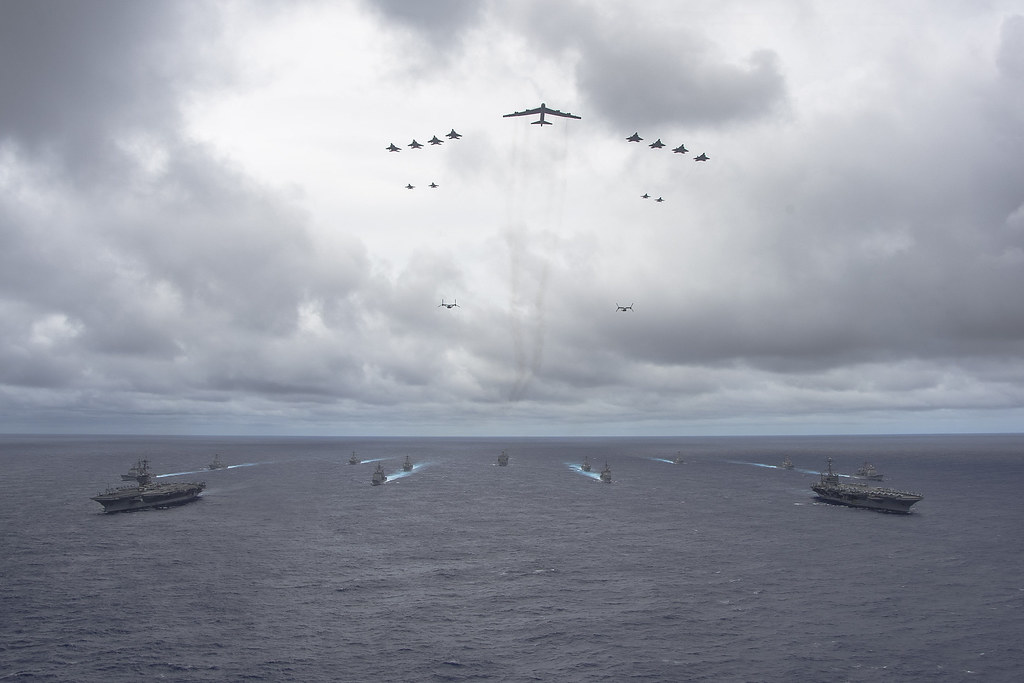
In this file photo, ships and aircraft operate in formation over the Pacific Ocean during exercise Valiant Shield 2014. (U.S. Navy/MC1 Trevor Welsh) >>

PEARL HARBOR - Forces from the U.S. Pacific Command are scheduled to participate in exercise Valiant Shield (VS) 2016, Sept. 12-23 on Guam and around the Marianas Island Range Complex.

Participants include USS Ronald Reagan (CVN 76), nine surface ships, the Bonhomme Richard Amphibious Ready Group - to include three amphibious vessels - an estimated 18,000 personnel and more than 180 aircraft from the U.S. Navy, Air Force and Marine Corps.

Valiant Shield is a U.S.-only, biennial field training exercise (FTX) with a focus on integration of joint training in a blue-water environment among U.S. forces. This training enables real-world proficiency in sustaining joint forces through detecting, locating, tracking and engaging units at sea, in the air, on land, and in cyberspace in response to a range of mission areas.

05 September 2015

USA: Bonhomme Richard ARG Completes Patrol in 7th Fleet

By Mass Communication Specialist 1st Class Joshua Hammond, Amphibious Squadron 11 Public Affairs

Sailors man the rails as USS Ashland (LSD 48) returns to Sasebo. (U.S. Navy/MC3 David A. Cox) >>

SASEBO, Japan - The Bonhomme Richard Amphibious Ready Group (ARG) completed its patrol of the U.S. 7th Fleet area of operations, Sept. 3.

During the underway, the Bonhomme Richard ARG, which comprises amphibious assault ship USS Bonhomme Richard (LHD 6), amphibious dock landing ship USS Ashland (LSD 48) and amphibious transport dock USS Green Bay (LPD 20), along with embarked 31st Marine Expeditionary Unit (MEU), conducted combined task force operations during Talisman Sabre 2015 in the Northern Territory of Australia, completed certification exercises in the Northern Marianas Islands and provided disaster relief to Saipan after Typhoon Soudelor.

28 February 2015

USA: Navy Aviation Electronic Attack Squadron Participates in Cope North

A USN E/A-18G Growler lands at RAAF base Amberley (File Photo)

By Tanya M. Champaco Mendiola, U.S. Naval Forces, Marianas, Public Affairs

YIGO, Guam (NNS) -- Electronic Attack Squadron (VAQ) 135 is participating in the two-week Cope North 2015 Exercise at Andersen Air Force Base, Guam, Feb. 16-27.

Cope North is a multilateral training exercise conducted annually. This year's Cope North brings U.S. Air Force, Navy and Coast Guard units together with service members from the Japan Air Self-Defense Force, the Royal Australian Air Force, the Republic of Korea Air Force, and the Royal New Zealand Air Force. 

For the past week, VAQ-135 maintenance personnel have shared a flight hangar with members of the Japan Air Self-Defense Force. The shared space has facilitated collaboration between the U.S. and Japanese units. 

24 February 2015

USA: Natural disaster response improved at Cope North 15


Exercise Cope North 15 participants
By Staff Sgt. Melissa B. White, Pacific Air Forces Public Affairs

ANDERSEN AIR FORCE BASE, Guam (AFNS) -- More than 300 service members from six countries joined together to conduct the humanitarian assistance and disaster relief (HA/DR) portion of exercise Cope North 15 from Feb. 15 to 18, at Andersen Air Force Base, Guam, and throughout the region of the Commonwealth of the Northern Mariana Islands.

"The Pacific theater and Pacific Command cover an enormous span of area, and every day we're encountering new issues," said Capt. Mark Nexon, the Cope North 15 HA/DR mission commander. "Natural disasters are very common -- there's a lot of volcanic activity, there's earthquakes, tsunamis and typhoons that remain a threat throughout the region, so practicing our capabilities and improving our capacities, and not just the United States, but all our partners in the region ... working together, we can cover more area together.”

09 September 2014

USA: U.S. Pacific Command Forces Come Together for Valiant Shield 2014


From U.S. Pacific Fleet Public Affairs

<< In this June 18, 2006 file photo, 14 ships and 17 aircraft participated in a joint photo exercise prior to Valiant Shield 2006. (U.S. Navy/PH3 Jarod Hodge)

PEARL HARBOR - Forces from the U.S. Pacific Command are scheduled to participate in Exercise Valiant Shield (VS) scheduled for Sept. 15-23, on Guam and around the Marianas Island Range Complex. Participants include two aircraft carriers, 19 surface ships, more than 200 aircraft and an estimated 18,000 personnel from the U.S. Army, Navy, Air Force and Marine Corps.

Valiant Shield is a U.S.-only, biennial field training exercise (FTX) with a focus on integration of joint training among U.S. forces. This training enables real-world proficiency in sustaining joint forces through detecting, locating, tracking and engaging units at sea, in the air, on land, and in cyberspace in response to a range of mission areas.

22 November 2012

USA: SecAF talks Pacific airpower

SecAF Michael Donley (Wiki Info)

by 2nd Lt Sarah Bergstein
36th Wing Public Affairs

11/20/2012 - ANDERSEN AIR FORCE BASE, Guam -- Secretary of the Air Force Michael Donley met with Team Andersen Airmen at an Airman's Call here Nov. 20. 

The secretary discussed several topics of national and international interest, to include the importance of Guam in the Asia-Pacific region, restructuring the size of the Air Force, changes in the Air Force's inventory and the current state of the Air Force budget. 

During his two-day trip to Andersen, he also visited with many Airmen, thanking them and their families for their service and sacrifice. 

"It's been said before, but it's still true," Donley began, "Our Airmen, along with their families, joint colleagues and other services, make countless sacrifices to serve our nation and to keep America secure. Our nation depends on you to conduct your missions and maintain vigilance, and this is a 365 day-a-year job."

Guam has been an important part of the United States for more than a century. Secretary Donley highlighted that the spotlight is focused on the region even more so now since the release of the new Defense Strategic Guidance in January.

"The direction from this strategic guidance calls on our nation to 'focus on a broader range of challenges and opportunities, including the security and prosperity of the Asia-Pacific region' as today's wars end," he said. "The guidance also makes clear that while the U.S. military will continue to contribute to security on a global basis, we will -- in necessity -- rebalance to the Asia-Pacific region."

Guam is said to play an increasingly important role as forces are realigned in the region. For the Air Force specifically, this builds on a long history of U.S. presence on Guam and in the Pacific.

The U.S. territory offers many military advantages, like its strategic value as the westernmost sovereign territory and home base to Northeast and Southeast Asia, which aids in ensuring peace and stability in the region.

The Asia-Pacific region spans more than 100 million square miles and 15 time zones. Today, about 60 percent of the Air Force's permanent forces outside the continental United States are postured in the region.

"The rebalance to the Asia-Pacific provides an opportunity for the Air Force to leverage the unique characteristics of airpower with range and speed," said Donley. "The Armed Forces structure rebalancing means the Air Force will invest in modernizing capabilities to project power and operate effectively in this region.

"For the past eight years Andersen has accommodated a continual presence of our nation's premier air assets," he said. "Its importance is only expected to grow, serving as a cornerstone to the new joint-training initiatives here in the Commonwealth of the Northern Marianas Islands."

Secretary Donley said that Andersen will continue to serve as the strategic and operational nucleus for U.S. military operations, originating from or moving through in support of training, or in building regional partnerships, humanitarian relief or other operational needs.

"The Air Force is committed to protecting critical infrastructure in this area in support of U.S. Pacific Command's strategy," he said. "Andersen can be proud of its many achievements."

Team Andersen Airmen had the opportunity to ask Secretary Donley questions regarding personnel and budget cuts, changes in the Air Force's inventory with regards to Andersen, the military buildup on Guam as well as questions concerning the quality of life of Airmen.

"We face difficult choices," Donley said, "But with our priorities in mind we can still take care of our people and modernize our systems to provide our nation with the global vigilance, reach and power it requires and our allies have come to rely on."

Donley recognized Team Andersen for its key role in providing peace and stability in the region through the Continuous Bomber Presence and Theater Security Packages, among other capabilities, as well as their participation in joint and coalition exercises, operations and humanitarian relief efforts.

"Our Air Force and our country need you to be great at what you do every day," he said. "You deserve to be proud of your important work here at Andersen."

26 September 2012

Editorial: The South Pacific - Microcosm of Future US – China Competition?


By Joanne Wallis

United States Secretary of State Hillary Clinton’s decision to attend the Pacific Islands Forum meeting in late August 2012 suggests that the South Pacific’s strategic importance in the broader Asia-Pacific region is increasing.  Indeed, the South Pacific may become a microcosm of how the Asia-Pacific’s changing power structure could develop, as it provides a small-scale and relatively low-risk testing-ground where the United States and China can explore their capacity to project power, judge each others’ responses, and potentially develop mechanisms for cooperation, rather than competition.

The theme of the 2012 Pacific Islands Forum meeting was ‘Large Ocean Island States – the Pacific Challenge’,[1] which highlighted that the islands of the South Pacific between them hold sovereignty over 20 million square kilometres of the Pacific Ocean.  These islands lie across vital sea lines of communication between the United States, Australia, New Zealand and Southeast Asia.  Therefore, they could offer strategically-important locations for military and naval access.

The South Pacific consists of three broad geographic and cultural areas: Melanesia, which comprises the arc of islands to the immediate north and east of Australia; Polynesia, which comprises the triangle of states above New Zealand and stretching up to Hawaii; and Micronesia, the band of islands to the north of Melanesia.

The United States’ focus in the region is in Micronesia, where it controls Guam and the Commonwealth of the Northern Mariana Islands.  It also has Compacts of Free Association with the Marshall Islands, Palau and the Federated States of Micronesia, according to which it is obliged to provide public services, security and defence support.  In Polynesia the United States also controls American Samoa.  Most significantly, the United States has the Anderson Air Force Base on Guam, and the Ronald Reagan Missile Defence test site at its base on Kwajalein Atoll in the Marshall Islands.

During the Cold War the United States engaged in strategic competition with the Soviet Union for influence in the South Pacific.  However, after the end of that war the United States largely withdrew its presence in the region.  Consequently, it reduced its aid program, halved the number of Peace Corps volunteers and closed aid and diplomatic posts.[2]

In contrast, China has been increasingly active in the South Pacific in the last few decades.  China’s interest was initially driven by its competition with Taiwan for diplomatic recognition. Although a truce (of sorts) has held since 2008, this competition has seen China and Taiwan engage in ‘chequebook diplomacy’ to win the favour of South Pacific states, and has resulted in China becoming the third-largest aid donor in the region, behind Australia and the United States.[3]

China’s more recent interest may be due to its desire to access the South Pacific’s natural resources, which include fisheries, timber, mineral and hydrocarbon deposits.  And, regardless of their small size, each independent South Pacific state has a vote in international organisations, which China can seek to persuade them to use in pursuit of its interests.  China also appears to have strategic interests in demonstrating its ability to project power in the region, and in potentially obtaining military and naval access as part of its ‘island chain’ defence strategy.[4]  Although China will remain militarily inferior to the United States long into the future, there are claims that in the event of conflict China could use locations in the South Pacific to approach the United States asymmetrically, perhaps as part of a sea denial strategy.[5]  The region also offers opportunities for signals intelligence monitoring, and China has already constructed a satellite tracking station in Kiribati (although it later had to be dismantled after Kiribati switched diplomatic recognition to Taiwan), which it is alleged to have used to monitor missile defence system tests in the Marshall Islands.[6]

China’s Vice Minister of Foreign Affairs, Cui Tiankai, declared at the recent Pacific Islands Forum meeting that China is ‘here in this region not to seek any particular influence, still less dominance’.[7] Despite this, China has invested heavily in diplomacy, and is now said to have the highest number of diplomats in the region.[8] High-level Chinese officials have also undertaken a number of visits to the region, which have been reciprocated by South Pacific politicians and officials. China has also used tools like language training, student exchanges and tourism to build links.  It also engages in military assistance and capacity-building programs.[9]  China also seized the opportunity created by Australia’s and New Zealand’s attempts to isolate the military regime in Fiji by building links with the Melanesian Spearhead Group, in which Fiji is an active member.

Clinton has admitted United States’ concern about China’s increasing presence.  For example, in her testimony before the Senate Committee on Foreign Relations in March 2011 she stated: ‘let’s just talk… straight Realpolitik…  We are in a competition with China.  Take Papua New Guinea, huge energy find…  ExxonMobil is producing it.  China is there every day in every way trying to figure out how it’s going to come in behind us, come in under us’.[10]  At the 2012 Pacific Islands Forum meeting Clinton was more circumspect, and in response to questions concerning China’s presence in the region, declared that ‘the Pacific is big enough for all of us’.[11]
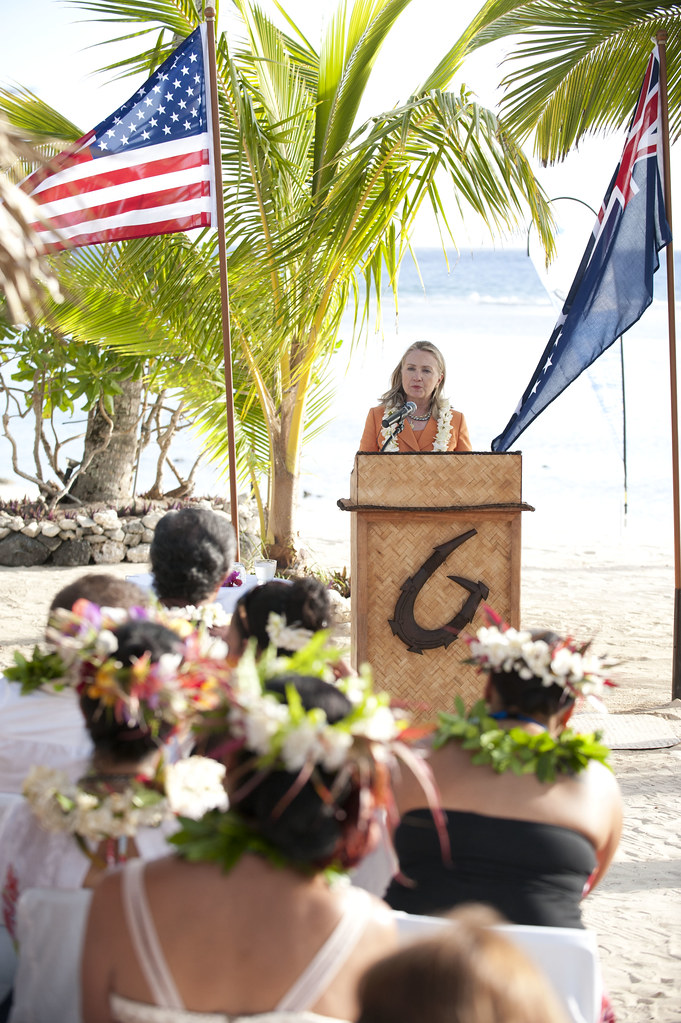
Clinton at event in Cook Islands (Hosted by Flickr)
However, the fact that Clinton attended the Forum meeting highlights Washington’s increased sensitivity to growing Chinese influence in the South Pacific. Consequently, the United States has resumed a more active role in the region.  Senior officials have conducted tours, the United States has bolstered its diplomatic presence and it has opened a USAID office in Papua New Guinea.  It has also increased its military presence, with the relocation of marines from Okinawa to Guam, and via the expansion of its ‘shiprider’ program, under which ships and aircraft from the United States Coast Guard (and now Navy), host law enforcement officers from South Pacific states and patrol their sovereign waters.[12]

Given the United States’ and China’s increasing focus on the South Pacific, the region might become a microcosm of broader emerging strategic rivalry between the two powers. Pessimistic analyses would predict that China and the United States (and its ally Australia) will engage in a zero-sum competition for regional influence, as occurred during the Cold War.  Robert Kaplan has argued that it is ‘not hard to imagine… a replay of the decades-long Cold War, with the center of gravity not in the heart of Europe but, rather, among Pacific atolls’.[13]  If this competition took on a military dimension it could come to a head if there is a clash between China’s island chain strategy and the United States’ presence in Micronesia.  Military bases in the region might also mean that South Pacific states could be dragged into a conflict elsewhere in the Asia-Pacific, such as in the South China Sea.

But there may be room for optimism.  Clinton has argued that, although ‘there are those who see America’s renewed engagements… perhaps as a hedge against particular countries… the United States welcomes cooperation with a number of partners, including… China’.[14]  There is potential for the United States (and its ally Australia) to try to draw China into a more cooperative approach to development and security, particularly by working through regional multilateral institutions. They could also encourage China to carry out joint projects with Western states, to ensure the effectiveness and coordination of aid.  Until recently China has been reluctant to do so, but Tiankai has agreed that China is ‘ready to exchange views, to compare respective practice and where possible and feasible, we’re open to work with them [Western states] for the benefit of the recipient countries’.[15]  Reflecting this new approach, China has taken up observer status on the OECD Development Assistance Committee.  It has also agreed to partner with New Zealand to improve water provision in the Cook Islands.[16]  Clinton welcomed the announcement of the China-New Zealand partnership, declaring that ‘New Zealand sets a good example for working with China’.[17]

Evidence of an emerging willingness by China, the United States and other Western states to cooperate in the South Pacific may suggest that proposals for the United States to engage and cooperate with China, perhaps in a ‘concert of powers’ model,[18] could succeed in the future. These proposals could be developed on a relatively small and low-risk scale in the South Pacific, so that the lessons learnt and the confidence gained may benefit broader Asia-Pacific stability and security.


Dr Joanne Wallis is a lecturer in the Strategic and Defence Studies Centre at the Australian National University, where she convenes the Bachelor of Asia-Pacific program.  She researches politics and security in the South Pacific. 


[1] Henry Puna, ‘Large Ocean Island States – the Pacific Challenge’, letter to Pacific Island Forum leaders from the Prime Minister of Cook Islands, available from: http://www.forumsec.org/resources/uploads/attachments/documents/Forum%20Theme%202012.pdf.
[2] Thomas Lum and Bruce Vaughn, The Southwest Pacific: U.S. Interests and China’s Growing Influence, CRS Report for Congress RL34086, Washington, Congressional Research Service, 6 July 2007.
[3] Fergus Hanson and Mary Fifta, ‘China in the Pacific: The New Banker in Town’, Policy Brief, Sydney, Lowy Institute for International Policy, April 2011.
[4] David Shambaugh, Modernizing China’s Military: Progress, Problems, and Prospects, Berkeley, University of California Press, 2002.
[5] Stratfor, ‘Island Strategy: Why Fiji May Matter’, 12 June 2000, http://www.stratfor.com.
[6] Joel Atkinson, ‘China-Taiwan diplomatic competition and the Pacific Islands’, The Pacific Review, Vol. 23, No. 4, 2010, p. 407-427.
[7] ‘China in Pacific for common development: Chinese vice FM’, People’s Daily Online, 1 September 2012.
[8] Graeme Dobell, ‘China and Taiwan in the South Pacific: Diplomatic Chess versus Pacific Political Rugby’, CSCSD Occasional Paper Number 1, May 2007.
[9] Tamara Renee Shie, ‘Rising Chinese Influence in the South Pacific: Beijing’s Island Fever’, in Anne-Marie Brady (ed.), Looking North, Looking South: China, Taiwan and the South Pacific, Singapore, World Scientific Publishing Company, 2010.
[10] Reuters, ‘Clinton says China seeks to outflank Exxon in Papua New Guinea’, 2 March 2011.
[11] Hillary Rodham Clinton, ‘Commemorating U.S. Peace and Security Partnerships in the Pacific’, speech at Tamarind House, Rarotonga, Cook Islands, 31 August 2012.
[12] Ibid.
[13] Robert D. Kaplan, ‘How We Would Fight China’, Atlantic Magazine, June 2005.
[14] Hillary Rodham Clinton, ‘Commemorating U.S. Peace and Security Partnerships in the Pacific’, speech at Tamarind House, Rarotonga, Cook Islands, 31 August 2012.
[15] ‘China in Pacific for common development: Chinese vice FM’, People’s Daily Online, 1 September 2012.
[16] ‘NZ to build Pacific assistance with China’, China Daily, 30 August 2012.
[17] Hillary Rodham Clinton, ‘Remarks with New Zealand Prime Minster Key’, New Zealand High Commissioner’s Residence, Cook Islands, 31 August 2012.
[18] Hugh White, The China Choice: Why America Should Share Power, Collingwood, Black Inc., 2012.


This Article first appeared on e-IR and is reposted here under a Creative Commons license.

22 June 2012

USA: Tripler continues care of Pacific Islanders, enhances outreach program


By Stephanie Bryant, Tripler Army Medical Center Public Affairs

HONOLULU (June 21, 2012) -- The U.S. military has been providing care to Pacific Islanders since World War II.

In 1989, when U.S. Sen. Daniel Inouye, Hawaii, introduced a bill to Congress creating a care-outreach program at Tripler Army Medical Center, that secured the bond between Tripler and Pacific Islanders across the region. 

The Pacific Island Health Care Project, or PIHCP, continues to be federally funded through U.S. Army Medical Command, and exists with the purpose of providing humanitarian care to the underserved indigenous peoples of the U.S. Associated Pacific Islands, as well as providing graduate medical education experiences to Tripler staff and residents.

Because of the geography in the Pacific region, a program like PIHCP offers health care for those who do not have access to or the resources to receive care. 

Mary Takada-Naito and her husband, Uchel, from Republic of Palau, had no knowledge of the program until they needed it. In October 2002, Uchel was diagnosed with hairy cell leukemia, a rare, slow-growing cancer of the blood, and was referred to Tripler for treatment.

"I actually never knew nor had heard of the PIHCP until my husband came to TAMC in 2002 for his medical treatments," Takada-Naito said. "Several months later, when the doctors and nurses, the facility and its personnel, and even the patients and their families had become familiar to us, is when we really started to appreciate what we were receiving from the program."

While her husband was receiving treatment, Takada-Naito volunteered to assist other patients from Palau, who required an interpreter. In March 2005, she officially became coordinator for the Palau Medical Referral Program and case manager for patients that come from Palau through PIHCP.

"My role is to coordinate patients' appointments, make sure our patients get to their appointments on time and be available to interpret for them as well as be their support system," Takada-Naito said.

The humanitarian care received as result of the program is only half of the reason it is special to Tripler and the region. The educational value makes it a great asset to the medical training center.

"(Leadership and key leaders in the region) recognized that a lot of the patients coming (from the Pacific Islands) would provide good education to the medical center's residents-in-training and (allow us to) give humanitarian care to the under-served Pacific Islands," explained Col. Mark Burnett, medical director, PIHCP and Pediatric Infectious Disease and Travel Medicine Physician. 

Burnett, who was a resident at Tripler from 1993-97, said he still remembers treating young Islanders at TAMC who were supported by the program many years ago and when he heard the PIHCP was in need of a new director, he volunteered. 

Since Burnett has only been director since March 2012, he said he receives a great deal of support and mentoring from Col. (Ret.) Donald Person, who was the first medical director for the program and was stationed in the Pacific for many years. 

"(Dr. Person) has a great love and interest for the people in the U.S. Associated Pacific Islands and this program was his baby," Burnett explained. "(He) recognized that there is a lot of need out (in the Pacific) and he was one of the people who really helped bring some of the patients (to TAMC)."

"There are incredible learning opportunities through this program," Burnett added. "It is really broadening our medical horizons and as people travel more and are deployed all over the world, I think it is really helpful for our doctors in training here."

Patients referred to Tripler have to have definable and fixable conditions. Then they can return to their lives on the islands.

Many changes have taken place since 1990 when the first patient from the Pacific Islands was admitted to TAMC.

"When (project participants explain) the PIHCP, much of it is synonymous with telemedicine," Burnett said. "When I was here in the early 90s, we would get calls from doctors in the islands and patients would be sent. We would get very little information about the patients prior to their arrival (at Tripler)."

Slowly throughout the 90s, the program equipped many of the islands with computers, digital cameras, scanners, video cameras and printers to support the web-based electronic consult and referral system that was created for it. By 2001, ten different sites were equipped for the web-based program.

"There are between 60-80 physicians with personal computers who are able to upload records and refer patients to be seen from their clinics now," Burnett said. "(In addition), as a lot of these islands get their own sophisticated medical care; a lot of the time they are just asking for advice and the patients don't have to be flown over here. It is a very rewarding (relationship)."

Burnett and Takada-Naito both feel that the program has a bright future and will continue to benefit Tripler and Pacific Islanders around the region.

"Not only did my family benefit successfully from PIHCP, but I have also seen firsthand many patients from the Pacific Islands returning home with smiles after having completed months of treatments," Takada-Naito explained. "When a seriously ill patient on a small island in the Pacific is told from their physician that he is being referred to TAMC, it sparks within the patient and his family a hope for cure. The PIHCP is about people, about giving hope, and it is about life."

Islands that are supported by PIHCP includes: American Samoa; Guam; the Commonwealth of the Northern Mariana Islands; the Republic of Palau; the Republic of the Marshall Islands, which includes Ebeye and Majuro; and, the Federated States of Micronesia, which includes Chuuk, Kosrae, Pohnpei and Yap.