Showing posts with label Bahrain. Show all posts

12 July 2017

News Story: Malaysia warns of IS militants fleeing to Southeast Asia

Hanoi (VNA) – Malaysian Defence Minister Hishammuddin Hussein has said intelligence reports indicated that foreign Islamic State (IS) fighters fleeing the Middle East are planning to shift their bases to Southeast Asia. 

Speaking at a meeting of the ruling United Malays National Organisation (UMNO) party on July 10, the Defence Minister declared IS is the enemy of the government.

He stressed that what happed in Middle East has a direct impact on Malaysia, adding that the region will be the IS’ focus and every member state of the Association of Southeast Asia Nations (ASEAN) will have to look at this seriously. 

Given the urgency of the matter, the minister said he will be visiting Saudi Arabia, the United Arab Emirates (UAE) and Bahrain this week to get latest intelligence reports on the militants and their whereabouts.

Read the full story at VietnamPlus

09 June 2017

News Report: Plans For 2 Littoral Combat Ships in Singapore, 1 in Bahrain in 2018 Shaped By Lessons Learned

Austal USA-built Independence class LCS
By: Megan Eckstein

WASHINGTON NAVY YARD – The Navy is laying the groundwork now for more complex Littoral Combat Ship operations in Asia and the Middle East, preparing to deploy two simultaneously to Singapore and one to Bahrain in 2018, the program executive officer for LCS told USNI News.

The service has deployed three LCSs overseas so far, all one at a time to Singapore: the Lockheed Martin-built USS Freedom (LCS-1) and USS Fort Worth(LCS-3), and the Austal USA-built USS Coronado (LCS-4). Rear Adm. John Neagley said the PEO and operators have been collecting as many lessons learned as they can during these deployments in the hopes of feeding that information back into maintenance models and logistics assumptions the manning and training pipelines and plans to backfit the ships with upgrades.

In his first formal interview since assuming command last summer, Neagley told USNI News that these lessons learned will all come into play next year when the Navy ups the difficulty of its LCS operations – with two Independence-variant ships operating concurrently out of Singapore, and one Freedom-variant ship operating out of Bahrain for the first time in the program’s history.

04 April 2017

Think Tank: Sea, air, land and space updates (4-Apr-2017)

Zoe Glasson, Sophie Qin, Madeleine Nyst and Patrick Kennedy

Sea State

Indonesia is continuing with its program of literally blowing up illegal fishing boats in its waters. On Saturday, authorities simultaneously destroyed 81 foreign vessels at 12 different locations, in what Maritime and Fisheries Minister Susi Pudjiastuti called ‘a victory for Indonesia’s war against illegal fishing’. Since ramping up its anti-poaching efforts in 2014, Indonesia’s special maritime task force Satgas 115 has captured 317 illegal boats, primarily from Vietnam, the Philippines and Malaysia; all have been confiscated and destroyed. The Indonesian government has linked the crackdown with its plan to revive its fisheries industry and re-establish itself as a maritime power.

Israeli defence electronics firm Elbit Systems has completed operational testing of its Seagull Unmanned Surface Vessel. The Seagull can carry out underwater mine hunting and clearing, as well as anti-diver and anti-submarine missions, enabling navies to use a single platform (with interchangeable modules) for different purposes. Its strategic value isn’t bad either—according to the brochure, Seagull’s ASW capability ‘returns the asymmetric advantage’ to those seeking to counter threats from terrorists, who are increasingly using midget submarines to target bigger and more powerful forces.

Ever heard of Project Combo? If not, you can read all about the US Navy’s Cold War plan to develop a secret communication system by mimicking sea mammal noises here.

22 February 2017

News Story: Saudi foreign minister - Iran is the 'biggest state sponsor of terrorism'

By: PR Newswire

WASHINGTON — Saudi Arabia's foreign minister has called Iran the "biggest state sponsor of terrorism in the world." 

Adel bin Ahmed Al-Jubeir made the remark Sunday in an address before the Munich Security Conference, citing several covert, political and military actions carried out by Iran to buttress his argument. 

"The Iranians do not believe in the principle of good neighborliness or non-interference in the affairs of others. This is manifested in their interference in Lebanon, Syria, Iraq, Kuwait, Saudi Arabia, Bahrain, Yemen, Pakistan, Afghanistan," he said. 

"We look at the region and we see terrorism and we see a state sponsor of terrorism that is determined to upend the order in the Middle East," he continued. "The Iranians are the only country in the region that has not been attacked by either Daesh or al-Qaida. And this begs the question: Why? If Daesh and al-Qieda are extremist Sunni organizations, you would think they would be attacking Iran, a Shiite state. But they have not. Could it be that there's a deal between them that prevents them or causes them not to attack the Iranians? This is a question that we keep asking ourselves." 

Daesh is an Arabic acronym for the Islamic State group. 

Read the full story at DefenseNews


---

PacificSentinel: Iran is no angle, but neither is Saudi Arabia, their just on opposite sides of the religious coin, both as bad as each other; has ISIS attacked Iran, no, why, because Iran has sent troops to help their puppet state Syria defeat ISIS (with lots of other nations involved in the fight as well), and it's working; as for Saudi Arabia, remind me who formed Al-Qieda again and where he was from...there's an old saying about glasses houses and throwing stones that the Saudi's really should look into!

20 February 2017

News Story: Despite Trump rhetoric, US pledge to the Gulf stable

By: Christopher P. Cavas and Jen Judson

WASHINGTON – Despite the churn in the U.S. capital as the new administration takes over, despite the attempted Muslim ban and despite President Trump’s “America first” proclamations, there is a sense among veteran U.S.-based Middle East observers that relations with the Gulf states are stable and might even benefit from the power changes. 

The U.S., said veteran U.S. ambassador Ryan Crocker, has spent years negotiating transit and basing rights and establishing a stable military presence in the Gulf area. 

“I do not expect to see those change under a Trump administration,” said Crocker. “They are low-cost to us and they have proven their value to us over and over. They are not objects of domestic criticism in this country or the host country. It’s a pretty good architecture.” 

Owen Daniels, assistant director for the Middle East Peace and Security Initiative in the Brent Scowcroft Center on International Security, agreed. 

“I would not expect to see as much flux. I think the countries that are in the Gulf are kind of taking a wait and see approach to the Trump Administration,” Daniels said. “From a perspective of opportunity, they see it as an opportunity to get closer to the U.S.” 

Jim Phillips, a senior research fellow for Middle Eastern affairs at the conservative Heritage Foundation, is confident relations could improve. 

“I think Gulf Cooperation Council members will be much happier with the Trump Administration’s policies on security issues than they were with the Obama Administration,” Phillips predicted. “The new administration has staked out a harder-line policy on Iran and on fighting terrorism than its predecessor.  It is likely to quickly approve arms sales to Saudi Arabia and Bahrain that were held up by the Obama Administration and is likely to respond more strongly to Iran’s missile tests, arming of Houthi rebels in Yemen and naval harassment in the Persian Gulf.” 

Read the full story at DefenseNews

31 January 2017

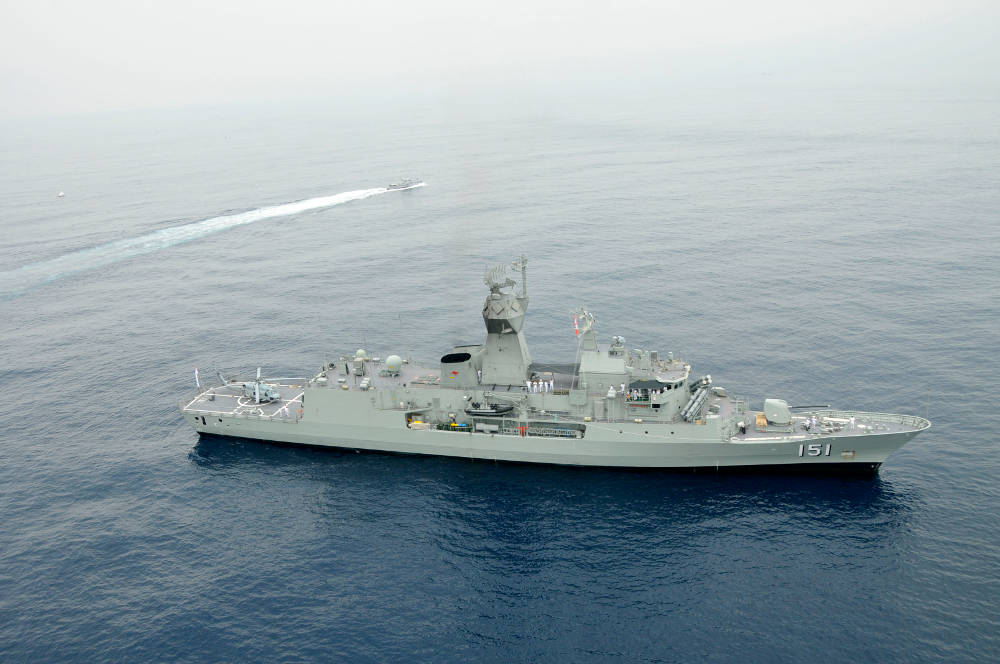
AUS: HMAS Arunta conducts training with the United States Coast Guard

HMAS Arunta (Image: Wiki Commons)
HMAS Arunta visited Bahrain for her first port visit after commencing operations in the Middle East Region (MER).

The visit provided an opportunity for Arunta’s boarding parties to conduct training with the United States Coast Guard (USCG) and agents from the Naval Criminal Investigative Service (NCIS).

Working from the purpose-built and life-like training facilities, the NCIS and USCG teams gave in-depth briefings and hands-on training using specialised search equipment.

Leading Seaman Marine Technician Christopher McDougal felt the training provided a realistic experience.

“The training was extremely helpful, especially being able to conduct deeper level searches on an actual Fishing Dhow,” said LSMT McDougal. 

30 January 2017

News Story: Policeman shot dead in Bahrain "terrorist" act

MANAMA, Jan. 29 (Xinhua) -- Bahrain said on Sunday that an off-duty police officer was shot dead in a "terrorist act."

"Initial details indicate that it was a terrorist act," the Interior Ministry said in a statement, referring to the attack in Bilad Al Qadem village.

The statement did not say when the attack took place.

Read the full story at Xinhua

29 November 2016

News Story: Mixed Signs for Foreign Military Sales Under Trump

By: Aaron Mehta and Pierre Tran

WASHINGTON AND PARIS — Foreign military sales (FMS) are a critical foreign policy tool, one used to bind partners to America while bolstering interoperability on US systems — and providing a boost to domestic industry.   

The administration of US President Barack Obama has made good use of FMS, setting records for foreign weapons sales in 2015 and coming close in 2016. But as President-elect Donald Trump’s administration spins up, the future of US sales abroad is unclear.

As with everything related to the Trump administration at this point, there is little hard evidence to go by. But analysts are watching closely for signs of what might come. In particular, there is concern that two areas of strong sales — the Gulf region and Europe — could be impacted by either the policies of the next administration or the statements of the next president. 

Analyst Byron Callan, of Capital Alpha Partners, wrote to investors the day after the election, noting some of Trump’s campaign positions could impact foreign weapon sales. 

“We would expect if countries increase spending, it would be to the benefit of their own industries and not necessarily favor US defense firms,” Callan wrote to investors, adding: “If a Trump administration takes a harder line on Muslims, that may also bear on US defense exports to some Middle Eastern and Asian countries.” 

Doug Berenson, managing director with Avascent, agrees there are potential roadblocks from Trump policies but stresses that a lot is still in the air.   

“I think there is a chance that many European countries could get nervous about what this means, about the reliability of the US as a supplier,” Berenson said. “But I think it’s too early to assume that would be the outcome.”

Read the full story at DefenseNews

03 November 2016

News Story: Bahrain clarifies on construction of UK navy logistic facility

Image: Wiki Commons
MANAMA, Nov. 2 (Xinhua) -- Bahrain's Foreign Affairs Ministry denied reports by media outlets and news agencies on Wednesday that a new UK military base was being constructed in Bahrain.

The ministry quoted official sources who said that what was indeed being constructed was a new facility to assist the Royal Navy called HMS Juffair.

"What is being constructed is not a military base, but logistic support facilities for the British Navy under an agreement between the two friendly countries and in accordance with rules and arrangements," said the Ministry.

Britain's Prince Charles and wife Camilla, Duchess of Cornwall, will visit the new British naval base, HMS Juffair, and officially inaugurate the Welfare Block next week, in order to serve personnel stationed at the base.

Read the full story at Xinhua

02 August 2016

News Story: Iran's top leader urges regional countries not to count on U.S. for solving problems

TEHRAN, Aug. 1 (Xinhua) -- Iran's Supreme Leader Ayatollah Ali Khamenei on Monday urged the regional countries and governments not to rely on the United States to tackle their issues, saying that Washington is not trustable.

The United States is "the producer or booster of the regional problems," rather than being a savior, Khamenei was quoted by Press TV as saying in a meeting with thousands of Iranians from several provinces in Tehran.

"The regional nations are able to solve their problems. We draw the attention of the regional governments to the point that the United States is unreliable, and it considers the Arab states as tools to serve Israel's existence and its interests," he said.

The experience of Iranians about the failure of the United States in the fulfilment of its obligations pertaining to a nuclear deal showed that it can never be trusted, Khamenei added.

"The United States has violated its obligations (over the nuclear deal) and is busy destroying Iran's economic ties with other countries," he said.

"The oppressive sanctions (against Iran) were supposed to be lifted quickly so that it could leave its (positive) impact on the people's lives," he said. "However, after six months (following the implementation of the deal) there has been no tangible change in the lives of the people."

The nuclear deal, reached between Iran and world powers in July last year, was implemented in January. The deal saw Iran scrap major part of its nuclear program in return for the removal of Western and international sanctions.

The United Sates still maintains sanctions on Iran over alleged violations of human rights and support of terrorism, which Iran denies.

Read the full story at Xinhua

14 January 2016

USA: Carter Hails Iran’s Swift Return of 10 U.S. Sailors

DoD News, Defense Media Activity

WASHINGTON, January 13, 2016 — Ten U.S. Navy sailors who were traveling from Kuwait to Bahrain yesterday when contact was lost with their pair of small craft are back in U.S. hands.

“I want to personally thank Secretary of State John Kerry for his diplomatic engagement with Iran to secure our sailors' swift return,” Defense Secretary Ash Carter said in a statement today. “Around the world, the U.S. Navy routinely provides assistance to foreign sailors in distress, and we appreciate the timely way in which this situation was resolved.”

A U.S. Naval Forces Central Command news release said the sailors departed Farsi Island shortly before 4 a.m. EST aboard the two riverine command boats they had been operating when they lost contact with the U.S. Navy. The sailors later were transferred ashore by U.S. Navy aircraft, the news release said, and other sailors took charge of boats and continued transiting toward Bahrain.

06 January 2016

Editorial: India’s New Fighter Jet Will Make International Debut in Bahrain

By Franz-Stefan Gady

The Tejas fighter jet will perform a flight demonstration during the Bahrain International Air Show in January.

India’s Tejas Light Combat Aircraft (LCA) will conduct a flight demonstration during this year’s Bahrain International Air Show held from January 21-23, The Business Standard reports based on information obtained from India’s Ministry of Defense.

“The show will witness flying demonstration of the ‘Tejas’, the latest and state of the art Light Combat Aircraft, the ‘Four-plus’ generation and highly cost effective fighter aircraft,” a defense ministry spokesperson said on January 1.

The display and flight demonstration of the Tejas fighter jet can be interpreted as a direct response to Pakistan’s attempt to sell its jointly-developed Pakistan Aeronautical Complex/Chengdu Aircraft Industry Corporation (PAC/CAC) JF-17 Thunder combat aircraft on the international arms market.

However, whereas Pakistan has already inducted the JF-17 into the Pakistan Air Force, only one fighter aircraft has been delivered to the Indian Air Force so far. “A fighter participating in an international air show is scrutinized like a Miss Universe contestant. Every mole of the Tejas will be scrutinized in Bahrain,” cautions an Indian military aviation expert interviewed by The Business Standard.

Read the full story at The Diplomat

19 November 2015

News Story: More Ships Can’t Save Overworked Navy; Basing Ships Abroad Can - CSBA

By SYDNEY J. FREEDBERG JR.

CAPITOL HILL: The Navy and Marines are deploying at a pace they can’t sustain, says a report released today. And no feasible defense budget can build a big enough force to solve the problem, the Center for Strategic and Budgetary Assessments says. Even the Navy’s famously optimistic 30-year shipbuilding plan — denounced by House seapower chairman Randy Forbes as “fantasyland” — wouldn’t close the gap between the supply of ships and the demand for them.

So more shipbuilding isn’t the solution. That is probably not the conclusion the Navy League was hoping for when it commissioned the study: “They didn’t really know what they were going to get,” said lead author Bryan Clark when he thanked his sponsors this morning. But if we can’t build our way out, what can we do?

We have to get more deployment time out of whatever ships we’ve got, said Clark, a former top aide to the Chief of Naval Operations. That includes expedients Congress may not like, especially basing more ships overseas.

Read the full story at Breaking Defense

09 March 2015

Editorial: India’s Middle East Policy Gathers Momentum

Image: Flickr user - narendramodiofficial

By Kabir Taneja

New Delhi’s active diplomacy with the region is now being bolstered by growing recognition of threats such as ISIS.

Much of India’s foreign policy, even today, is based on the fundamentals laid down by the country’s first prime minister, Jawaharlal Nehru. India’s place in the world and the policies that have shaped its global personality as a nation are based on Nehru’s ideals, which were sacrosanct until the Indo-China war of 1962 offered a perspective based on realism, rather than idealism.
Nehru was genuinely fond of driving India’s foreign policy, just like Manmohan Singh and now Narendra Modi have been. However, Nehru’s play in extending India’s hand of friendship and cooperation in the Middle East and Persian Gulf (more commonly known in India as West Asia) was a masterstroke, the benefits of which India reaps in the region even today.
India’s influence post-independence in the region started with the rapport that Nehru ended up building with the former Egyptian President Gamal Abdel Nasser. By 1953, eminent Indian diplomat V. K. Krishna Menon had already started to market the idea of a Non-Aligned Movement (NAM) at the United Nations. Nehru, Gamel, and others from Asia and Europe later championed the NAM, at the time a revolution, but now an idea well past its expiry date.
Nehru made Cairo a single-point policy in West Asia, though which New Delhi over the years developed exposure to the various intricacies of the region. Even though trade between Egypt and India never flourished to the levels that both Nasser and Nehru had hoped for, the Nehru-Nasser dynamic did lay much of the groundwork for India’s policy of strategically backing Arab states. Even after Nasser died in 1970, India supported his successor President Anwar Sadat’s regime as it partnered with Hafez al-Assad’s Syria and took on the Israelis in the October War (Yom Kippur War). 

Read the full story at The Diplomat

24 September 2014

Editorial: US Air Strikes in Syria - China's Conundrum

A U.S. Air Force KC-135 Stratotanker aircraft refuels a
Navy F/A-18F Super Hornet. (Image by Flickr user:
U.S. Department of Defense)

By Shannon Tiezzi

As the U.S. begins its anti-IS campaign in Syria, China has a tough decision to make.

In the early morning of September 23, the United States carried out 14 air strikes and launched 47 Tomahawk missiles against Islamic State (IS) targets within Syria. The U.S. has led over 100 airstrikes against IS in Iraq but Tuesday marked the first time U.S.-led forces have made good on Obama’s promise to go after IS forces within Syria’s border.
According to U.S. defense officials, the air strikes targeted weapons supplies, training compounds, barracks, and command and control facilities used by IS. The Pentagon reported that, in addition to the U.S., Bahrain, Jordan, Qatar, Saudi Arabia, and the United Arab Emirates participated in the strikes. Over the same period, the U.S. also carried out independent strikes against the Al Qaeda-affiliated Khorasan Group within Syria. In his remarks on the air strikes in Syria, President Barack Obama promised that “we will not tolerate safe havens for terrorists who threaten our people.”
As I’ve noted before, U.S. air strikes against IS pose a thorny problem for China. On one hand, Beijing has repeatedly emphasized its absolute commitment to rooting out terrorism, as well as stressing the danger international extremist groups pose for China. Beijing is particularly concerned about Uyghur militants training and fighting with IS, then eventually bringing their new capabilities to bear on China itself.
However, China is extremely wary of supporting U.S. military action on foreign soil. The airstrikes in Iraq were more palatable to Beijing, as the Iraqi government had requested help and was working in concert with Washington and its allies to coordinate the campaign against IS. Syria is another matter altogether. The U.S. government has repeatedly called for Syrian President Bashar al-Assad to step down, accusing him of using brutal tactics to protect his hold on power. 
Read the full story at The Diplomat

14 February 2014

News Story: BAE Takes Aim at F-15 and F/A-18 Upgrade Work


By ANDREW CHUTER

SINGAPORE — With a substantial contract under its belt to upgrade South Korea’s fleet of Lockheed Martin F-16s, BAE Systems is now looking to extend its activities in the market for modifying other nations’ aircraft by looking at Boeing’s F-15 and F/A-18 jets, said executives from the US arm of the British-based company.

BAE returned to the Singapore Airshow for the first time in years, hoping that a local program to update F-16s might be thrown open to competition rather handed to aircraft builder Lockheed Martin, as looks the case right now.

Buoyed by the recent signing of a $2.4 billion deal to act as systems integrator for upgrading 130 KF-16 fighters for South Korea, John Bean, the vice president for global fighter programs at BAE in the US, said if given the chance the company, would look to repeat the success in Singapore as well as attempting to land an upgrade deal on the two Boeing-built fighters.

“We have made initial inquiries in Japan where they are formulating their [F-2 and F-15] requirements at this point. All the countries are trying to keep their acquisition plans quiet so we can’t comment too much, other than to say we are active in a number of countries,” Bean said at the show.

Read the full story at DefenseNews

13 March 2013

News Report: Media Watchdog Calls Vietnam, China 'Spy States'


By Richard Finney

China and Vietnam are among five “State Enemies of the Internet” identified Tuesday by a global media watchdog, which for the first time also listed an equal number of private-sector companies accused of selling monitoring equipment to repressive regimes, thereby helping police to track and jail political dissidents.

Based in the U.S., France, Britain, Germany, and Italy, these companies “sell products that are used by authoritarian governments to violate human rights and freedom of information,” the Paris-based Reporters Without Borders (RSF) said in its report “Enemies of the Internet 2013.”

RSF identified the companies—Gamma,  Trovicor, Hacking Team, Amesys, and Blue Coat—in its report as “digital mercenaries” and as “Corporate Enemies of the Internet.”

“Their products have been or are being used to commit violations of human rights and freedom of information,” the rights group said.

“If those companies decided to sell to authoritarian regimes, they must have known that their products could be used to spy on journalists, dissidents and netizens."

Reporters Without Borders called on governments to introduce controls on the export of surveillance software and hardware to countries that flout fundamental rights, saying, “The private sector cannot be expected to police itself.”

15 September 2012

POTENTIAL HAWK ORDER TO EXPAND (BAE's) INDIA FOOTPRINT


We have received a Request for Proposal (RFP) from Hindustan Aeronautics Limited (HAL) for a potential order to supply products and services for the manufacture of 20 Hawk Advanced Jet Trainer (AJT) aircraft.

The aircraft, to be built by HAL in Bengaluru, will fulfill the Indian Air Force’s requirement for its prestigious aerobatic team. 

Upon successful conclusion, this would be the third contract placed on us for the supply of materials and equipment for the Hawk Mk132, building upon previous orders of 66 aircraft in 2004, comprising supply of 24 Hawk aircrafts in fly-away condition and 42 aircraft built under license by HAL, and a further 57 aircraft in 2010. Under these contracts, we have worked closely with the Indian MOD and HAL to establish a production line in India where the aircraft are now assembled. Hawk trainers already in service with the Indian Air Force are performing well.

Guy Griffiths, Group MD, International, said, “This is a tremendous opportunity to build on the success of Hawk in India and demonstrates the progress we are making in capturing significant opportunities to address the defence modernization requirements of the Indian Government. Together with HAL, we look forward to giving the Indian Air Force’s display team a fantastic aircraft.” 

Together with HAL we are committed to strengthen our relationship through ongoing discussions on exploring long-term sustainable business opportunities, globally.

The potential addition to the Indian fleet, one of the largest fleets of Hawk anywhere in the world, would take the number of Hawk aircraft ordered worldwide to over 1,000.  The Hawk aircraft has been widely exported. Customers include Australia, Canada, South Africa, Bahrain, India, the Royal Saudi Air Force and the UK Royal Air Force. The UK Royal Air Force aerobatics team Red Arrows has used the BAE Systems Hawk since 1979.

15 December 2011

AUS: Navy assumes Command of International Task Force in the Middle East

Royal Australian Navy’s Commodore Jonathan Mead has assumed command of Combined Maritime Operations in support of counter-terrorism in the Gulf region of the Middle East.

Supported by a team of Australian and New Zealand naval personnel, Commodore Mead now commands Combined Task Force 150 (CTF 150) after conducting a handover ceremony with Commodore John Clink of the Royal Navy at the US Naval Central Command in Bahrain today.

Commodore Mead said it was a privilege to be entrusted with Australia’s third command of CTF 150. This also represents the first rotation for an Australian Commander to be supported by a Royal New Zealand Navy Deputy Commander, Captain Lance Cook.

“Both the Australian and New Zealand Defence Forces take great pride in contributing to the coalition efforts to maintain maritime security in such a vital region, for the stability and economic prosperity of the world at large,” Commodore Mead said.

During its deployment, CTF 150 will plan and execute operations conducted by ships and aircraft from Combined Maritime Forces (CMF) member nations across an area of two and half million square miles of international waters, encompassing the Red Sea, Gulf of Aden, Arabian Sea, Indian Ocean and Gulf of Oman. 

CTF 150 is one of three task forces operated by CMF, a multinational coalition headquarters that is based in Bahrain. The remaining task forces are CTF 151 (counter-piracy) and CTF 152 (Gulf maritime security).

The principal mission of CTF 150 is to deter and suppress exploitation of the maritime environment by those who perpetuate or enable terrorist acts.

CTF 150 vessels are concurrently committed to the development of regional state capacities to counter terrorists in order to combat threats to international peace and promote regional security and stability. CTF 150 vessels also assist mariners in distress and undertake humanitarian work as required.

18 May 2011

USA: Deputy Secretary Steinberg's Visit to Bahrain

Deputy Secretary James Steinberg visited Bahrain on Tuesday, May 17, accompanied by Near Eastern Affairs Assistant Secretary Jeffrey D. Feltman and National Security Council Senior Director Puneet Talwar. Deputy Secretary Steinberg consulted with officers at the U.S. Embassy and met with Bahraini government officials. During his meetings, Deputy Secretary Steinberg affirmed the long-standing commitment of the U.S. to a strong partnership with both the people and the Government of Bahrain and stressed the importance of full respect for universal human rights. He urged all parties to pursue a path of reconciliation and comprehensive political dialogue.

US State Department