Showing posts with label Warship. Show all posts

28 September 2017

Industry: Navantia Congratulates (AUS) Navy on the Commissioning of HMAS Hobart

HMAS Hobart (File Photo)
The commissioning of HMAS Hobart (III) into service by the Royal Australian Navy on Saturday, 23 September 2017 marks the achievement of a major milestone for both Navantia Australia and the Australian shipbuilding industry and workforce. The ship was built under the AWD Alliance.

Navantia commenced operating in Australia in 2006 when the AWD Project was just beginning. Since that time and its selection in 2007 as ship designer, Navantia has worked closely with Australia and Australian industry to bring this ship into reality.

“Navantia Australia is very proud of our role as ship designer and shipbuilding management services provider for the AWD Alliance,” said Donato Martínez, Navantia Australia’s managing director. “Through our experience in the AWD program, Navantia Australia has developed strong partnerships with Australian industry and a deep understanding of the Royal Australian Navy and Australian Defence Force requirements.” 

News Story: Philippines, Australia conduct maritime patrol in Sulu Sea

ANZAC class Frigate like HMAS Parramatta
By Roel Pareño

ZAMBOANGA CITY — The Philippine Navy and Royal Australian Navy (RAN) conducted joint maritime patrol exercises in the Sulu Sea, the site of frequent cross-border kidnapping and hijacking attacks by militants linked to the Abu Sayyaf group.

Rear Admiral Rene Medina of the Naval Forces Western Mindanao (NFWM) said the three-day exercise started Friday between Del Pilar Class Frigate BRP Ramon Alcaraz (FF16), under Cmdr. Glen Dizon, and its counterpart Her Majesty Australian Ship (HMAS) Parramatta of the RAN.

He said Australian Embassy in the Philippines' defense attaché Capt. Bradley Ian White headed the delegation of HMAS Parramatta.

BRP Alcaraz is currently under the operational control of Naval Task Group-Tawi-Tawi of the NFWM that is guarding the border under orders from President Rodrigo Duterte.

Medina said the exercises were designed to strengthen the defense relationship of both navies through an established communication while conducting joint maritime patrols in the region.

Read the full story at PhilStar

27 September 2017

News Report: USS Ronald Reagan Supercarrier to Conduct Exercises Off Korean Peninsula

The US Navy has announced that the nuclear-powered supercarrier USS Ronald Reagan will be deployed to the Korean Peninsula to participate in joint exercises with the South Korean Navy as part of a continued American military buildup in the region as it faces off against North Korea.

The entire USS Ronald Reagan strike group, which includes four destroyers and two submarines, will be participating in exercises alongside South Korean ships in late October. The Pentagon claims that the exercises have been in the works for a long time, and are not a response to current tensions with Pyongyang.

On Friday, the 100,000-ton Reagan conducted drills with Japanese warships south of the Korean Peninsula as a response to the twin North Korean ballistic missile tests in August and September.

Then on Saturday, a pair of US B-1B Lancer strategic bombers flew within miles of the North Korean border. North Korea did not issue an official response to the mission, leading South Korean intelligence to claim that Pyongyang only found out about the bombers when the Pentagon told them.

News Story: Japan evaluating sites for Aegis Ashore missile defense system

CGI of an Aegis Ashore Ballistic Missile Defense (BMD) System
By: Mike Yeo

MELBOURNE, Australia ― Japan is evaluating locations to base the Aegis Ashore land-based ballistic missile defense system of which it has expressed interest in acquiring to better defend against North Korean ballistic missiles.

According to the Asahi Shimbun newspaper, which quoted Japanese Defense Ministry sources, Japan is looking at placing the Aegis Ashore on two sites along the country’s western coast to give complete coverage against North Korean ballistic missiles.

The newspaper reported that the sites under consideration for the northern system are either the Kamo sub-base in Oga, Akita prefecture, and the Sado sub-base in Sado, Niigata prefecture; for the system covering the southern part of Japan, either the Unishima sub-base in Tsushima or the Fukuejima sub-base in Goto, both in Nagasaki prefecture.

These sites are all part of Japan’s current early-warning and ballistic missile-defense radar network operated by the Japan Air Self-Defense Force, operating a mixture of J/FPS-3, J/FPS-5 and other older radars.

The Asahi Shimbun reported that Japan plans to have its Aegis Ashore systems operational by 2023, although this could be pushed forward if the regional security changes. The newspaper quoted Defense Minister Itsunori Onodera as saying that “we want to introduce the system at the earliest possible schedule”.

Read the full story at DefenseNews

News Story: Chinese navy fleet arrives in Brunei for friendly visit

Chinese Navy Warships underway (File Photo)
BANDAR SERI BEGAWAN, Sept. 25 (Xinhua) -- A Chinese naval fleet arrived at the Muara port of Brunei on Monday for a three-day friendly visit to the country, conveying a message of friendship and cooperation.

The Chinese naval fleet docked at Brunei's largest port, receiving a warm welcome by the Bruneian navy, government officials and Chinese Embassy officials, as well as Chinese living in the sultanate.

Speaking upon the fleet's arrival, Shen Hao, commander of the Chinese naval fleet, said at the welcoming ceremony that the friendly exchanges between the two countries date back to more than 1,500 years ago, and the traditional friendship between the two peoples has been continuing to grow.

Read the full story at Xinhua

26 September 2017

News Story: Chinese naval fleet returns home after drill with Russia & China, Russia conclude joint naval drills

Chinese Navy Warships (File Photo)
Chinese naval fleet returns home after drill with Russia

SANYA, Sept. 25 (Xinhua) -- A Chinese naval flotilla Monday returned to a military port in the city of Sanya in southern China's Hainan Province after a military exercise with the Russian navy in the Baltic Sea.

The formation, comprising missile destroyer "Hefei," missile frigate "Yuncheng" and supply vessel "Luomahu," was the first Chinese fleet to ever sail in the region for a military exercise.

The joint drill, held in July, was the first phase of "Joint Sea 2017," which had similar exercises in the Sea of Japan and Okhotsk this year.

Read the full story at Xinhua

--

China, Russia conclude joint naval drills

MOSCOW, Sept. 25 (Xinhua) -- The last batch of scheduled exercises in the second phase of the 2017 China-Russia Joint Sea Drills was completed in the Okhotsk Sea near Russia's Far East Federal District on Monday.

Starting in the morning, Chinese and Russian commanders simulated joint rescues of ships hijacked by pirates and ships in distress, and later in the afternoon, fleets of the two sides held a farewell ceremony after the completion of both exercises.

During the entire week-long drills, major Chinese and Russian fleets conducted a string of highly challenging joint operations, including air defense, anti-submarine and anti-fleet actions as well as maritime search and rescue.

Read the full story at Xinhua

23 September 2017

News Report: India's Defense Sector Prepares for 100% Foreign Direct Investment

FDI proposals for 100% have to be in areas where India lacks either the existing capabilities or is not even developing it.

NEW DELHI (Sputnik) — India is planning to further liberalize its defense sector by allowing 100 percent foreign direct investment (FDI) in projects. The move is mainly aimed at curtailing the striking slowdown in the defense sector which has failed to attract huge investments in recent years despite the introduction of sweeping reforms in defense investment rules.

Disclosing the government's agenda, defense ministry officials said that 100 percent FDI would be allowed in cases where foreign firms would be willing for the complete transfer of technology.

"The government of India would be open to considering 100 percent FDI in defense, should the company be willing to provide full technology transfer," Ashok Kumar Gupta, India's Secretary of Defense Production was quoted as saying during his interaction with representatives of US corporate sector.

22 September 2017

News Report: India Begins Deployment of Submarine in Indian Ocean Region After Long Gap

The Shishumar class attack submarine is being accompanied by two other naval vessels and two maritime patrol aircraft on a month-long mission to enhance cooperation with the countries of the Arabian Sea rim.

New Delhi (Sputnik) — India is deploying an attack submarine to the Western Arabian Sea in the Indian Ocean after a long gap. The Indian submarine Shishumar entered Duqm in Oman along with naval ship INS Mumbai and two P-8I long-range maritime reconnaissance aircraft on Wednesday. Meanwhile, naval ship INS Kochi is on its way to join the fleet.

"Indian Naval Ship Mumbai and submarine Shishumar entered Duqm, Oman as part of this deployment to the Western Arabian Sea, after conducting a series of exercises en-route. An Indian naval submarine is visiting a foreign port after a long gap," the Indian Navy said in a statement.

20 September 2017

News Report: US Navy Blames Collisions on Operations Pace, Failure to Prioritize Safety

USS Fitzgerald, after colliding with a container ship 
Carla Babb

WASHINGTON — The U.S. Navy is blaming the high pace of operations, budget uncertainty and naval leaders who put their mission before safety for recent deadly incidents at sea.

The destroyer USS John S. McCain collided with an oil tanker last month off the coast of Singapore, leaving 10 U.S. sailors dead and five injured. And the USS Fitzgerald, another destroyer, collided with a container ship in waters off Japan in June, killing seven sailors.

The collisions are still under investigation, but at a Senate Armed Services Committee hearing Tuesday, the chief naval officer, Admiral John Richardson, said a failure of leadership throughout the service was the main contributing factor in the deadly collisions.

"I own this problem," Richardson testified.

He vowed to make safety the most important goal of the Navy in the wake of recent events, acknowledging that commanders of vessels on forward deployments too often put the mission first, at the expense of safety.

"Only with those [safety certifications] done and the maintenance properly done can we expect to deploy effectively and execute the mission," he said.

At the start of Tuesday's committee hearing, U.S. Senator John McCain extended his "deepest condolences" on behalf of all Americans to the family members of those killed, some of whom sat in the hearing room. The USS John S. McCain was named in honor of the Arizona Republican's father and grandfather, both of whom were Navy admirals.

News Story: Japan deploys PAC-3 missile interceptor near North Korea flight path

A Japanese Patriot PAC-3 Missile System
By: Mari Yamaguchi

TOKYO (AP) — Japan on Tuesday moved a mobile missile-defense system on the northern island of Hokkaido to a base near recent North Korean missile flyover routes.

Defense Minister Itsunori Onodera said a Patriot Advanced Capability-3 interceptor unit was deployed at the Hakodate base on southern Hokkaido “as a precaution” as part of government preparations for a possible emergency.

The relocation came after a North Korean missile was test-fired last week and flew over southern Hokkaido and landed in the Pacific off the island’s east coast — the second flyover in less than a month.

The PAC-3 was brought from another base in Yakumo town on Hokkaido, about 80 kilometers (50 miles) northeast of Hakodate. The system has a range of about 20 kilometers.

Read the full story at DefenseNews

News Story: Japanese gov't reluctant to reveal details of SDF cooperation with US forces

The Japanese government is reluctant to disclose the details of Self-Defense Force (SDF) operations to cooperate with U.S. forces in peacetime, which have been expanding under the security legislation enacted two years ago.

How to fulfill accountability for SDP cooperation with U.S. forces is posing a challenge to the government.

Defense Minister Itsunori Onodera underscored the significance of the security-related laws at a news conference on Sept. 15. "The Japan-U.S. alliance has further strengthened, and U.S. and other concerned countries' confidence in Japan has increased," he said.

Following repeated missile launches by North Korea, the Japan Maritime Self-Defense Force carried out a mission to guard U.S. Navy vessels in peacetime for the first time in May this year. Moreover, SDF supply vessels have been engaged in a mission to refuel U.S. Aegis destroyers, which are on alert against missile launches, once or twice a month since April.

Read the full story at The Mainichi

19 September 2017

USA: US, Malaysian navies begin bilateral maritime exercise

By Lt. Clyde Shavers, Destroyer Squadron 7 Public Affairs

In this file photo, USS Coronado (LCS 4) arrives in Langkawi, Malaysia, earlier this year for the International Maritime and Aerospace Exhibition. (U.S. Navy/MC2 Amy M. Ressler) >>

LUMUT, Malaysia - The U.S. and Royal Malaysian Navy kicked off Maritime Training Activity (MTA) Malaysia at Lumut Naval Base, Sept. 18.

Nearly 300 U.S. and Malaysian Sailors aboard the littoral combat ship USS Coronado (LCS 4), Kasturi-class corvette KD Lekir (F26) and Lekiu-class frigate KD Lekiu (F30) are participating in the exercise.

“The U.S. and Royal Malaysian Navy maintains a close and unique partnership that continues to grow and evolve with each bilateral and multilateral exercise,” said Capt. Matthew Jerbi, deputy commodore of Destroyer Squadron (DESRON) 7. “MTA Malaysia is just one of many opportunities for both navies to work closely together towards cooperatively ensuring regional maritime security and stability.”

News Story: China, Russia start joint naval drills

VLADIVOSTOK, Russia, Sept. 18 (Xinhua) -- China and Russia started the second stage of their "Joint Sea-2017" military exercises on Monday with the arrival of a Chinese naval fleet in the Russian port city of Vladivostok.

The exercises are scheduled to take place in the Sea of Japan and the Okhotsk Sea, after the first stage was held on July 22-27 in the Baltic Sea.

It is the first time that the venue of the drills has extended to the Okhotsk Sea. Naval forces from both sides will, also for the first time, conduct joint submarine rescue exercises and joint anti-submarine exercises.

Read the full story at Xinhua

News Story: To shoot down or not? NKorea launch highlights intercept issues

CGI of an Aegis Ashore system (Click Image to Enlarge)
By Thomas Watkins with Shingo Ito in Tokyo

North Korea's latest missile launch over Japan set sirens blaring and triggered alerts telling people to seek shelter -- yet neither Tokyo nor Washington tried to shoot the rocket down.

The test follows one in August that saw another rocket soar over Hokkaido. In that case too, much-vaunted Japanese and US missile-intercept capabilities were not used.

Now some in the United States are wondering why all this sophisticated weaponry isn't being used, especially as North Korean leader Kim Jong-Un accelerates toward his goal of building a nuclear missile capable of striking the United States.

"The next time the North Koreans launch a rocket, especially one that will traverse over our ally Japan, I would hope that we shoot it down as a message to the North Koreans and to other people, like in Japan, who are counting on us," Republican Congressman Dana Rohrabacher told lawmakers this week.

"Unless we demonstrate we're willing to use force, there's no reason for them to believe we will."

The US Pacific Command confirmed Friday's rocket was an intermediate-range ballistic missile (IRBM), and Seoul's defense ministry said it probably traveled around 3,700 kilometers (2,300 miles), hurtling to a maximum altitude of 770 kilometers.

The missile, which fell in the Pacific Ocean, represented North Korea's furthest-ever flight.

Evans Revere and Jonathan Pollack of the Brookings Institution wrote in a paper that Washington should declare that any future North Korean missiles toward or over US or allied territory would be deemed a direct threat that would "be addressed with the full range of US and allied defensive capabilities."

Read the full story at SpaceDaily

15 September 2017

News Story: Japan refuels US missile defense ships under new security laws

TOKYO (Kyodo) -- The Maritime Self-Defense Force has refueled U.S. ships patrolling to counter North Korean missile launches under new security laws that took effect last year, a Japanese government source said Thursday.

The refueling missions to U.S. Aegis ships sailing in the Sea of Japan were conducted multiple times since April, making them the second instance in which Japanese Self-Defense Forces were known to have performed their expanded roles under the security legislation.

The legislation has loosened the constraints of Japan's war-renouncing postwar Constitution imposed on the activities of the defense forces, setting the stage for U.S. and Japanese troops to work more closely than ever.

Top government spokesman Yoshihide Suga said the SDF personnel are engaging in activities to provide supplies to the U.S. military based on the legislation, but refrained from acknowledging specific operations.

"I cannot comment on the issue because it will unveil the details of the operations of the SDF and the U.S. military," the chief Cabinet secretary said at a regular press conference.

In May, the MSDF engaged in a mission to protect a U.S. Navy vessel off Japan for the first time under the legislation, although Tokyo has also not officially confirmed that operation to avoid impacting U.S. military activities and bilateral relations.

Read the full story at The Mainichi

14 September 2017

News Story: Chinese naval fleet departs for joint drill in Russia

Chinese Navy Warships (File Photo)
QINGDAO, Sept. 13 (Xinhua) -- A Chinese naval fleet sailed from a port in Qingdao in east China's Shandong Province Wednesday for Russia's Vladivostok to take part in a scheduled joint military exercise with the Russian navy.

The fleet consists of missile destroyer "Shijiazhuang," missile frigate "Daqing," comprehensive supply ship "Dongpinghu," and submarine rescue ship "Changdao." The fleet is carrying ship-borne helicopters and deep submersible rescue vehicles.

The upcoming drill, which will be held in the Sea of Japan and Okhotsk, is the second phase of an annual joint naval drill between the two countries.

The first stage was held from July 22 to 27 in the Baltic Sea.

Read the full story at Xinhua

09 September 2017

News Report: India Gearing Up for Two Major Joint Military Exercises With US, Russia

India’s joint military exercises with the world’s superpowers are not reminiscent of muscle-flexing in the region but preparedness for unforeseen contingency globally, says expert.

New Delhi (Sputnik) – India and the United States are currently preparing for a joint military training named Yudh Abhyas — 2017 to be held at the Joint Base Lewis McChord, Washington from 14 to 27 September. This will be the 13th edition of the joint exercise hosted alternately between the two countries since 2004. Indian Army has termed the exercise a part of a joint preparation to meet any unforeseen contingency across the globe. 

“Exercise Yudh Abhyas is one of the largest joint running military training and defense corporation endeavors between India and USA. Multiple scenarios will be rehearsed during the joint exercise with a view to understand each other's organizational structure and battle procedures which would result in a higher degree of joint manship that would further facilitate interoperability between the armed forces of both countries to meet any unforeseen contingency across the globe,” Indian Army said in a statement.

News Story: (US) Congress, Navy Share Blame For Fatal Collisions At Sea

USS Fitzgerald after colliding with a commercial ship
By SYDNEY J. FREEDBERG JR.

CAPITOL HILL: Congress’s repeated budget malpractice and the Navy’s flawed policies combined to cause the accidents that killed 17 sailors, the Navy and the GAO say. Legislative dysfunction means budget cuts, caps, and delays have chronically shortchanged training and maintenance across the fleet, forcing sailors to work 100-plus hours a week to try to catch up. But the Navy also made fundamentally flawed assumptions about its Japan-based ships, overworking them even more at the expense of safety – even as it kept assigning more ships to what it considered an exemplary unit.

“I personally have made the assumption for many, many years that our forward-deployed force in Japan was the most proficient, well-trained, most experienced force we have, because they’re operating all the time,” Adm. Bill Moran, vice-Chief of Naval Operations, told the House Armed Services seapower subcommitte yesterday. “It was the wrong assumption.”

In fact, the assumption was exactly backwards. To keep “operating all the time,” the Japan-based ships were cutting corners. This showed up in their proficiency certifications, normally awarded to the crew for demonstrating the requisite skill levels in various areas from basic safety to ballistic missile defense. In January 2015, GAO found, destroyers and cruisers based in Japan had 93 percent of their required certifications, with only 7 percent expired. In June 2017, 37 percent of certifications had expired.

Read the full story at Breaking Defense

News Story: Aussie warship project to be delayed for two years by local companies - minister

BAE Systems Type 26 Global Combat Ship for SEA 5000
CANBERRA, Sept. 8 (Xinhua) -- A 28-billion-U.S.-dollar Australian warship project could be delayed for two years if local companies are handed the contract, a government minister has warned.

The Future Frigates project will see nine new anti-submarine warfare frigates designed and built to replace Australia's existing Anzac frigate fleet.

The Australian bid to build the ships is being led by South Australia's ASC and Western Australia's Austal but Spain's Navantina, Britain's BAE Systems and Italy's Fincantieri have also been shortlisted for the project.

Despite an initial promise that the ships would be built in Australia, the Defence Department has convinced the government that the Australian-built clause should be "optional" rather than "mandated."

Christopher Pyne, Australia's defence industry minister, said: "Advice from the Department of Defence is that changing the request for tender to mandate a particular shipbuilder would result in a delay of at least two years in the Future Frigates program."

Read the full story at Xinhua


--

PacificSentinel: I think people need to remember three things, first of all the project was moved forward by two or three years in the first place, so a two year delay would put it back on the original time table, the second thing is the reason it was moved forward in the first place, which was to build a local shipbuilding industry, so sending the construction overseas defeats the original purpose anyway, the third thing is that the ANZAC class Frigates have just finished an upgrade that should see them more than capable of lasting for an additional 2 years.

08 September 2017

News Story: Japan MSDF says human error behind recent helicopter crash

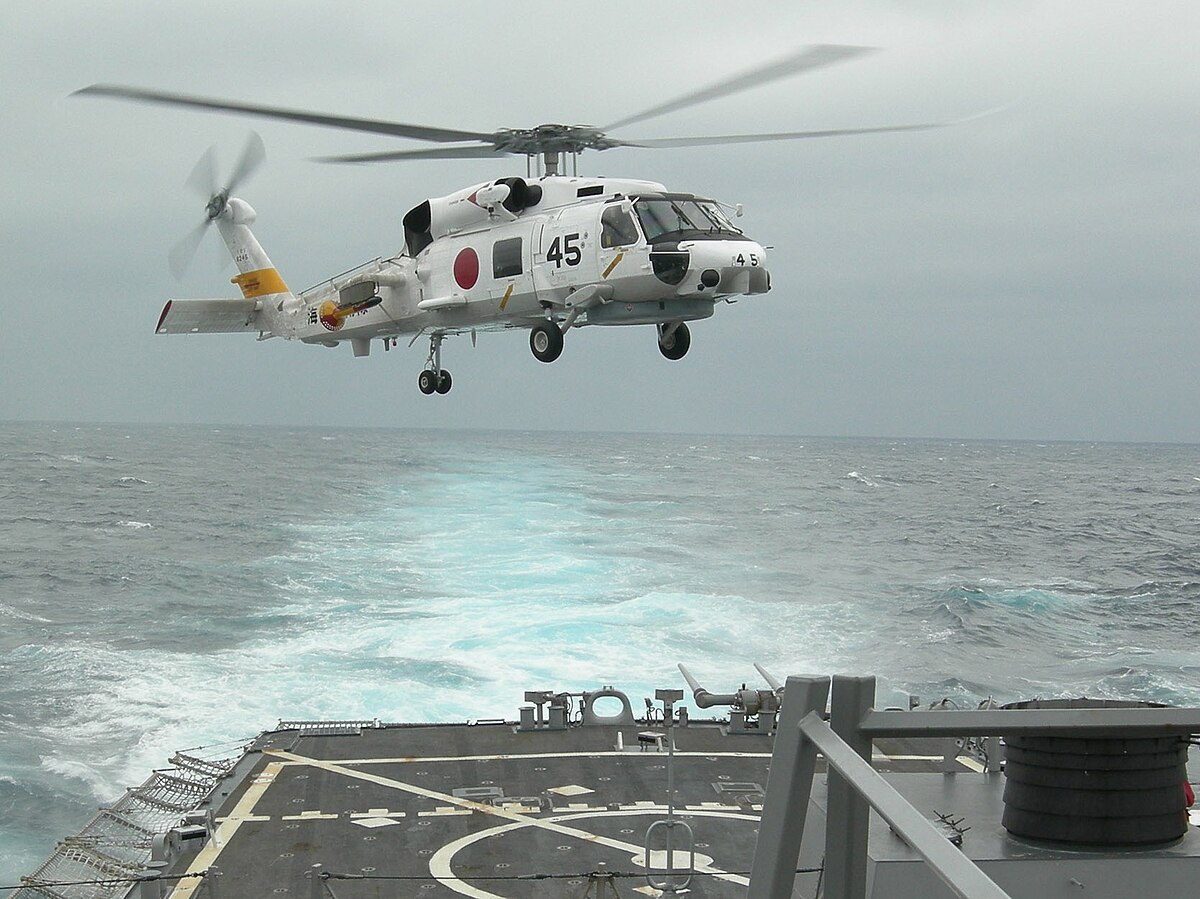
A JMSDF SH-60J Seahawk helicopter (Image: Wiki Commons)
TOKYO, Sept. 7 (Xinhua) -- Japan's Maritime Self-Defense Force (MSDF) said on Thursday that a recent helicopter crash off northeastern Japan was caused by human error, and flights of helicopters of the same type will be resumed.

Three of the four crewmen aboard the helicopter were still missing and the MSDF is continuing searching for them.

A SH-60J patrol helicopter belonging to the MSDF lost contact during a landing and takeoff drill on a destroyer off Aomori Prefecture, northeastern Japan on Aug. 26.

Four people were on board the helicopter. One of them was rescued some 40 minutes after the incident, while the other three remained missing.

Part of the wreckage of the helicopter was found later around the crash area. The water at the crash site is about 2,600 meters deep.

According to the MSDF, based on data from the flight recorder and the account of a rescued crew member, the crash happened when the crew members were focusing on fixing an error with the bearing indicator and failed to notice the chopper was losing balance.

Read the full story at Xinhua