Showing posts with label US-Australia Relations. Show all posts

29 July 2017

USA: USS Ronald Reagan wraps up Brisbane port visit

By MC2 Brandon Martin, USS Ronald Reagan Public Affairs

USS Ronald Reagan (CVN 76) sits along the pier at Port of Brisbane, July 26. (U.S. Navy/MC2 Kenneth Abbate) >>

CORAL SEA - The Navy’s forward-deployed aircraft carrier, USS Ronald Reagan (CVN 76), departed Brisbane, July 28, after a scheduled five-day port visit following the ship’s participation in exercise Talisman Saber 2017.

TS17, a joint exercise sponsored by the U.S. Pacific Command and Australian Defence Force Headquarters Joint Operations Command, is a biennial exercise designed to enhance U.S.-Australian military interoperability through a variety of maritime, land and air operations scenarios.

“Talisman Saber was a fantastic opportunity to train and enhance the collective maritime capabilities of both the Australian and U.S. navies,” said Capt. Buzz Donnelly, Ronald Reagan’s commanding officer. “In addition to our training with Australia, our Sailors also had a tremendous chance to see and experience the culture of our Australian partners during our port visit, which only serves to develop our countries’ bonds, both ashore and at sea.”

01 July 2017

USA: USS Bonhomme Richard arrives in Sydney

From USS Bonhomme Richard (LHD 6) Public Affairs

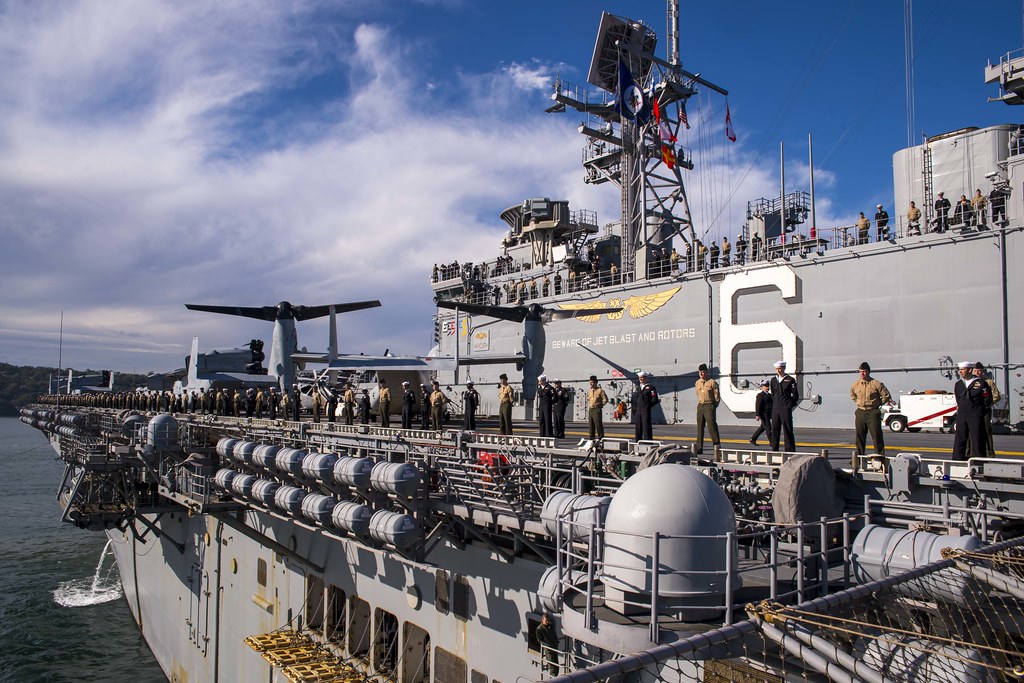
Sailors and Marines man the rails aboard the amphibious assault ship USS Bonhomme Richard (LHD 6) as the ship arrives in Sydney, June 29. (U.S. Navy/MC3 William Sykes) >>

SYDNEY, Australia - The amphibious assault ship USS Bonhomme Richard (LHD 6) arrived in Sydney for a scheduled port visit, July 29.

Bonhomme Richard departed White Beach, Okinawa at the beginning of June along with the 31st Marine Expeditionary Unit (MEU), the amphibious transport dock USS Green Bay (LPD 20) and the amphibious dock landing ship USS Ashland (LSD 48) as the Bonhomme Richard Expeditionary Strike Group (ESG), and has been conducting routine operations in the Indo-Asia-Pacific region.

Bonhomme Richard conducted multiple exercises, drills and training before commencing the biennial exercise Talisman Saber 2017 (TS17) with an at-sea ceremony prior to the ship’s arrival.

30 June 2017

AUS: Talisman Saber 2017 officially opened in Sydney

Australia's largest military exercise, Talisman Saber, was officially opened today aboard the United States Landing Helicopter Dock the USS Bonhomme Richard (BHR) off the Sydney coast.

Minister for Urban Development, the Honourable Paul Fletcher MP, representing the Minister for Defence, and the US Charge d'Affaires, Mr James Carouso, officially announced the start of the combined military exercise taking place from late June through to late July. Field training will occur in Shoalwater Bay Training Area, near Rockhampton and Mount Bundy Training Area, south of Darwin.

The Minister was joined by the US Pacific Forces Commander, Admiral ADM Harry B. Harris, Jr and Officer Conducting the Exercise, Australia's Chief of Joint Operations Vice Admiral David Johnston along with other senior Australian Defence Force.

Vice Admiral Johnston said the exercise is important to highlight and certify the interoperability between the forces.

“Talisman Saber is the premier Australia‑United States bilateral exercise,” Vice Admiral Johnston said.

29 June 2017

USA: Exercise Talisman Saber 2017 highlights enduring US, Australia alliance

From U.S. Army Pacific Public Affairs

In this file photo, Royal Australian Navy and U.S. Navy ships steam together during Talisman Saber in 2015. (Royal Australian Navy photo) >>

FORT Shafter, Hawaii - More than 33,000 U.S. and Australian personnel will participate in the biennial military training exercise Talisman Saber 2017 in Australia, June 23 to July 25, 2017.

Talisman Saber, jointly sponsored by the U.S. Pacific Command and Australian Defence Force Headquarters Joint Operations Command, will incorporate U.S. Army, Navy, Marine Corps and Air Force and the Australian Defence Force as well as other government agencies from each country.

Featuring 21 ships, to include the U.S. Navy aircraft carrier USS Ronald Reagan (CVN 76), the Bonhomme Richard Expeditionary Strike Group, and more than 200 joint aircraft, this seventh iteration of the exercise will focus on training a Combined Task Force of U.S. and Australian forces in a mid-intensity, high-end warfighting scenario, incorporating interagency participation, along with a command post exercise involving a transition between a 3 and 4-star Headquarters. U.S. Pacific Command units and Australian forces will conduct live and virtual training exercises in multi domains on sea, land, air, cyber and throughout multiple training areas in and around Australia.

08 June 2017

USA: Australia, U.S. Discussions Ranged the Globe, Dunford Says

By Jim Garamone 
DoD News, Defense Media Activity

PEARL HARBOR, Hawaii, June 7, 2017 — The Australia-U.S. Ministerial Consultations in Sydney this week were not just a formality, but an effort to sync the relationship and strengthen it for the future, the chairman of the Joint Chiefs of Staff said today.

Secretary of State Rex Tillerson, Defense Secretary Jim Mattis, Australian Foreign Minister Julie Bishop and Defense Minister Marise Ann Payne were the principles at the meeting held in the Government House on Sydney Harbor. Marine Corps Gen. Joe Dunford and Navy Adm. Harry Harris, the commander of U.S. Pacific Command, also attended.

Dunford told reporters traveling with him that the discussions were comprehensive and covered the range of interests the two nations share. “We talked North Korea, we talked South China Sea, we talked about the insurgency in the Philippines, we talked about the maritime domain in the Sulu Sea and so forth,” Dunford said.

06 June 2017

USA: Australian, U.S. Ministers Work Together to Ensure Strength of Alliance

By Jim Garamone 
DoD News, Defense Media Activity

SYDNEY, June 5, 2017 — The United States does not take its alliance with Australia for granted, Defense Secretary Jim Mattis said here today.

Australian Foreign Minister Julie Bishop and Defense Minister Marise Ann Payne hosted Mattis and Secretary of State Rex Tillerson for the 27th Australia-U.S. Ministerial Consultation at the Government House on Sydney Harbor. Also attending were Marine Corps Gen. Joe Dunford, chairman of the Joint Chiefs of Staff; Air Chief Marshal Mark Binskin, chief of the Australian Defense Force; and Navy Adm. Harry Harris, commander of U.S. Pacific Command.

The ministerial was serious business between friends. “We don’t take this alliance for granted, it takes work, and that’s what we're here to do -- work with you,” Mattis said at the meeting’s opening. “I would also note that we are united … in our resolve, even against an enemy that thinks by hurting us, they can scare us. Well, we don’t scare.”

“We’re here to work together in a manner that protects the freedom and the values that we share together,” he said, “and we’re committed to passing those freedoms onto the next generation intact.”

USA: Joint Statement AUSMIN 2017

On 5 June, Minister for Foreign Affairs Julie Bishop, and Minister for Defence Senator Marise Payne, hosted U.S. Secretary of State Rex W. Tillerson, and Secretary of Defense James Mattis in Sydney for the annual Australia-United States Ministerial (AUSMIN) consultations.

AUSMIN 2017, the 27th AUSMIN meeting and the first under the Trump Administration, builds on the meeting between our leaders on May 4 in New York that demonstrated the continued closeness of the Australia-U.S. relationship. The strength and vitality of our Alliance is based on a shared commitment to freedom and democracy and has enduring importance in our respective national security, foreign and strategic policies.

Bilateral defense, security, and intelligence cooperation under the Alliance is as important today as it was when the ANZUS Treaty was signed in 1951. 2017 marks the 75th anniversary of the Battle of the Coral Sea and the 50th anniversary of the Joint Defense Facility Pine Gap, with the 100th anniversary in 2018 of Australian and U.S. forces first fighting together at the World War I Battle of Hamel. Today, both countries are working side by side in Iraq and Syria as part of the global coalition against ISIS, and continue to make military contributions to Afghanistan’s security.

01 June 2017

News Story: McCain Calls for Australia's Allegiance

Sen. John McCain
(Image: Wiki Commons)
U.S. Senator John McCain, Chairman of the Senate Armed Services Committee, asked an audience in Australia: Why are we allies?

“The answer transcends narrow materialism,” he said. “The animating purpose of our alliance is that we are free societies, founded by immigrants and pioneers, who put our faith in the rule of law and who believe that our destinies are inseparable from the character of the broader world order.

“We believe that when the strong trample the rights and independence of the weak with impunity, then our liberty and our sovereignty are at risk.

“We believe that when all peoples cannot sail the seas, and fly the skies, and engage in commerce freely, then our prosperity will suffer.

“We believe that when the balance of power in the world favors those bent on injustice, and aggression, and conquest, then the peace we cherish will not last.

“These are values that time does not diminish. These are ideas that truly are worth the fighting for. This is why we are allies—and why we must remain so.”

McCain was speaking at the State Library of New South Wales, Sydney, Australia on Tuesday at the invitation of the US Studies Centre at the University of Sydney.

He said he understood that many are questioning whether America is still committed to these values. “Other American allies have similar doubts these days. And this is understandable.

Read the full story at MarEx

News Story: US senator calls for joint exercises to challenge 'bully' China

Sen. John McCain
(Image: Wiki Commons)
By Patricia Lourdes Viray

MANILA, Philippines — An American senator suggested that United States-led multilateral exercises could be a good way to push back against Beijing's excessive claims in the disputed South China Sea.

"If the Chinese are able to prevent us from exercising freedom of navigation then I think that has a profound consequences for the entire region," Sen. John McCain (R-Arizona) said in a speech in Sydney.

McCain, chair of the US Senate Armed Services Committee, stressed that China's vast territorial claims have no basis in international law.

"The challenge is that as China has grown wealthier and stronger, it seems to be acting more and more like a bully," McCain said.

McCain's remarks in Australia comes days before delegates from the US and China are scheduled to attend the Shangri-La Dialogue or the 16th Asia Security Summit in Singapore.

The US senator noted that Australia has become entangled in a strategic competition between America and China.

The senator, however, did not directly urge Australia to take part in freedom of navigation operations in the South China Sea.

Read the full story at PhilStar

31 May 2017

AUS: Australian-US Ministerial consultations (AUSMIN) 2017

Australia will host the United States Secretary of State, Rex Tillerson, and Secretary of Defense, Jim Mattis, in Sydney on 5 June for the 2017 Australia-United States Ministerial Consultations (AUSMIN). The US delegation will include the Chairman of the Joint Chiefs of Staff, General Joseph F. Dunford, and Commander, US Pacific Command, Admiral Harry Harris.

Established over 30 years ago, AUSMIN is the premier forum for Australia-US bilateral consultations on foreign affairs, defence and strategic matters. 

This will be the first AUSMIN with the new US Administration, and will build on our strong, dynamic bilateral relationship and our steadfast Alliance, which began with the signing of the ANZUS treaty in 1951.

During the meeting we will discuss our shared commitment to ensuring global peace and stability, and our mutual strategic priorities including North Korea, Iraq, Syria, Afghanistan, and defeating ISIS. Australia-US cooperation and collaboration in the Pacific and South East Asia will also be a key focus.

Australia and the US have a substantial economic partnership. The Australia-US Free Trade Agreement (AUSFTA) has boosted growth in both countries, with bilateral trade worth nearly $70 billion in 2015-16. The US is also the largest investor in Australia, with investments of $861 billion in 2016. In the same year, Australia’s investment in the US was $617 billion.

USA: Secretary of State Tillerson Travel to Sydney and Wellington

U.S. Secretary of State Rex Tillerson will be in Sydney, Australia, June 5–6, with Secretary of Defense James Mattis to participate in the 2017 Australia-U.S. Ministerial Consultations hosted by Australian Foreign Minister Julie Bishop and Australian Defense Minister Marise Payne.

Secretary Tillerson, Secretary Mattis, and their counterparts will discuss the full range of U.S-Australian cooperation on bilateral, regional, and global issues. The Secretaries will coordinate our policies and identify ways to further strengthen the alliance and deepen cooperation between our two governments.

The Secretary will then travel to New Zealand to reaffirm our strong ties and discuss coordination on shared strategic interests with Prime Minister English and Foreign Minister Brownlee.

06 May 2017

News Story: Trump downplays tense ties with Australian PM

WASHINGTON, May 4 (Xinhua) -- U.S. President Donald Trump on Thursday played down the strained ties between him and Australian Prime Minister Malcolm Turnbull in the past and praised a "tremendous friendship" between the two countries.

"We had a good telephone call," said Trump after his first meeting with Turnbull in New York on the decommissioned aircraft carrier USS Intrepid to mark the 75th Anniversary of the Battle of the Coral Sea, referring to a reported acrimonious phone call back in January.

Later during a gala dinner, Trump acknowledged that the phone call was "a little bit testy."

"They said we had a rough phone call. We didn't really have a rough phone call," said Trump.

Read the full story at Xinhua

27 April 2017

News Story: Australian PM to visit U.S. president in New York

CANBERRA, April 26 (Xinhua) -- Australian Prime Minister Malcolm Turnbull will travel to New York next week to meet U.S. President Donald Trump in what will be the first meeting between the pair in official capacities.

The meeting comes just three months after the pair's phone call, during which Trump reportedly hung up on the Australian prime minister, who was discussing a refugee deal previously struck between the two nations.

In a statement released early on Wednesday, Turnbull said he was "delighted" to confirm the visit, which would coincide with the 75th anniversary of Battle of the Coral Sea, during which Australian and U.S. forces battled the Imperial Japanese Navy for wartime supremacy in the Pacific.

The prime minister said the series of meetings would provide a good opportunity for Australia and the United States to "reaffirm our alliance and the United States' engagement with the Asia-Pacific".

"Australia and the United States share the values of democracy, the rule of law and a commitment to peace, prosperity and security," Turnbull said.

"Our forces continue to serve together in defence of those values in the Middle East where I have visited our troops and discussed the future of the region with U.S. commanders and Defence Secretary James Mattis."

The visit was officially announced by White House spokesperson Sean Spicer in the United States' capital on Tuesday (the U.S. time).

Read the full story at Xinhua

24 April 2017

News Story: U.S. vice president discusses Korean Peninsula with Australian PM

SYDNEY, April 22 (Xinhua) -- U.S. Vice President Mike Pence met Australian Prime Minister Malcolm Turnbull on Saturday, as U.S. aircraft carrier USS Carl Vinson steamed toward the Korean Peninsula.

"The (U.S.) president wanted me to be here early in this administration to reaffirm the strong and historic alliance between the United States of America and Australia," Pence told Turnbull.

Pence thanked Turnbull for his support on the highly contentious situation on the Korean Peninsula.

"While all options are on the table, let me assure you the United States will continue to work closely with Australia, our other allies in the region and China" to bring pressure on the Democratic People's Republic of Korea (DPRK), Pence said.

Read the full story at Xinhua

22 April 2017

News Report: US Vice President Seeks to Reassure Australian Alliance Following Trump Spat

U.S. Vice President Mike Pence met Australian Prime Minister Malcolm Turnbull in Sydney, in an effort to improve relations after a highly publicized argument between U.S. President Donald Trump and the Australian leader.

The visit to Australia is the first by a senior Trump administration official as the United States looks to strengthen ties with Asian allies.

Pence sought to reassure Australia Saturday that the United States remains committed to the countries’ longtime alliance, following a tense first telephone call between Trump and Turnbull.

“I bring greetings this morning from the president of the United States,” Pence told Turnbull and other Australian officials ahead of their meeting. “I spoke to him first thing, and he wanted me to pass along his very best regards to you. And the president wanted me to, early in this administration, to reaffirm the strong and historical alliance between the United States and Australia.”

During Trump’s initial phone call with Turnbull, Trump criticized an Obama administration refugee resettlement deal with Australia that would bring refugees from Australia to the United States. He reportedly cut short the phone call and later tweeted that the deal was “dumb.”

During his visit to Australia, Pence is also scheduled to meet with Australian Foreign Minister Julie Bishop and the leader of the opposition party, Bill Shorten.

Pence is on a 10-day, four-country trip to Asia that has taken him to South Korea, Japan and Indonesia.

This story first appeared on Voice of America & is reposted here with permission.

14 March 2017

News Story: National security on agenda for Aussie Attorney-General on U.S. visit

CANBERRA, March 13 (Xinhua) -- Australia's Attorney-General George Brandis will discuss key aspects of national security cooperation when he meets with counterparts in the United States this week.

In a media release detailing his upcoming trip, Brandis said he would meet with a "range of key U.S. officials" to both strengthen the bilateral relationship between the two nations and discuss varied aspects of national security including counter-terrorism.

"This visit will provide our nations with an opportunity to strengthen our strong and trusted partnership and collaborate on a range of national security, counter-terrorism, CVE, cyber security and intelligence issues, Brandis said on Monday

"I will be working to further advance our cooperation in responding to regional and global threats and challenges, including the U.S.-led coalition to counter (Islamic State)."

Read the full story at Xinhua

25 February 2017

Think Tank: Alliance management and the Trump administration

Image: Flickr User - Scott Anderson
Elsina Wainwright

If the Trump–Turnbull call illustrated the operatic nature of the early Trump administration, then the Trump–Abe long weekend presented an alternative picture of US alliance management under the new President.

Both episodes demonstrate how leader-to-leader relations play a role in maintaining forward momentum of an alliance and shaping how it is viewed. Any leaders-level changing of goal posts—on not tweeting opinions about preexisting deals, say—undermines public, as well as official, trust and risks amplifying divergent interests. Conversely, a rapport based on extended interaction and a focus on the overall relationship can consolidate a relationship and help smooth over past problems and divergent interests.

Regarding the Trump–Turnbull call: disagreements are far from unheard of in the US–Australia relationship. But the leaking of the truncated call and President Trump’s ‘dumb deal’ focus and tweet helped transform it into a metaphor for the broader dysfunction in the early days of this White House: the disruption and volatility, significant leaking and limited agency involvement.

It certainly blindsided both Canberra and Washington (beyond the Oval Office), because if any ally had been well positioned with the alliance-sceptical President Trump, it was Australia. Australia pulls its weight more than many other US allies: it’s helping to combat ISIS in the Middle East and increasing defence spending to 2% of GDP—in addition to Australia’s valuable intelligence partnership with the US, high-capability military and key role in US force dispersal strategy.

Prime Minister Abe’s visit built on his initial meeting with then President-elect Trump as the first foreign leader to visit after the election. President Trump emphasised the ‘very, very good bond’ between himself and Abe, and the opening hug, discussion and long handshake at the White House were followed by a Mar-a-Lago weekend of business, golf, and dinner. Both Trump and Abe appeared eager to build good will and make the visit a success. Abe announced Japan’s increased investment in the US, and Trump reaffirmed America’s security commitment to Japan—including the disputed islands—and thanked Japan for hosting American troops.

President Trump clearly values face-to-face meetings, and this visit focused more on the overall US–Japan relationship rather than a purely transactional, individual-deal-based approach. Both sides sought to subsume problems—not least Trump’s previous provocative comments about Japan’s value as an ally—within the broader context of a robust alliance.

But it’s still too early to view the Abe visit as the start of a new trajectory for Trump’s alliance management. Athough the Trump–Trudeau meeting seemed positive, Secretary of State Tillerson, Defence Secretary Mattis, and Vice President Pence’s European trips indicate how messages of reassurance to allies can be undercut by confusing signals from the President himself.

As with all things in the Trump administration, it’s unlikely alliance management will be linear, and there are some concerning open questions. Most pressing: is the chaos emanating from the White House the teething pains of a new administration—though unlike any we have seen—or is this an administration in crisis? Will the new national security adviser, H.R. McMaster, manage to calm a National Security Council in disarray and institute an orderly policy process? How will McMaster affect the competing centres of power within the White House and the access secretaries Tillerson and Mattis have to the President, and can key positions in the NSC, State and Defence be filled quickly?

As for Australia, these initial indications of the Trump administration’s alliance management have been instructive. The fundamentals of ANZUS are robust enough to withstand the phone call—which is good, because ANZUS remains critically important to Australia’s defence, at a time of regional military modernisation and soaring defence technology costs. The White House would also have seen the extraordinary groundswell of American popular and Congressional support for Australia and ANZUS after the call: a timely reminder not just of ANZUS’ history but its contemporary strategic importance.

Canberra is now adapting to the profoundly changed circumstances by working the multiple tracks of the bilateral relationship, including traditional channels with the State Department, the Department of Defense, Vice-President Pence’s office, and Congress. Foreign Minister Julie Bishop’s meetings with the Vice President and Secretary Tillerson were important opportunities to fortify the relationship, get more insight into US policy, and provide Australia’s views on critical issues. These below-leaders’ level channels will likely continue to be a focus for Canberra; leaders’ level relations can be built when Prime Minister Turnbull visits the US. It’s also a good time to utilise other channels of communication, including business, technology, and cultural/entertainment contacts.

The early, frenzied weeks of the Trump administration will surely give added impetus to Canberra’s push to shore up other security partnerships, including with Japan, Singapore, India and South Korea, as part of the broader regional web of bilateral, trilateral and multilateral security linkages in the face of questions about America’s ongoing regional role.

Adapting to the Trump administration and its alliance management will require adroit navigation and a strong sense of Australia’s national interests.

Elsina Wainwright is a New York-based non-resident Senior Fellow at Sydney University’s US Studies Centre and a Visiting Fellow at New York University’s Center on International Cooperation.

This article first appeared on the ASPI "The Strategist" Blog and is reposted here under a Creative Commons license.

18 February 2017

USA: Mattis, Australian Defense Minister Confer in Brussels

DoD News, Defense Media Activity

WASHINGTON, Feb. 17, 2017 — Defense Secretary Jim Mattis expressed his admiration of the high-performing troops of the Australian armed forces during a meeting with his Australian counterpart, Defense Department spokesperson Navy Cmdr. Sarah Higgins said.

Mattis and Australian Defense Minister Marise Payne met on the margins of a meeting at NATO headquarters in Brussels of defense ministers from countries participating in the campaign to counter the Islamic State of Iraq and Syria, Higgins said.

Mattis is on a multiday trip to Europe to meet with international partners in the counter-ISIS campaign and is scheduled to speak at the Munich Security Conference in Germany today.

The defense secretary also thanked the minister for the long-term alliance and friendship between the U.S and Australia’s military and people, she said. This was the first meeting between an Australian cabinet official and a member of the new U.S. administration, the commander noted.

11 February 2017

AUS: First Enhanced Air Cooperation activity to commence

A squadron of United States Air Force (USAF) F-22 Raptors will arrive in Australia today ahead of the first Enhanced Air Cooperation (EAC) activity in Australia under the US Force Posture Initiatives.

The Minister for Defence, Senator the Hon Marise Payne said the visiting F-22s will be located at RAAF Base Tindal and will be the largest and longest rotation of fifth-generation aircraft to Australia to date.

“The F-22s will conduct integrated training activities with the Royal Australian Air Force’s 75 Squadron F/A-18A/B Hornets along with ground assets and personnel,” Minister Payne said.

“The EAC aims to strengthen bilateral collaboration and interoperability with the United States.”

The commencement of EAC activities in 2017 will continue to strengthen our already close air-to-air relationship with the United States.

09 February 2017

News Story: Australia could be caught in U.S. trade war with China - expert

SYDNEY, Feb. 8 (Xinhua) -- The looming prospect of a trade war between the United States and China, has a leading Australian expert concerned about the impact on Australia, especially as both nations are the country's most major trading partners.

James Laurenceson, deputy director of the Australia-China Relations Institute (ACRI), told Xinhua on Wednesday, Trump's behavior towards China is increasingly volatile and erratic, and could lead to a trade war between the two nations.

"The difference between Trump's pre-election rhetoric and the policy decisions since taking office have narrowed, not widened," Laurenceson said.

"Most notably, the people he has surrounded himself with are extreme China hawks, particularly on the trade side."

The primary concern with the Trump administration has always been whether his subordinates were acting on his behalf to further his real policy motives, or whether their actions are being guided as a means of negotiating a stronger position from which to negotiate with China on trade.

Laurenceson was adamant that Trump's comments about Taiwan and currency valuations, prove he is trying to use any means necessary to bargain, but there needs to be real concern that he may attempt to follow through with his controversial words.

Read the full story at Xinhua