Showing posts with label Mirage 2000. Show all posts

30 May 2017

News Report: With China Rattled by Long Bridge, India to Build 17 Highways for Jet Landing

An Indian Air Force Su-30MKI Flanker Fighter
India has announced a major overhauling of highways that can be used as airstrips for the Indian Air Force (IAF). Nitin Gadkari, India’s Minister of Road and Transport, has said 17 highways along border areas will be developed to double up as airstrips which will have immense strategic value.

New Delhi (Sputnik) — The IAF had asked the country's national highway authority to build highways in definitive locations in such a way that it can land its combat jets for "operational contingencies" and disaster relief operations. These highways will be located in some 10 states, including Jammu and Kashmir, West Bengal and Assam which is close to the border with China.

"People residing in border areas need highway network and better infrastructure. We are building 17 such highways which can be converted into airstrips," Gadkari told PTI. These highways will be equipped with weapon storage dumps, landing lights, fuel and fire-fighting equipment.

09 December 2016

News Report: Indian Missile BVRAAM Fails Trials Yet Again

Indian plans to produce a beyond-visual-range missile that matches French, Russian and Israeli air-to-air missiles have suffered a setback. Despite a reshuffle in DRDO and inking of the MTCR, the Astra failed yet another test.

New Delhi (Sputnik) − The Indian Air Force suffered a heart ache when its home-grown beyond-visual-range air-to-air missile (BVRAAM) failed to perform during a trial held in Balasore on Wednesday.

Sources said the 'Astra missile' exploded immediately after it was fired from an aircraft. The missile lost velocity within seconds and banked sharply downwards. It exploded on the eastern coast of Odisha. Astra is being developed by India's Defense Research and Development Organization (DRDO).

26 September 2016

News Story: Indian air force test fires long range air-to-air MICA missile

Air-to-Air MICA Missile (Image: Wiki Commons)
NEW DELHI, Sept. 24 (Xinhua) -- Indian Air Force has test fired long range air-to-air MICA missile on a manoeuvring target from a combat aircraft, a statement issued by Indian government's Press Information Bureau said Saturday.

"Tigers - the first squadron of Indian Air Force, successfully fired the recently acquired long range Beyond Visual Range (BAV) air-to-air MICA missile on a manoeuvring target from Mirage-2000 Upgrade aircraft," the statement read.

Indian Defense officials said the missile achieved a direct hit on a target which was much smaller than an actual aircraft and flying at low altitude.

Read the full story at Xinhua

--

Quote Story: The long-range nuclear capable ballistic missile, developed jointly with Israel

PacificSentinel: I really wish these people did their homework before they wrote stories, the Barak-8 is NOT a "nuclear capable ballistic missile", it's a Surface-to-Air Missile.

23 September 2016

News Story: French Defense Minister Travels to India in Wake of Rafale Jet Reports

By: Pierre Tran

PARIS — French Defence Minister Jean-Yves Le Drian traveled to India Thursday for a scheduled meeting on Sept. 23, as requested by President François Hollande, said the Ministry of Defence spokeswoman Valérie Lecasble. 

The minister’s travel plan has raised hopes France will sign Friday an agreement with India for the sale of 36 Dassault Aviation Rafale fighter jets in a deal widely reported to be worth €7.87 billion ($8.8 billion). 

Lecasble declined to comment on whether Le Drian would be signing a deal and the value of the expected acquisition, instead pointing to a statement from the French president's office. 

However, an official with the Indian Ministry of Defence, speaking on condition of anonymity, said Le Drian will meet his Indian counterpart, Defence Minister Manohar Parrikar, on Sept. 23 to sign an intergovernmental agreement for the Rafale jets. He would not provide further details. 

Read the full story at DefenseNews

19 September 2016

News Report: India’s Rafale Fighter Jets to Serve as ‘Strategic Delivery System’ of Nukes

India pushed forward the completion of the long-delayed deal for the French fighter jets after determining that the aircraft fulfills a vital strategic purpose – the delivery of nuclear weapons.

India and France are expected to announce the Inter-Government Agreement (IGA) for the purchase of 36 Rafale fighter jets in the coming days with New Delhi expediting the process at long last after identifying the French warplanes as serving a critical strategic function – the delivery of nuclear weapons.

The purchase comes as the Indian Air Force fleet, comprised mostly of Russian MiGs, is reaching the end of their service and with the military only fulfilling 32 fighter jet squadrons despite defense planning calling for the existence of 42 squadrons. The 36 Rafale fighter jets, however, do very little to fill the capability gap that China is expected to face in the coming years with the jets only filling two squadrons collectively.

26 April 2016

News Story: India To Produce Precision-Guided Munitions Domestically

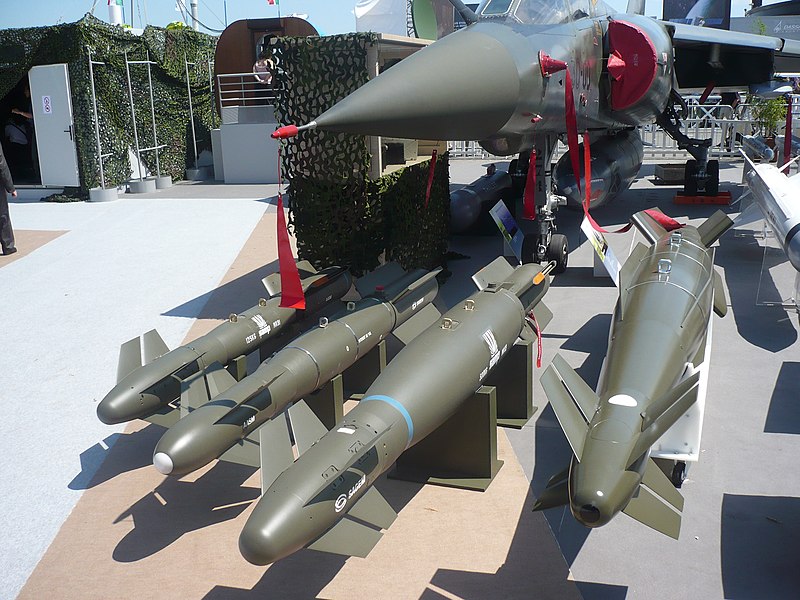
AASM family of weapons (Image: Wiki Commons)
Vivek Raghuvanshi

NEW DELHI — For the first time a domestic company will produce precision-guided and laser bombs in India for the country's defense forces.

Emerging private firm OIS Advanced Technology (OIS-AT) will partner with Sagem of France to manufacture the munitions, which India currently import from Israel, France, Russia and the United States for its fighters.

"OIS-AT has teamed up with Sagem of France to establish manufacturing for precision-guided guidance kits to meet domestic requirements," said Sanjay Bhandari, chairman and managing director of OIS-AT. "Separately, we also have plans to establish manufacturing for advanced munitions to meet Indian Air Force (IAF) requirements."

"We are pleased to collaborate with OIS-AT with our combat-proven, high-precision, AASM Hammer Guidance and Range Extension kit for aerial munitions for the Indian Air Force. With OIS-AT we have a partner with a core focus and appreciation of advanced technologies and innovation to advance our joint interests for the Indian Air Force," Sagem CEO Martin Sion said.

Read the full story at DefenseNews

06 April 2016

News Story: Rand Report Spells Doom For Taiwan

Wendell Minnick

Liquidate Fighter Fleet, Procure SAMs, If Taiwan Wants To Survive

TAIPEI — Radical changes in Taiwan’s air defense order of battle that include the retirement of all the indigenous defense fighters and Mirage 2000-5 fighter aircraft with cost savings moved to the procurement of a substantial number of mobile surface-to-air missile (SAM) systems are among the recommendations in a think tank report.

The report, “Air Defense Options for Taiwan: An Assessment of Relative Costs and Operational Benefits,” suggests that Taiwan downsize its fighter fleet and increase investment in SAM systems. The Rand Corp. study tests this strategy against three vignettes that span the range of conflict, from air sovereignty to disarming strikes and invasion air defense.

Rand crunches the numbers in the 172-page report with reckonings that make this paper hard to ignore against political hype inside Taipei and the sexy fighter aircraft tradition in the Taiwan air force that goes back to the Flying Tigers of World War II.

Taiwan defense spending appears to have hit a plateau with economic and political conditions working against the military’s desire to have both a strong fighter aircraft fleet and a SAM capability.

“We estimate that Taiwan will spend about US$22 billion in the next 20 years on the fighter aircraft currently in its fleet with no changes, and another US$3.3 billion to retrofit the F-16 fleet. That is fairly substantial for a military that has averaged about US$10.5 billion in total annual spending in recent years,” the report says. It was written by Michael J. Lostumbo, David R. Frelinger, James Williams and Barry Wilson.

China’s procurement and development of fighter aircraft, surface-to-surface ballistic missiles, land-attack cruise missiles and bomber aircraft advancements are not slowing, and could pulverize Taiwan’s air bases within hours of a war, the report says. None of Taiwan’s fighter aircraft would survive or be deployable on runways turned into a lunar landscape.

Read the full story at DefenseNews

11 March 2016

News Story: Indian AF Says New Indigenous Missile Will Be Too Heavy

Indian Tejas (LCA)
By Vivek Raghuvanshi

NEW DELHI — India's Air Force has raised objections to the indigenous new generation anti-radiation missile (NGARM) currently in development.

The 60-kilometer-range NGARM, developed by state-owned Defence Research and Development Organisation (DRDO), will undertake flight trials in three months but Indian Air Force (IAF) officials say the missile is too bulky.

DRDO is developing NGARM for the service's Mirage-2000H, Jaguar, Su-30 MKI and the upcoming Light Combat Aircraft.

"NGARM being developed by DRDO weighs around 140 kilograms and is too heavy, whereas IAF wants only such missiles that do not weigh over 100 kilograms; this one will not meet our requirement," said a senior Air Force official.

"DRDO has never kept us in the loop about this missile, and we are not sure if we will at all use it," the IAF official said, adding, "infrared radiation seeker technology from Russia will make it too bulky."

Read the full story at DefenseNews

26 January 2016

News Story: Dassault Expects Rafale Contract With India Within Month

By Pierre Tran and Vivek Raghuvanshi

PARIS AND NEW DELHI — Dassault Aviation expects India to sign a contract for Rafale fighter jets in a month’s time, following Monday’s signing of an intergovernmental, with France opening the door to the sale of 36 Rafale fighters, the aircraft builder said.

France saw the signing as a big step forward but the financial negotiations remain to be closed, said President François Hollande, Reuters reported.

“During French President François Hollande's visit to India, French and Indian government authorities signed an intergovernmental agreement paving the way for the conclusion of a contract for the sale of 36 Rafale fighters to India,” Dassault said in a statement. “Dassault Aviation is very pleased with this progress, and is actively supporting French authorities in their efforts to finalize a complete agreement within the next four weeks.”

Defense Minister Jean-Yves Le Drian signed the intergovernmental agreement with his Indian counterpart, reported daily Le Figaro, owned by the Dassault family.

Read the full story at DefenseNews

24 November 2015

Editorial: Dassault’s Rafale Struggles in the Asia-Pacific

By Benjamin David Baker

Dassault faces tough competition in the region.

As previously reported by The Diplomat, several Asian states are on a military shopping spree. Countries such as Indonesia, Malaysia and China are buying new fighters; Australia and Pakistan are getting new submarines. In contrast to the Cold War, when military purchases were primarily dictated by political affiliation with either Washington or Moscow (or, more rarely, London, Beijing, or Paris), the Asian arms market today involves dealers from all over the world.

French company Dassault is one of the players trying to expand its operations in the region. Known for its series of popular fighters, the Mirage, Dassault has previously delivered hardware to such diverse states as Israel, Argentina and Taiwan. These fighters proved popular, both due to their reliability and costs, as well as the fact that they represented an alternative to U.S. and Soviet models.

Dassault’s latest fighter, the Rafale, is a good platform. The fighter is a twin-engine, fourth generation multirole fighter, which means that it is supposed to be able to conduct a wide range of missions, including air-to-air combat, air-to-ground and air-to-sea strikes, and long-range reconnaissance. Furthermore, it is nuclear-capable, and constitutes a part of France’s “force de dissuasion”–its sea and air-based nuclear deterrence. In service since 2001, the Rafale serves as France’s main fighter, alongside the Eurofighter Typhoon and Dassault’s other modern fighter, the Mirage 2000. The Rafale has previously seen service in Libya, Mali, and Afghanistan and is currently involved in the French operation in Syria. The aircraft has been exported to Egypt and Qatar, which have each ordered 24 Rafales. (For technical specifications on the Rafale, see here and here.)

However, Rafale’s largest export market is India. Originally hailed as the “Mother of all Defense Deals,” India was set to purchase 126 Rafales back in 2012. However, as reported by Ankit Panda and Franz-Stefan Gady for The Diplomat, this deal has hit many roadblocks due to disagreements over price, offsets, and Indian specification demands their Rafales. The purchase has now been scaled down to 36 fighters in a government-to-government, of which the final details on offsets and technology transfers are still under negotiation.

Read the full story at The Diplomat

07 October 2015

Editorial: India’s Air Force Will Field 42 Combat Squadrons by 2027

By Franz-Stefan Gady

The Indian Air Force chief is optimistic about expanding the number of IAF combat squadrons.

The head of the Indian Air Force, Air Chief Marshal Arup Raha, recently announced that the Indian Air Force (IAF) will in all likelihood be able to deploy 42 combat squadrons by 2027 the Business Standard reports.

“We are looking forward to building up our combat fleet to 42 squadrons by the end of the 14th plan, by 2027. I think it is possible, it is viable, there are a lot of options available with us, and discussions are already on,” he told reporters last Saturday in New Delhi.

The Indian Air Force currently operates 32 (some sources say 35) combat squadrons. However, the Indian government’s 35-member Standing Committee on Defense said in a report this April that the number of squadrons could drop as low as 25 (See: “The Indian Air Force’s Big Problem: Not Enough Pilots”).

The reason for the decline in active combat squadrons is that aircraft (primarily MIG-21) are more rapidly retired or are lost in crashes than replacements are available. Next to MIG-21 squadrons, the IAF’s 5 MIG-27 and 7 Jaguar squadrons will also have to be slowly phased out over the next years since the aircraft will have reached the end of their service life in the 2020s.

Read the full story at The Diplomat

19 September 2015

News Story: Indian Air Force scrambling to outgun China, Pakistan in the air

Rafale Fighter, former MMRCA winner of the Indian AirForce
After the J-20, set to be China's first fifth-generation stealth fighter, begins service with frontline units, the People's Liberation Army Air Force will be undefeatable by the Indian Air Force in any future aerial warfare between the two nations according to the Sina Military Network based in Beijing.

In order to up their game against this potential future threat, India originally planned to purchase 126 Dassault Rafale fighters from France, through its Medium Multi-Role Combat Aircraft program. However, the Indian government withdrew the program on July 30 this year. Instead, New Delhi tried to reach a new contract with Paris to purchase only 36 Rafales. However, the contract was not finalized as of the end of July.

One third of the Indian Air Force's fighters currently in service are still obsolete Mikoyan-Gurevich MiG-25 supersonic interceptor and reconnaissance aircraft introduced from the former Soviet Union during the Cold War. The Indian Air Force plans to decommission all of its MiG-21 fighters before the end of this year. However, it is not having much progress in finding advanced combat aircraft to replace them. It has purchased a total of 272 Su-30MKI fighter from Russia. Among them, 220 have been delivered.

Read the full story at Want China Times

14 April 2015

Editorial: Don’t Write Taiwan’s Air Force Off Just Yet


By Michal Thim and Liao Yen-Fan

Taiwan needs anti-access strategy, but it also needs an air force to complement it.

Taiwan’s defence planners are in a precarious position. Modernization of the PLA has irreversibly tilted the qualitative edge towards Beijing, and Taiwan lacks the wherewithal to engage in an arms race with its powerful neighbour, who happens to claim Taiwan as part of its territory. Perhaps the only way out is to redirect efforts towards asymmetrical platforms: Taiwan needs to mount anti-access/area-denial (A2AD) capability on its own. Yet compromising the combat effectiveness of the Air Force (ROCAF) is not the answer. A suggestion to scrap the much needed upgrades to Taiwan’s standing fleet of F-16s without augmenting its existing force structure, as proposed in The Diplomat in an otherwise thoughtful piece by Van Jackson, means just that.

Granted, Jackson is absolutely correct in identifying A2AD as the desirable direction, and Taiwan has already taken notice. Other experts, such as James R. Holmes or Ian Easton have argued for incorporating A2AD platforms into Taiwan’s defence posture. Jackson’s proposition would fit well into the “porcupine strategy” proposed by US Naval War College Professor William S. Murray in 2008 (PDF), who also recommended scrapping high-level expensive acquisitions and proceeding with affordable investments to enhance survivability. One of the authors of this piece has similarly advocated for Taiwan’s A2AD approach elsewhere.
However, “going asymmetrical” must accommodate and use existing assets. An active fighter complement has its unique role in both peace and war, and while the ROCAF would not be able to maintain Defensive Air Superiority (DAS) even under ideal conditions, it does contribute to the goal of building-up “resolute defense and credible deterrence” as stressed in Taiwan’s defensive-oriented (PDF) military policy. Obviously, Taiwan’s defense  cannot voluntarily vacate the sky before shots are fired. As long as the People’s Liberation Army Air Force (PLAAF) must deal with the ROCAF, it cannot direct resources elsewhere (i.e. against land and sea based A2AD assets, for example). Thus, discontinuing upgrades and never proceeding with the sale of new fighter jets would effectively degrade the ROCAF into a mere peace time air policing force. That in turn would undermine Taiwan’s emerging A2AD infrastructure.
Read the full story at The Diplomat

27 March 2015

News Story: Dassault - Work on India Rafale Sale 95% Done


By Pierre Tran

PARIS — Work on completing an Indian contract for acquiring the Rafale fighter jet is taking time, but 95 percent of the paperwork is done, Dassault Aviation Chairman Eric Trappier said.

The deal to purchase 126 Rafales is now "95 percent completed," with the French company working with the Indian authorities to review thousands of contract pages, Trappier said Wednesday, Agence France-Presse reported.

Trappier was speaking at Istres, southern France, as Dassault and Thales handed over the first two upgraded Mirage 2000 fighters to the Indian Air Force. The modernization deal, reported by La Tribune to be worth €1.4 billion (US $1.5 billion), is for 51 fighters.

"I would like to go faster [but] it is an enormous contract," Trappier said. "As I have said before, I prefer that we are taking our time now … rather than have problems later."

Read the full story at DefenseNews

26 March 2015

Industry: The first two Indian Mirage 2000 I/TI delivered to Indian Authorities


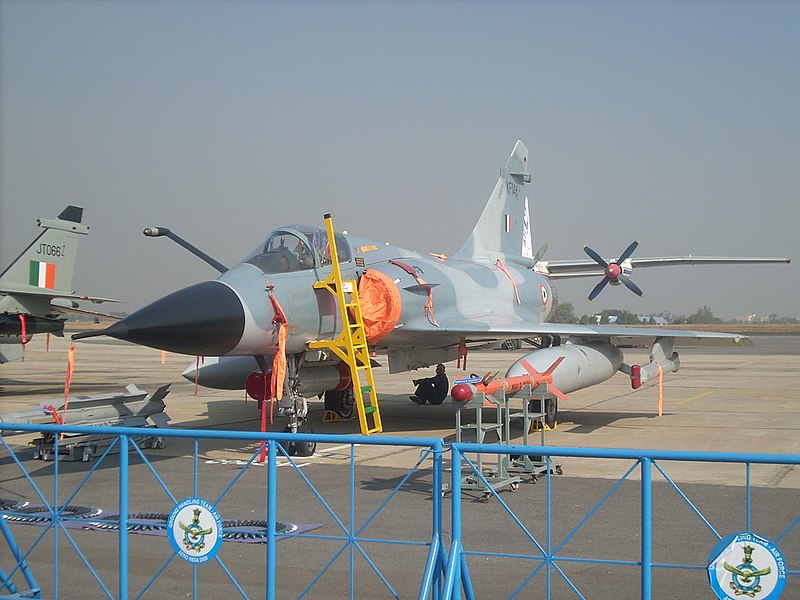
An Indian AirForce Mirage 2000 (Image: Wiki Commons)
Today, the acceptance ceremony of the first two Indian Air Force Mirage 2000 I/TI was held at Istres, Dassault Aviation’s Flight Test Centre, under the high patronage of HE Ambassador Arun K. Singh, the Indian Ambassador to France. The ceremony was hosted by Eric Trappier, Dassault Aviation Chairman & CEO, and Pierre Eric Pommellet, Thales  Executive Vice President,  Defence Mission Systems.

The signing of the contract for the upgrade of Indian Mirage 2000 fleet occured in July 2011. The maiden flight of its first upgraded Mirage 2000 was completed successfully by Dassault Aviation on the 5th October 2013, following a two year development phase dedicated to the equipment kit provided by Thales including the radar, the electronic warfare suite and the mission computer.

27 January 2015

Editorial: Is the JF-17 Really a Tough Sell for China and Pakistan?


By Ankit Panda

An Egyptian contract for the JF-17 may have just slipped out of reach for China and Pakistan.

The JF-17 Thunder (also known as the FC-1 Xiaolong) is a lightweight, single-engine, multi-role combat aircraft developed jointly by Pakistan Aeronautical Complex and China’s Chengdu Aircraft Corporation. With a relatively low unit cost of $15-25 million, price is the primary selling point for this capable and versatile jet which Flashpoints‘ Robert Farley has described as conceptually a “modern MiG-21.” Despite the seemingly positive bang-for-buck proposition, the JF-17 has had a hard time finding committed buyers. Indeed, part of the reason that defense procurement programs the world over have shirked the jet is prestige, but additionally, the jet remains largely unproven. While a few states have expressed interest, Pakistan and China received some bad news this week with the news that Egypt — a major regional military — will likely instead go with France’s Rafale and Mirage 2000-series of jets.
As reported by Defense News, Egypt will likely acquire the Mirage fighters (specifically the 2000-9s and refurbished 2000-5s) off the United Arab Emirates, and is also currently in the process of negotiating a contract for 20 Rafale fighters. Egypt has additionally shown interest in the MiG-35. All of these options carry a significantly higher per-unit cost compared to the JF-17. The Rafale starts at around $90 million per unit, a considerably larger sum than the JF-17′s modest asking price. While these jets certainly offer advanced capabilities over the JF-17 to make up for their higher price tags (particularly in the areas of avionics and maneuverability), the JF-17 being passed over will undoubtedly frustrate both China and Pakistan. 

Read the full story at The Diplomat

26 January 2015

News Story: JF-17 Presses On After News of Egypt's Plan


By Usman Ansari

ISLAMABAD — News that Egypt may acquire the UAE's Mirage fighters is likely to scupper Pakistan's hopes of selling the JF-17, especially since Cairo is also reportedly negotiating for 20 Rafale fighters, and shown interest in the MiG-35. However, brisk development of the JF-17 continues alongside sales efforts.

Kaiser Tufail, former Pakistani air commodore, said the UAE's offer of an undisclosed number of Dassault-built Mirage 2000-9s to Egypt means the JF-17 may be out of contention in Cairo.

"If [Egypt] purchases Mirage 2000-9s as well as some more of the older refurbished 2000-5s, it would certainly not need the JF-17, which is less capable than the French fighter," he said.

Read the full story at DefenseNews

21 January 2015

News Story: Taiwan Arrests Alleged Chinese Spy


By Wendell Minnick

TAIPEI — Taiwan has arrested an alleged Chinese spy, the first such apprehension in Taiwan in decades, according to the National Security Bureau.

The question many here in Taipei are asking is whether China will attempt some sort of swap to get him back. China is holding two Military Intelligence Bureau agents who were captured in Vietnam more than a decade ago.

On Jan. 16, Taipei prosecutors went forward on indictments on mainlander Zhen Ziaojiang's alleged spy ring, which included five Taiwanese accused of spying for China. The indictment charged former Army Maj. Gen. Hsu Nai-chuan, Air Force Lt. Col. Chou Chih-li, Air Force pilot Sung Chia-lu, Air Force official Yang Jung-hua, and karaoke club owner Lee Huan-yu.

According to media outlets, Zhen was a captain and an intelligence officer in the People's Liberation Army. This has given rise to the assumption that the Army's Second Department of the General Staff Department was in charge of the operation.

In 2005, Zhen obtained residency in Hong Kong and began flying to Taiwan ostensibly on business and tourist trips, which were allegedly missions to recruit Taiwan military officers, according to government statements to the press. Zhen's alleged mainland intelligence contact has been identified as a "Mao Shangyu," most likely a pseudonym, based in Xiamen City, Fujian Province, the statements said.

Read the full story at DefenseNews

15 December 2014

News Story: French Air Chief Confident on Rafale Exports


By PIERRE TRAN

PARIS — France has a good chance of winning export sales for the Dassault Rafale fighter, which is needed to balance the defense budget books, French air chief Gen. Denis Mercier said on Dec. 11.

“I am fairly confident there will be a good story,” he told the defense journalists association, when asked about the export prospects for the twin-engine fighter. “This is a high-quality plane.”

The French government has written an assumed sale of the Rafale to foreign clients into the multiyear budget. The deals are needed to maintain annual production of 11 aircraft from the line near Bordeaux, southwest France.

India and France have agreed to speed up negotiations for a US $12 billion order for 126 Rafales for the south Asian nation, with plans to seal the deal by March 31.

A delegation of senior Egyptian Air Force and Navy officers landed here on Dec. 10 to negotiate buying 23 to 26 Rafales, worth €3.6 billion (US $4.4 billion), and two DCNS multimission frigates, worth €1.8 billion, La Tribune reported.

Qatar is in advanced talks for the Rafale, the business website reported.

Read the full story at DefenseNews

29 September 2014

Editorial: Taiwan, Asia’s Secret Air Power

Taiwanese Leshan early warning radar

By Ian Easton

A look at what Taiwan is doing to ensure its air defense and why it matters for the United States and the region.

When current and former world leaders, including Bill Clinton, visit Taiwan, they often stay at the Grand Hotel Taipei, an opulent Chinese architectural landmark perched atop Yuan Mountain. With spectacular views of the downtown riverfront and a palm-lined swimming pool surrounded by lush green jungle, guests at the Grand Hotel could be forgiven for thinking they had arrived at one of the most peaceful spots in East Asia.
In fact, just under their feet lies a vast underground command center from which Taiwan’s top leadership would direct their nation’s armed forces in the event of a war with China. This facility, like many around the high-tech island, shows that when it comes to the defense of Taiwan, there is much more than meets the eye (PDF).
Known officially as the Tri-Service Hengshan Military Command Center, the sprawling tunnel facility stretches through the mountain in a line that starts near the Grand Hotel and goes down to the giant Ferris wheel in Dazhi. Built to defend against China’s growing fleet of ballistic missiles, this hardened nerve center is designed to allow Taiwan’s government (and thousands of military personnel) to live and work for months, riding out air raids above while organizing the defense of Taiwan from below.
Linked to a large network of subterranean command posts and military bases around Taiwan and its outer islands – as well as the U.S. Pacific Command in Hawaii – the Hengshan Military Command Center is the ultimate redoubt for Taiwan’s president. It is so important, in fact, that China’s strategic rocket force, the Second Artillery, has actually simulated missile attacks on the bridges that connect it to the Presidential Office.
On the other side of the city, buried inside a wet rocky outcropping near the campus of National Taiwan University, lies another tunnel complex, the Air Operations Center. Known affectionately as “Toad Mountain” by Taiwanese air force officers, this facility oversees one of the most robust air and missile defense networks on the planet. Fed vast quantities of information by airborne early-warning aircraft, long-range radars, listening posts, unmanned aerial vehicles and satellites, Toad Mountain stands constant watch over all of Taiwan’s airspace, ready to scramble fighters or assign surface-to-air missiles to intercept intruders. And, like every other Taiwanese military facility, it has multiple back-ups. Just in case. 

Read the full story at The Diplomat