Showing posts with label East Asia. Show all posts

09 August 2017

News Story: Chinese FM calls on security cooperation for East Asian countries

MANILA, Aug. 7 (Xinhua) -- Chinese Foreign Minister Wang Yi on Monday called on all countries in East Asia to strengthen security cooperation, especially on non-traditional security issues like terrorism, transnational crimes and natural disasters.

He made the remarks while attending a series of meetings of the ministers with the Association of Southeast Asian Nations (ASEAN), which are being held in the Philippine capital city of Manila, including East Asia Summit (EAS) and ASEAN Regional Forum (ARF).

Wang said communication between countries on security issues is very important as it can remove misunderstanding and misjudgment whiling enhancing mutual trust.

He mentioned that China issued a white paper on its policies on Asia-Pacific security cooperation this January, which showed China's determination to safeguard regional peace and stability.

Read the full story at Xinhua

07 April 2017

News Report: VP Pence to Embark on Asia-Pacific Trip in Mid-April

U.S. Vice President Mike Pence
U.S. Vice President Mike Pence will visit South Korea later this month as North Korea's showcasing of its nuclear and missile programs further escalates tensions in the East Asia region.

Pence will be on a 10-day, four-nation Asia-Pacific trip that is to include visits to Japan, Indonesia, Australia and Hawaii. He departs April 15, according to the White House.

This will be the vice president's first official travel to the Asia-Pacific rim, where he will meet with leaders to discuss military alliances, trade and economic issues.

10 January 2017

News Report: East Asia Quiet as US-North Korea Tensions Escalate Over ICBM Test

Brian Padden

SEOUL — The increasing tensions between the United States and North Korea over a possible intercontinental ballistic missile test are not provoking strong reactions in East Asia.

On Sunday, North Korea declared it could test-launch an intercontinental ballistic missile at any time from any location, according to an unnamed Foreign Ministry spokesman who was quoted by the official KCNA news agency.

U.S. Secretary of Defense Ash Carter responded by calling an ICBM launch a "serious threat' to the United States, and would not rule out taking military action to shoot down the missile if it crossed into the territory of the U.S. or its allies.

"If it were coming--if it were threatening to us, yes. That is, if it's predicted impact or one of our friends or allies, yes, we would shoot it down," said Carter.

08 December 2016

News Report: Center of Global Power Shifts to Asia - Turkish Deputy Parliament Speaker

The center of the global power was moving to the Asian region, Turkish Deputy Parliament Speaker Ahmet Aydin told Sputnik.

MOSCOW (Sputnik) — Aydin said that the Energy corridor and the Silk Road passed through the region will facilitate turning of the Asian region into "the world center of power and attraction."

The parliament speaker noted that the region would continue developing, since Turkey would soon complete the construction of the railway linking Europe and Asia. Agricultural sector, livestock, industrialization are also promptly developing in the region, Aydin said. 

Aydin stressed that among the Asian countries, India remained number one in the sphere of information technology, while China continued to generate sustainable economic growth with the rest of the Asian countries trying to follow the trend of development.

This story first appeared on Sputnik & is reposted here with permission.

11 October 2016

News Story: China calls for Asian community of shared future

BANGKOK, Oct. 11 (Xinhua) -- Delegates from 34 member countries of Asia Cooperation Dialogue(ACD) gathered in Bangkok to talk about Asian cooperation, development and integration during the 2nd ACD summit held here on Monday.

China called for an Asian community of shared future for the continent.

"It is time for us to vigorously build an Asian community of shared future driven by the two wheels of cooperation and dialogue," said Chinese Vice President Li Yuanchao at the summit, under the theme "one Asia, Diverse Strength."

Li said the Asian community of shared future is about facilitating common development, promoting common interests, enhancing common security and taking on common responsibilities.

According to him, to build the Asian community of shared future, Asian countries need to enhance unity and coordination to maintain stability in the continent, strengthen connectivity to deepen integration and promote beneficial cooperation to boost development.

"China supports a multi-tiered Pan-Asian connectivity network to facilitate comprehensive integration of infrastructure in Asia," Li said.

Read the full story at Xinhua

20 September 2016

Think Tank: East Asia 2036

Mike Scrafton

Earlier this year PwC reported it had identified ‘the equivalent of US$250 billion in projects… [which have] been built already, recently started construction or have been agreed on and signed’ related to China’s One Belt One Road (OBOR) initiative. OBOR is a massive undertaking with two fundamental components. The maritime ‘road’ strategy is focused on developing ports in the Indian Ocean,the coast of Africa and the Mediterranean. The ‘belt’ involves investment in infrastructure cooperation in a zone that stretches from Xinjiang (the north-western part of China) to the Baltic Sea. These activities will have consequences for East Asia that go beyond trade and will shape the strategic environment in coming decades.

The scale of the initiative is impressive. A European Parliament report estimated that it could involve, ‘an area that covers 55% of world GNP, 70% of global population, and 75% of known energy reserves’. The vision and framework for the initiative were released by the Chinese Government in March 2015 and it emphasises cooperation between China and the countries involved in ‘policy coordination, facilities connectivity, unimpeded trade, financial integration and people-to-people bonds’. If even partially successful, China will eventually sit at one end of ‘a massive trade network reaching from often neglected central Asia to Central Europe’. As of May 2016 China held US$3.19 trillion in foreign exchange reserves and US$746 billion in its sovereign wealth fund. With US$890 billion worth of deals officially in train, ‘the massive trade and investment effects across Eurasia could well reshape a significant part of the global economy’.

25 August 2016

News Story: China, S. Korea, Japan should develop ties in spirit of taking history as mirror, look forward to future - Chinese FM

TOKYO, Aug. 24 (Xinhua) -- China, South Korea and Japan should develop their relations in the spirit of taking history as a mirror and looking forward to the future, Chinese Foreign Minister Wang Yi said here Wednesday.

Speaking at a joint press conference with his South Korean counterpart Yun Byung-se and Japanese counterpart Fumio Kishida after a trilateral meeting, Wang said to realize the healthy and stable development of their ties, China, South Korea and Japan should overcome difficulties, remove disturbances, build up consensus and focus on cooperation, so as to keep the cooperation of the three countries in the right direction.

The Chinese foreign minister said since the China-South Korea-Japan leaders' meeting last year, positive progress has been made in pragmatic cooperation and communication in all fields between the three sides which should be cherished.

He believed that Wednesday's gathering will create favorable atmosphere for the Group of 20 (G20) summit to be held in east China's Hangzhou early in September and pave the way for the East Asian leaders' meetings next month.

At the just concluded trilateral meeting, the three sides agreed that facing new changes in regional and international situation, China, South Korea and Japan should shoulder the responsibilities of promoting economic development in East Asia, taking the lead in regional cooperation in East Asia and maintaining regional peace and stability so as to make greater contribution to the overall revitalization of Asia as well as the world peace and development, Wang said.

Read the full story at Xinhua

23 August 2016

Think Tank: Who wins a war in East Asia?

Image: Flickr User - Renato Ganoza
Mike Scrafton

Under what circumstances would Australia join in a war against China? RAND’s report War with China: Thinking Through the Unthinkable (WwC) illuminates the gravity of that decision.

WwC explores ‘two variables: intensity (from mild to severe) and duration (from a few days to a year or more)’. It models a number of conventional war scenarios confined to East Asia/Western Pacific between 2015 and 2025 and waged with maritime assets—surface and submarine—and aircraft, missiles, space assets and in cyberspace. The US homeland isn’t attacked but assets in China are.

WwC finds the military and economic costs to China and the US are high and increase rapidly with intensity and duration. WcC doesn’t quantify costs to allies like Australia though economic costs are forecast to be ‘immensely costly for the belligerents, East Asia, and the world’. As a minimum, as Paul Dibb has observed, China mightn’t spare Australia’s critical infrastructure especially intelligence capability.

27 July 2016

News Story: Chinese, Russian FMs agree to be vigilant to outside forces stoking regional tension

VIENTIANE, July 26 (Xinhua) -- Chinese and Russian foreign ministers have agreed here to be vigilant to outside forces that stoke regional tension through various excuses and internationalize bilateral disputes.

Chinese Foreign Minister Wang Yi and his Russian counterpart Sergey Lavrov made the remarks during their meeting late Monday on the sidelines of the ASEAN foreign ministers'meeting held in the Lao capital Vientiane.

Wang said that recent successful visit by Russian President Vladimir Putin to China and the three joint statements signed by the two leaders enriched China-Russia comprehensive strategic partnership of coordination, expanded the influence of their bilateral ties and was of historical significance to promote the sound and steady development of international situation.

Wang said China is willing to fully implement the important consensus reached by the two leaders and well prepared for bilateral high-level contacts in the second half of this year.

For his part, Lavrov fully agreed with Wang on the fruitful results made at the two leaders' meeting, saying that the joint statements and other documents signed during President Putin's visit showcased the common position shared by the two countries on developing bilateral relations and on major international issues.

Read the full story at Xinhua

News Story: China pledges to further advance cooperation in East Asia - FM

VIENTIANE, July 26 (Xinhua) -- China will make joint efforts with other countries within the framework of ASEAN Plus Three (China, Japan and South Korea)or APT to push forward cooperation in East Asia, Chinese Foreign Minister Wang Yi said on Tuesday.

When attending an APT foreign ministers' meeting in the Lao capital, Wang said, "China has been an active participant and promoter for the East Asia cooperation."

The platform of APT or "10 +3" has bolstered the East Asia cooperation, and played a vital role in helping boost understanding, deepen cooperation and confront challenges, he said.

Wang called on all APT countries to stick to an integration process suitable to the regional situation and uphold the principle of accommodating the comfort level of all parties so as to make the cooperation benefit all.

Read the full story at Xinhua
10 June 2016

USA: Timor-Leste defense chief welcomes Pacific Partnership

By MC2 Hank Gettys, Pacific Partnership Public Affairs

Rear Adm. Charles Williams, commander of Task Force 73, salutes during the Pacific Partnership 2016 opening ceremony at the Timor-Leste Ministry of Defense. (U.S. Navy/MC2 Hank Gettys) >>

DILI, Timor-Leste - The Chief of Defense Force to Timor-Leste, Major General Lere Anan Timur hosted the Pacific Partnership 2016 opening ceremony June 8.

Hospital ship USNS Mercy (T-AH 19), anchored off the coast of Dili, brought an international team of military and civilian professionals in disaster relief, engineering and medicine to Timor-Leste for its first mission stop of Pacific Partnership 2016.

Speakers at the event included His Excellence Dr. Rui Maria de Araujo, Prime Minister of Timor Leste, U.S. Ambassador to Timor-Leste Karen Stanton, and Rear Adm. Charles Williams, Commander, Task Force 73.

03 June 2016

News Story: UN Security Council slams DPRK's failed ballistic missile launches

UNITED NATIONS, June 1 (Xinhua) -- The UN Security Council on Wednesday "strongly condemned" the most recent failed ballistic missile launches of the Democratic People's Republic of Korea (DPRK) on May 31 and April 27-28.

"These repeated attempted launches are in grave violation of the DPRK's international obligations under United Nations Security Council resolutions," the 15-nation UN council said in a statement.

"The members of the Security Council deplore all DPRK ballistic missile activities, including these multiple failed launches, noting that such activities contribute to the DPRK's development of nuclear weapons delivery systems and increase tension," it said.

"The members of the Security Council further regretted that the DPRK is diverting resources to the pursuit of ballistic missiles while DPRK citizens have great unmet needs," the statement said.

The Security Council has adopted five resolutions -- resolutions 1718 (2006), 1874 (2009), 2087 (2013), 2094 (2013) and 2270 (2016) -- to curb the DPRK's nuclear and missile programs.

Read the full story at Xinhua

26 February 2016

Think Tank: The 2016 Defence White Paper, China and East Asia - the end of an illusion

Benjamin Schreer

The strategic narrative of Australia’s new Defence White Paper contains some interesting new aspects. One is the expression of much greater concern about the emerging maritime order in East Asia and China’s growing willingness to alter the status quo. In fact, the document reflects the end of the illusion in Canberra that somehow China will continue to accept the (predominantly) Western rules-based maritime order.

The previous two Defence White Papers had quite different things to say about China. The Rudd government’s 2009 version used fairly strong language on China’s evolving security challenge for the regional order. The Chinese reportedly weren’t amused. Four years later, the Gillard government markedly toned down the rhetoric, noting that China’s military modernisation was to be expected of a growing major power. It’s reasonable to assume that just like the US-administration of Barack Obama, the Australian government at the time still had hopes that China would emerge as a ‘responsible stakeholder’ in maritime Asia.

However, since then China has made abundantly clear that it doesn’t accept the established rules in maritime East Asia. Evidence for a growing assertiveness includes Beijing’s unilateral declaration of an East China Sea Air Defense Identification Zone in November 2013 which drew a strong response from the Abbott government; the creation and militarisation of artificial structures and disputed islands in the South China Sea (SCS); and attempts to coerce its smaller Southeast Asian neighbours into accepting its massive claims within its so-called ‘nine-dash line’.

Think Tank: Japan’s vision for the East Asian security order

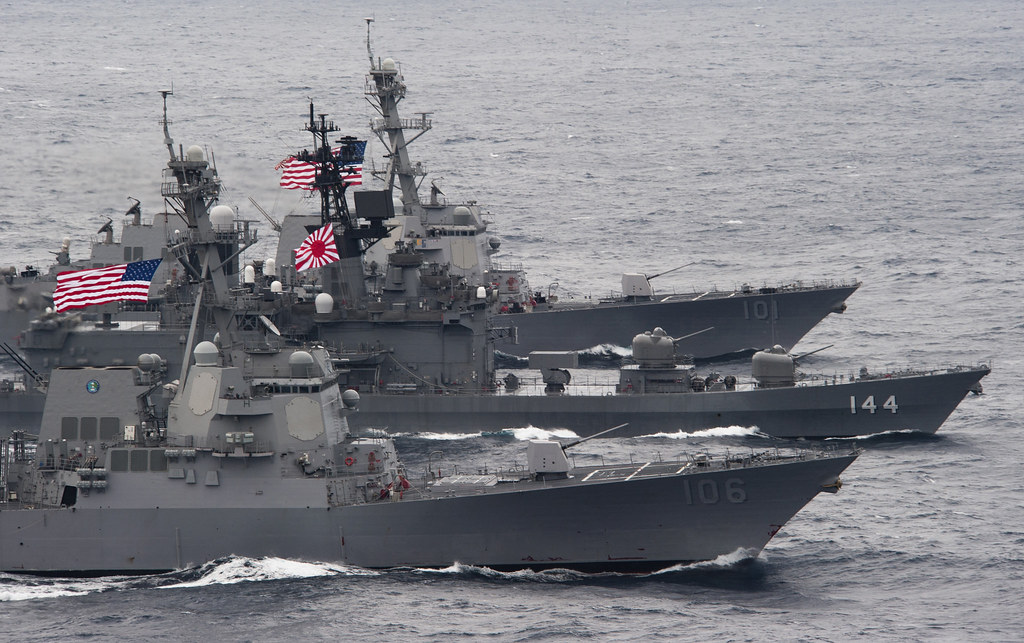
Image: Flickr User - Official U.S. Navy Page
Author: Ryo Sahashi, Kanagawa University

The regional order in East Asia is in flux. The relative decline of US power in Asia has led to new challenges. The principles, rules, norms and methods for managing the international agenda are being questioned. The willingness of the United States to maintain an active role in East Asia, alongside the behaviour of China and key groupings such as ASEAN will define the future of the region. How these key actors respond to the changing security environment will be crucial in determining the future of the security order in East Asia.

So, what does this mean for Japan?

Japan today seems to be the strongest supporter in the region for maintaining a US-led order in both the security and economic realms. After the short tenure of former prime minister Yukio Hatoyama, who served from September 2009 to June 2010, Japan lost its desire to be an architect of the regional order. Instead, Japan has focused on integrating its Asian policy with its bilateral relationship with the United States.

12 February 2016

Editorial: Avoiding Landmines - Trajectory of the Japan-China Relationship in 2016

Image: Flickr User - Day Donaldson
By J. Berkshire Miller

Can pragmatism win over antagonism in the Japan-China relationship in 2016?

From a surface view, it appears that strained relations between Tokyo and Beijing are experiencing a slight détente. Japan’s Prime Minister Shinzo Abe held two summit meetings with his Chinese counterparts—one with Chinese President Xi Jinping last April in Jakarta and the second with Premier Li Keqiang on the sidelines of the Trilateral Summit with South Korea this past November in Seoul. There also has been increased dialogue between foreign ministers, resuscitated talks on security and maritime affairs, and high-level commitments to implement crisis avoidance mechanisms to avert a potential clash over their dispute in the East China Sea.

There were other positive signs too. Abe appears more willing to accommodate Chinese concerns about Japan’s approach toward history through his decision not to visit the controversial Yasukuni shrine (after his provocative visit in December 2013 enraged Beijing). And, while it received boiler-plate criticism from Beijing, Abe’s statement on the 70th anniversary of the end of World War II last August made reference to upholding previous statements—including the Murayama Statement—on Japan’s wartime contrition and guilt.

China, too, has responded with a more pragmatic approach to its relations with Japan. Beijing finally abandoned its stubborn and ineffective approach of pre-conditioning high-level dialogue upon Japan’s willingness to make concessions over the disputed Senkaku (referred to as Diayou in China) Islands. Meanwhile, despite constant public statements of concern, Beijing has ratcheted down the overt rhetoric of its criticisms of Japan’s attitude toward history.

Read the full story at The Diplomat

02 June 2015

Editorial: Security Integration in the Asia-Pacific

By Yuxin A. Zhang

What prevents closer security ties in East Asia? A lot.

Regional integration can help countries achieve wealth, peace, and stability through cooperation aimed at addressing issues of common concern. Integration can be both economic and political, with security concerns generally emerging as part of the latter. Regional economic integration in the Asia-Pacific, in particular East Asia, has moved forward a step since the conclusion of the Asia-Pacific Economic Cooperation conference in Beijing last year. Intra-regional trade has increased and foreign direct investment has surged. Yet security integration has barely budged. Five factors are playing a role in this.

First, recent political developments in the region, specifically the disputes over the South China Sea and East China Sea, have created a “security dilemma.” Pertinent or not to its disputes with its neighbors, China’s substantial military buildup worries the other countries involved in the disputes and has encouraged them to step up their own military procurement. In response, China has increased its own military expenditures still further. The security dilemma has provided opportunities for confrontation and could further destabilize the region, particularly since China is unlikely to seek international arbitration over the island disputes. The Chinese government considers the disputes internal affairs, and it has re-claimed sovereignty over the Diaoyu/Senkaku Islands as well as the Paracel Islands, the Spratly Islands, and others. Japan has also affirmed its territorial sovereignty over Diaoyu/Sankaku and has shown no intention of proposing international arbitration. The resulting impasse, together with the unwillingness of the parties involved to address sovereignty disputes through legal means, has added to the political complexities.

Read the full story at The Diplomat

04 May 2015

Think Tank: Pride and prejudice - maritime disputes in Northeast Asia


Elena Atanassova-Cornelis, Ramon Pacheco, Eva Pejsova

Overlapping sovereignty claims at sea constitute one of the major sources of diplomatic tensions in East Asia, with repercussions for the security environment in the broader Asia Pacific. Given the importance of the region’s maritime realm for the functioning of the global economy, any instability caused by the possible escalation of these disputes also poses a threat to Europe, a major trading partner, which relies on its sea lines of communication (SLOCs) for the export and import of goods.

The three concrete cases addressed in this report include the dispute over the Senkaku/Diaoyu Islands in the East China Sea – administered by Japan and laid claim to separately by the People’s Republic of China and the Republic of China (Taiwan); the Dokdo/Takeshima Islands in the Japan Sea/East Sea – administered by South Korea and claimed by Japan; and the Southern Kurils/Northern Territories in the Sea of Okhotsk – administered by the Russian Federation and claimed by Japan.

Download PDF document from ISS (58 Pages)

06 April 2015

Editorial: Ukraine and the Russia-China Axis


By James D.J. Brown

Current U.S. policy on the Ukraine crisis is driving Russia into China’s embrace.

It is easy to make an emotional case for Western assistance to the Ukrainian government in its confrontation with Russia. In principle, the people of Ukraine should have the liberty to determine their own foreign policy orientation and the international community should support their freedom to make this choice. Such a stance is morally unimpeachable. It is also a perilous basis for policymaking. Pursuing ideals in isolation from assessments of what is achievable and without reference to the broader international context risks unleashing a horror of unintended consequences. This being so, foreign policy makers must restrict themselves to the art of the possible and base their decisions on cold-hearted assessments of long-term security interests.
Based on the prioritization of such strategic goals, what should be the West’s Ukraine policy? There are those who believe that, on this occasion, realist and liberal goals coincide, and that security imperatives dictate that the West must act forcefully to end Russia’s intervention in its neighbor’s affairs. The argument here is that Vladimir Putin’s Russia is an aggressive, expansionist state whose actions, in the words of Chancellor Merkel of Germany, call “the whole of the European peaceful order into question.” What is at stake, therefore, is not just the status of one country but the fate of the entire postwar international system. This is because it is assumed that conceding to Russian demands in Ukraine will inevitably encourage it to advance elsewhere. Given the specter of Russian tanks rolling into the Baltic States, it is no surprise that many have come to favor supplying Kiev with “lethal defensive weapons.”
This makes for a compelling narrative, not least because it draws upon historical memories of appeasement and Nazi expansionism. In reality, however, the argument is without foundation. Economically weak and demographically in decline, Russia represents no serious threat to the international status quo. Indeed, holding a privileged position that it no longer merits, Russia has absolutely no incentive to challenge the postwar order. Moscow’s actions in Ukraine are therefore best interpreted, not as self-assured expansionism, but rather as the panicky response of an insecure state to a perceived threat to its fundamental national interests.
Even if Russia’s actions are driven by weakness and not strength, this does not necessarily mean that Western interests would not be best served by taking a forceful stance. What alters this calculation, however, is an assessment of the broader geopolitical implications of this policy. Regarded at a global level, the punishing sanctions regime and exclusion of Russia from Western groupings comes to look like a strategic mistake. This is because it is has had the effect of forcing Moscow to overcome its hesitations and commit fully to close relations with Beijing. Should this relationship evolve into a full-blown Chinese-Russian axis, it will be a development of historic proportions since, while Russia on its own does not seek to challenge the established international order, China certainly does. What is more, despite Russia’s diminished status, it is able to contribute significantly to Chinese international power. Closer bilateral relations can therefore be anticipated to encourage Beijing’s attempts to assert regional hegemony. In this way, by taking an uncompromising stance against its 20th century adversary in Europe, the United States may be inadvertently assisting its 21st century rival in Asia. 

Read the full story at The Diplomat

03 February 2015

AUS: Australia and UK reaffirm close partnership


Australia and the UK today reaffirmed the importance of our close partnership on a range of security and foreign policy issues at the seventh annual Australia-UK Ministerial Consultations (AUKMIN), in Sydney.

Our agenda focused on the Middle East, including responding to the growing threat of Daesh – also known as ISIL – and foreign fighters, Afghanistan, the evolving security situation in East Asia, and defence planning and interoperability. Our dialogue on these issues reinforced the value of the strong co-operation between our countries.

We agreed to continue our close cooperation on counter-terrorism, including in the Asia Pacific region, in line with our commitment to work together to reduce the risks posed by international terrorism and foreign fighters. We also undertook to continue our consultations on the Australian Defence White Paper and the UK Strategic Defence and Security Review and to continue to confer on strategic issues that appear on the UN Security Council agenda, building on Australia’s successful two-year term on the Council.

30 January 2015

Editorial: Is China’s Periphery Becoming the Core of Its International Relations?


By Neil Thomas

An op-ed by an influential Chinese scholar reflects trends in Chinese foreign policy.

The U.S.-China bilateral relationship is widely regarded by politicians, practitioners, and pundits as the world’s most important. Effectively managing China’s reemergence as a major power in the context of a U.S.-led international order is seen as key to continuing peace and security in the Asia-Pacific. But is working together the best way for China to get what it wants?
This was the subject of an op-ed published on 13 January in China’s Global Times by leading Chinese international relations scholar Yan Xuetong, Dean of the Institute of Modern International Relations at Tsinghua University in Beijing.
Yan’s article, entitled “Holistic ‘Periphery’ more important than the United States” (Chinese), argues that China’s rise will be more effectively achieved by fostering friendly ties with neighboring countries, rather than focusing on improving U.S.-China relations in order to reduce “American resistance.”
Yan asserts that the “inevitable course” of rising powers over world history has been to first become a regional power and then a global power. Thus, given China is not yet a global power and must avoid diplomatic overreach* “China must view its periphery as its most important diplomatic focus.”
Yan defines China’s “periphery” as East Asia, Russia, Central Asia, South Asia, and Southeast Asia, contending that “Faced with the reality that China is stronger than they are, neighboring countries must choose whether they support or obstruct China’s rise. This makes it possible for China to gain the support of [those] that wish to benefit from China’s rise,” weakening U.S. President Barack Obama’s “Pivot to Asia” strategy to reinforce American primacy in the region. 

Read the full story at The Diplomat