Showing posts with label Tata. Show all posts

09 September 2017

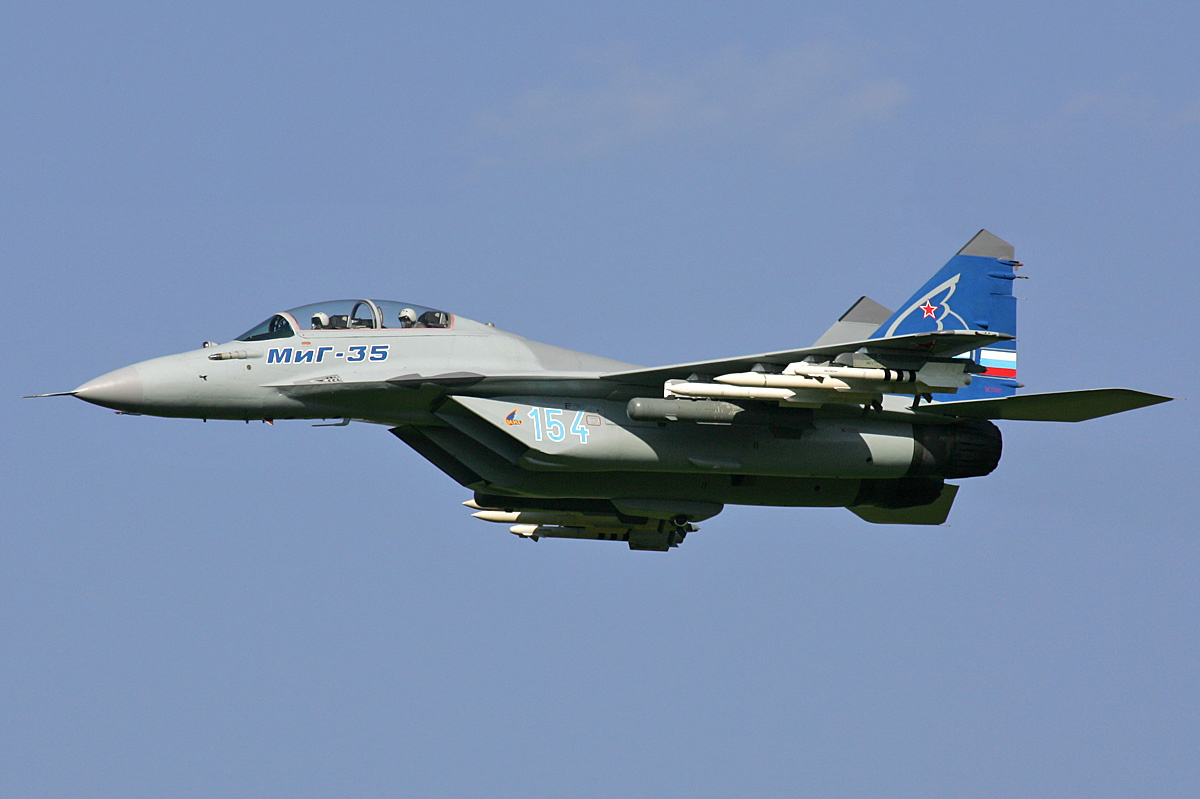
News Story: Russia Pitches MiG-35 to India as FGFA Project Falters

MiG-35 (Image: Wiki Commons)
by Neelam Mathews

As the contest to supply a new fighter aircraft to the Indian Air Force (IAF) heats up, the MiG-35 has emerged as a viable candidate. India is supposedly seeking about 220 single-engine fighters to replace 11 squadrons of MiG-21/27s that entered service in the 1990s.

Rosoboronexport is believed to have offered a licensed production deal for the twin-engine MiG-35 that would compensate for the IAF’s reluctance to proceed with the Indo-Russian Fifth Generation Fighter Aircraft (FGFA) project.

At the MAKS 2017 airshow in July, Ilya Tarasenko, director general of Russian Aircraft Corporation MiG, said: “We are actively working with the IAF in order to win the tender.” Russia has committed to a 40-year maintenance and upgrade contract to preclude the support issues that have arisen in the past with Russian aircraft in service with the IAF. Meanwhile, also at MAKS, Sergei Chemezov, CEO of the Rostec State Corporation, told reporters that a decision on the design and development of the FGFA would be made in the “nearest future.” He did not provide a timeline for the project, a version of Russia’s Sukhoi T-50, which has been under discussion between the two countries for the past decade.

According to an Indian defense official, “The MiG-35 is 25 percent cheaper [than rival candidates for the IAF requirement]; has an AESA radar; has commonality with the fleet; and being in the light to medium category enables it to land in the same airfields that the [indigenous] Light Combat Aircraft does. If the FGFA does not go through, Russia will have to be compensated, and this is the only contract left at the moment.” 

Read the full story at AINonline

07 September 2017

News Report: India’s Home-Made Howitzer Creates World Record in User Trial

India's new ATAGS artillery gun during early test firing
Apart from its capability to fire ammunition at almost 48 kilometers, India’s locally developed ATAGS is the world’s only gun with a six-round “automated magazine” that fires a six-round burst in just 30 seconds.

New Delhi (Sputnik) — India’s locally manufactured advanced towed artillery gun system (ATAGS) has created a record in ammunition firing during a user trial conducted at Pokhran in the western state of Rajasthan. The 155-millimeter 52-calibre howitzer fired three shells out to a record distance of approximately 47.2 kilometers in comparison to 40-45 kilometer by other such systems currently operational in the world.

Defense sources told Sputnik that this is, perhaps, the longest distance covered by an artillery gun system. “The system fired three shells at more than 47 kilometers using special, long-range ammunition called high explosive base bleed in Pokhran,” defense sources told to Sputnik.

02 September 2017

News Story: Saab, Adani Group forge partnership for India’s single-engine fighter

JAS-39 Gripen (Image: Wiki Commons)
By: Vivek Raghuvanshi 

NEW DELHI — Saab of Sweden and Indian infrastructure conglomerate Adani Group have forged a partnership to build Gripen E aircraft and work on other aerospace programs in the Asian country.

The Sept. 1 announcement means India’s single-engine fighter aircraft competition worth $12 billion is now shortlisted between the Saab-Adani partnership and Lockheed Martin of the U.S. in a tie-up with India’s Tata Advanced Systems Limited.

”The intended collaboration would encompass design, development and production of Gripen for India and other high-tech products of national importance for India and also the creation of joint ventures in India in line with and in support of the Make In India policy,” according to a Saab news release.

Lockheed Martin is pitching its F-16 Block 70 aircraft, whereas Saab is fielding the upgraded Gripen E in response to the expression of interest sent to select aerospace companies through foreign Indian embassies in November 2016.

“Our plans in India are to create a new defense eco-system that would involve many partners, vendors and suppliers. To achieve this, we need a strong Indian partner who can help create the framework for the infrastructure and eco-system to come into place,” said Håkan Buskhe, CEO and president of Saab.

The president of Adani group, Gautam Adani, said: “We are proud of our enduring relationship with Saab and look forward to partnering in major projects such as Gripen. Our various collaborations in aerospace and defence sectors will help establish new production lines in India, generate employment and build sustainable skills.”

Read the full story at DefenseNews

24 August 2017

News Report: India Floats Biggest Tender for Procurement of 234 Naval Helicopters

In a procurement that could be one of the biggest additions to India’s naval warfare capabilities in recent times, the Indian Navy intends to purchase at least 123 naval multi role helicopters (NMRH) with anti-submarine capabilities and light utility twin engine helicopters for offshore and shore based operations.

New Delhi (Sputnik) — Hard pressed by operational inadequacies, the Indian Navy has made public its intentions to procure at least 234 aerial vehicles to serve in warships. A request for information (RFI) has been sought from six global manufacturers for an estimated deal of over $5 billion.

The Indian Navy has said 123 naval multi-role helicopters should have anti-submarine warfare capabilities. The requirement has been outlined keeping in mind the growing presence of foreign submarines in the Indian Ocean region. The Indian Navy has also floated tentative requirements for light utility twin engine helicopters weighing about 4.5 tons to be used in both shore-based and offshore operations.

The procurement would be executed under the newly approved strategic partnership (SP) model that seeks to identify an Indian private firm as a strategic partner who would tie up with a shortlisted foreign original equipment manufacturer (OEMs) to manufacture military platforms. The main criteria for the selection of OEMs would be the compatibility of their products with the Services Staff Qualitative Requirements (SQRs), and their commitment to provide technology and other assistance to enable their Indian partners to produce in India with maximum localization.

14 July 2017

News Story: Indian Navy launches hunt to acquire 110 helicopters in $5B deal

Kamov Ka-226T (Image: Wiki Commons)
By: Vivek Raghuvanshi

NEW DELHI — The Indian Navy has begun its process of acquiring 110 light utility helicopters after rejecting Russia's Kamov Ka-226T, which are being built for the Air Force and Army, according to a Ministry of Defence official. 

"The Kamov 226T does not have blade folding and cannot be fitted inside a ship's hangar. Moreover, it is not suitable to carry the torpedoes, which is the mandatory requirement," said an Indian Navy official. 

The light utility helicopters, or LUH, will be procured under the strategic partnership policy India's government approved last month, under which a private-sector defence company will be selected as a strategic partner, which, in turn, will tie up with an overseas original equipment manufacturer, or OEM, shortlisted by the MoD. 

In the next two months, an expression of interest will be given to domestic companies, including Bharat Forge, Reliance, Larsen & Toubro, Mahindra Aerospace and Tata Advanced Systems. The domestic companies will partner with overseas OEMs to compete for the contract worth $5 billion. 

Read the full story at DefenseNews

28 June 2017

News Report: Questions Arise as US-India F-16 Deal Seeks to Get Airborne

CGI of Lockheed Martin's F-16 for India (File Photo)
A lucrative aviation deal between US-India firms to manufacture F-16 fighter jets in the south Asian nation has attracted criticism that old technology is being "dumped."

US defense contractor Lockheed Martin has taken further steps to secure a deal which would relocate the manufacture of F-16 fighter jets to India. News of the multi-billion dollar agreement with Indian industry giant Tata Group came as Indian Prime Minister Narendra Modi met with US President Donald Trump in Washington on Monday, June 26.


A press release issued by both firms stated that India will be able to "produce, operate and export the multi(-role) fighter F-16 Block 70 aircraft."

27 June 2017

News Report: Modi Confident in 'Convergence' of US, Indian Interests

Indian Prime Minister Narendra Modi said he is "confident in the growing convergence" between India and the U.S. as he prepares to meet with President Donald Trump at the White House.

In an op-ed published in the Wall Street Journal, Modi stated his optimism for economic growth and increased bilateral trade between the two countries.

"In an uncertain global economic landscape, our two nations stand as mutually reinforcing engines of growth and innovation," he wrote.

On Sunday, Modi met with top American business executives and members of the Indian diaspora on his first visit to the U.S. since Trump was elected president.

Meeting with tech leaders 

At a hotel meeting in Washington with leaders of some of the top American technology companies, the prime minister extolled the virtues of doing business in India where he said there was "minimum government," making it easy to do business in the South Asian nation.

Among those attending the meeting were Google's Sundar Pichai, Satya Nadella of Microsoft and Shantanu Narayen of Adobe Systems, who are all Indian Americans. Amazon chief Jeff Bezos and Apple's Tim Cook also attended the meeting.

24 June 2017

News Story: MQ-9B drone sale for India to be OK'd

MQ-9B Guardian (Image: Wiki Commons)
By: Aaron Mehta

WASHINGTON — The U.S. State Department is in the final stages of clearing the sale of 22 MQ-9 drones to India, with an expectation that U.S. President Donald Trump will announce the sale during the upcoming visit of Indian Prime Minister Narendra Modi. 

Modi, who will meet with Trump for the first time on June 26, is expected to discuss a wide range of topics, including terrorism and visas, but is poised to walk away with an offer to purchase the unarmed MQ-9B Guardian design produced by General Atomics. 

The Guardian design is a variant of the Predator B drone, equipped with several radar systems specifically useful for maritime searches.  

“We are pleased that the U.S. government has cleared the way for the sale of the MQ-9B Guardian to the Indian Government,” said Linden Blue, CEO of General Atomics Aeronautical Systems, in a statement to Defense News. “Guardian provides the endurance and capability required to significantly enhance India’s sovereign maritime domain awareness in the Indo-Pacific. General Atomics Aeronautical Systems is standing by to support the US and Indian Governments throughout this process” 

It is unclear how much the sale will be worth, nor what offsets were being offered to India. Modi’s Make in India initiative has emphasized production on the ground in India be part of weapon procurement from foreign suppliers. However, GA estimates the sale will create around 5,000 jobs in the U.S. through its supply chain. 

An industry source confirmed that General Atomics has been told the sale is being approved. A spokesman for the U.S. State Department declined to comment. 

But offering sales to New Delhi and getting them concluded are two very different things, with the Indian government notorious among defense circles for dragging out negotiations before cancelling them outright. 

Read the full story at DefenseNews

22 June 2017

News Story: Lockheed - Trump's 'Buy American' emphasis unlikely to thwart potential F-16 production in India

CGI of the F-16IN developed for the Indian MMRCA contest
By: Valerie Insinna

LE BOURGET, France — Lockheed Martin is still waiting for India to make a decision on its fighter jet competition. However, in the event of a win, the company feels assured its proposal to move the F-16 line to India won’t raise eyebrows with the Trump administration, despite the president’s focus on keeping jobs in the United States. 

Earlier this year, Orlando Carvalho, executive vice president of Lockheed Martin's aeronautics business area, said the company was keeping a close eye on what U.S. President Donald Trump’s comments would ultimately mean for the proposed move, which is seen as a key incentive for getting India on board. 

But during a June 20 interview at the Paris Air Show, Carvalho said Lockheed’s engagements with officials have bestowed some level of confidence that the administration will ultimately be supportive. 

“We’ve briefed various members of the administration on the program, on what that program would mean for the United States and what it means for India, and throughout all of the briefings and discussions that we’ve done, we haven’t seen any resistance to the program by the administration,” he told Defense News. 

“Given that, 'yes,' for a short answer, we are feeling more comfortable with the administration. It doesn’t see this program as an issue.” 

Read the full story at DefenseNews

20 June 2017

News Report: Tata, Lockheed Martin to Produce F-16 Block 70 Fighter Jet Together in India

CGI of the F-16IN for India
The F-16 Block 70 will be produced in India under a partnership with Tata Advanced Systems Limited (TASL), Lockheed Martin said in a press release on Monday.

The F-16 Block 70, the newest version of the fighter jet, will be produced in India under a partnership with Tata Advanced Systems Limited (TASL), Lockheed Martin said in a press release on Monday.

"Lockheed Martin and Tata Advanced Systems Limited signed a landmark agreement affirming the companies’ intent to join hands to produce the F-16 Block 70 in India," the release stated.

The release noted this "unprecedented" partnership will allow India to produce, operate and export the F-16 Block 70.

The agreement builds on a previous agreement between Lockheed Martin and TASL, which successfully build airframe components for the C-130J airlifter and the S-92 helicopter, the release added.

10 June 2017

News Report: Indian Army to Induct 108 Multi Barrel Rocket Launchers Worth $2 Billion

Pinaka Multiple Launch Rocket System (MLRS)
The Indian defense ministry has planned to float a tender to purchase six regiments of homemade Pinaka multi-barrel rocket launchers for $2 billion. Each regiment will comprise three batteries of six Pinaka launchers mounted on Tatra trucks.

New Delhi (Sputnik) — The tender is expected to be issued to firms by the next month while the acquisition order is expected to be placed within 18 months. Pinaka supplements the existing artillery gun at ranges beyond 30 km with quick reaction time and high rate of fire. Pinaka is developed by state-owned DRDO with private defense firms Tata Power SED and L&T.

Indian defense ministry had placed an order for two regiments i.e 36 systems last December. The Army intends to have 22 Pinaka regiments by 2026 including 12 regiments of Guided Pinaka. This is an advanced version of the Pinaka, wherein the firing range has been enhanced to 65+ km from the existing 38 km. India conducted two developmental tests of the 214-mm caliber Guided Pinaka earlier this year.

09 June 2017

News Report: India's TASL Delivers Components to Boeing for Chinook Helicopters

Boeing CH-47F Chinook helicopter
Indian defense firm Tata Advanced Systems (TASL) has begun delivery of the first crown and tailcone assembly to Boeing for the Indian configuration of 15 CH-47F Chinook helicopters, which can carry loads up to 9.5 ton at 282 kilometer per hour.

New Delhi (Sputnik) — Boeing had chosen to procure components from the Indian company through a joint venture against mandatory requirement to offset 30 per cent of the price tag for the helicopter. But this JV did not provide the much needed technological know-how to India’s TASL. Nevertheless, Boeing termed this development a significant step to increase defense capability and manufacturing capacity out of India with strategic partners.

“Tata Advanced Systems has demonstrated its ability to deliver high-quality components to the CH-47 Chinook program on schedule, which in turn helps Boeing meet commitments to our customers. We are clearly invested in leveraging the full potential of capability that exists in India to continue delivering greater value for less cost to our US and international customers,” Pratyush Kumar, President, Boeing India, said.

27 May 2017

News Report: Indian Experts Say Russian Defense Firms Have Advantage in Make in India Scheme

The Narendra Modi government’s decision to take the strategic partnership policy route with foreign companies to promote Make in India initiative in defense manufacturing will be to the advantage of Russian companies which already have solid ties in the sector, said experts.

New Delhi (Sputnik) — Unveiling the policy, India’s Defence Minister Arun Jaitley, who also holds the finance portfolio, categorically said the policy is aimed at “encouraging Make in India in relation to defense manufacturing.” The policy will allow Indian private sector companies to form joint ventures with global defense firms.

“The capacity building of the private sector in defense manufacturing will begin now,” PTI quoted Jaitley as saying after the Cabinet meeting.

Experts agreed the new policy will be contrary to the government’s attempts to build a military-industrial complex to boost job creation and spur innovation.

12 May 2017

News Story: India floats repeat tender for homemade rocket launchers valued at $2B

Pinaka Multi-Launch Rocket System
By: Vivek Raghuvanshi

NEW DELHI — In a move aimed at becoming more self-sufficient with multi-barrel rocket launchers, the Indian Ministry of Defence has floated a big-ticket bid to buy six regiments of homemade Pinaka multi-barrel rocket launchers for $2 billion. The order for the acquisition is expected to be placed within 18 months.   

Last December, the ministry placed an order for two regiments — one regiment is 18 systems — totaling a $350 million order for the Pinaka rocket launchers. Industry sources say India is now contemplating exporting the Pinaka. 

The order will be split between the prime state-owned contractors Bharat Earth Movers Limited and the Ordnance Factories Board, or OFB, and private sector defense companies Larsen & Toubro and Tata Power SED. Under the contract, BEML will supply the vehicles for the rocket launchers; L&T and Tata Power SED will supply the launcher systems; and OFB will supply the rocket ammunition . 

L&T and Tata Power SED have designed and developed the Pinaka system with the Defence Research and Development Organization, or DRDO. The Indian Army currently operates two regiments of the Pinaka systems. 

Read the full story at DefenseNews

24 March 2017

News Story: Could 'America First' policy upend Lockheed’s F-16 plans in India?

CGI of the Lockheed Martin F-16IN offering for the MMRCA
By: Aaron Mehta

WASHINGTON – As the Trump administration focuses on a pro-American industrial policy, Lockheed Martin is keeping a close eye on what that might mean for plans to build F-16 fighters in India.  

For now, company officials are staying positive about the chances that they will be allowed to go through with a plan to open a production line for the F-16 in India. But they acknowledge that the change in administration may require a shift in plans. 

“We’re working closely with the administration to understand what is [their] policy towards a program like the Indian fighter recapitalization program,” Orlando Carvalho, executive vice president of the company's aeronautics division, said in an interview Tuesday.  

“The indications we have heard have been positive. From the Defense Department, from the State Department, the indications are that they are supportive of what the Indian government wants to do. But we’re working with the administration to understand that,” Carvalho added.  

John Rood, Lockheed’s international senior vice president, added that the company has briefed the new administration on the potential F-16 plan, but noted that any timeline for a final decision rests with the Indian government more than the U.S. administration.

Read the full story at DefenseNews

10 March 2017

News Story: Indian Navy seeks to replace Israeli Barak-1 air defense system

Barak-1 SAM (Image: Wiki Commons)
By: Vivek Raghuvanshi

NEW DELHI — India's Navy has launched a new program to buy short-range surface-to-air missile systems from overseas to replace its aging Israeli Barak-1 air defense systems. 

India has made a global request for information to purchase 10 SRSAM systems and 600 missiles at a cost of about $1.5 billion.

Once responses are received in the next two months, the Navy will issue a tender under the Make in India policy's global purchasing category after six months to acquire the SRSAM systems. Under the program, overseas defense companies would need to forge partnerships with domestic companies to carry out 30 percent offsets obligations and include indigenous technology in the SRSAM systems.

An Indian Navy official said the proposed SRSAM system should be capable of vertically launching Mach 3-class active seeker missiles that can provide 360-degree defense coverage to meet all naval air defense applications including the need to carry out multiple simultaneous engagements.

Each SRSAM system will have a command and control system, a fire control system, a command link radar and one launcher to carry between eight and 16 missiles depending upon the size of the warship. The system's is expected to be inducted within the next five years.

According to an Indian Navy official, the foreign companies expected to make a bid are European-wide MBDA; Thales of France; Saab of Sweden; KBP Tula of Russia; Israel Aerospace Industries and Rafael Advanced Defense Systems of Israel; Raytheon of the United States; and Doosan Group and Samsung of South Korea. 

Read the full story at DefenseNews

28 February 2017

News Story: India seeks homemade electronic warfare suites for Russian helos

By: Vivek Raghuvanshi

NEW DELHI — The Indian Air Force is turning to domestic companies to build electronic warfare suites for its fleet of Russian Mi-17V-5 helicopters.

"We will submit a new proposal in the next three months to Ministry of Defence to seek project approval to source around 200 EW suites [that] cost around $100 million from domestic companies" a senior Air Force official said.

"Supply of complete set of EW suites appears to be beyond the capability of any single [Indian] company," said retired Air Force air marshal and defense analyst Daljit Singh.

However, the domestic companies will need to tie up with overseas original equipment manufacturers to build EW suites, said a senior MoD official, adding that the "MoD is hopeful that the domestic companies will be able to supply the suites for the [Russian] helicopters." 

Read the full story at DefenseNews

25 February 2017

News Report: India Clears $2.6 Billion Air Defense System Purchase From Israel

India is also negotiating with Russia for long range air defense system S-400 which is expected to be finalized next month.

NEW DELHI (Sputnik) — In a bid to expedite the overhauling of obsolete air defense system, Indian government has approved a budget of $2.6 billion for the acquisition of Medium Range Surface to Air Defense Missile Systems from Israel. Sources told Sputnik that this acquisition for the Indian Army will be in line with ongoing India-Israel LRSAM and MRSAM projects for Indian Navy and Indian Air Force respectively. The system is jointly developed by India and Israel and will intercept aerial threats at range up to 70 Kilometer. According to approved proposal, Indian Army will start receiving the missile system by 2023. A total of 40 firing units and over 200 missiles are proposed for induction in the Indian armed forces.

The project will be completed in India under the guidance of Defense Research Development Organization. Bharat Dynamics is expected to produce the system whereas private sector companies like Tata Power SED and Larson & Turbo are likely to participate for supplying components for the missile system.

18 February 2017

News Story: Low-key Aero India 2017 witnessed limited agreements

By: Vivek Raghuvanshi

BANGALORE, India — The aerospace and defense exhibition Aero India 2017 was low-key in terms of business activities, with no major deals signed or Ministry of Defence announcements on the Strategic Partners policy, which has the potential to boost business for the domestic private sector. 

Friday was the expo's final business day, but it remains open Feb. 18 for the general public.

More than 72 fighter aircraft participated at the event in the wake of the runup for a production tender for single-engine fighters for the Indian Air Force; however, the MoD did not announce introduce a road map for the tender. 

Mostly only joint venture agreements and memorandums of understanding were announced between overseas defense companies and Indian entities. Foreign companies partner with domestic businesses to stay connected to the Indian market, which will see all future big-ticket tenders awarded to domestic companies under a much-awaited MoD policy. 

A top MoD official said Aero India 2017 was productive, as it provided a platform to foreign original equipment manufacturers to forge partnerships with domestic defense companies to move forward Make in India defense initiatives. 

Read the full story at DefenseNews

26 January 2017

News Story: In Policy Reversal, Private Companies to Build Indian Howitzer

By: Vivek Raghuvanshi

NEW DELHI — Reversing an earlier practice to give big-ticket orders only to state-owned companies, India's first homemade 155mm/52-caliber towed artillery gun, the Advanced Towed Artillery Gun System (ATAGS), will be built jointly by private sector companies. 

"Initially an order of 114 guns worth $350 million will be given next year to the private companies," an Indian Ministry of Defence (MoD) official said. 

The Indian Army has a requirement of more than 1,500 towed guns, and the production order could be worth more than $4.5 billion, a potential boost for domestic private defense businesses. 

The ATAGS is being developed by the state-owned Defence Research and Development Organization (DRDO) in partnership with two private sector firms — Kalyani Group and Tata Power SED. 

"Two ATAGS prototypes have already been made and are under trials. MoD has already projected immediate requirement of 114 guns. The production can start within two years of order placement. With two partners having [their] own production line, [they] can meet the requirement faster," Bhupinder Yadav, a retired Indian Army major general and defense analyst, said. 

Read the full story at DefenseNews