Showing posts with label RoK-US Relations. Show all posts

25 September 2017

News Story: Seoul, Washington voice concern about distorted Japanese reports

SEOUL, Sept. 23 (Yonhap) -- High-ranking officials from South Korea's presidential office Cheong Wa Dae and the White House held telephone talks Saturday and expressed concern about some distorted reports in the Japanese media about the recent trilateral summit involving President Moon Jae-in, U.S. President Donald Trump and Japanese Prime Minister Shinzo Abe in New York, a source said.

The White House, in particular, voiced serious concern that distorted reports by some Japanese media outlets could harm the three countries' policy coordination against the increasingly provocative regime in Pyeongyang, said the source.

The high-ranking officials from Cheong Wa Dae and the White House talked on the phone for 30 minutes, beginning at 7:30 a.m. (Seoul time), the source noted. They discussed follow-up measures to North Korean leader Kim Jong-un's strongly worded warning against the U.S. as well as Trump's visit to Seoul, which is expected to happen in November this year.

Following the three-way summit of Moon, Trump and Abe in New York on Thursday, some Japanese media reported that the U.S. leader had been angered by Seoul's decision to provide US$8 million in aid to the North.

The Cheong Wa Dae official was quoted by the source as saying in the phone conversation, "Some Japanese media, citing government sources, have carried several reports that distort what was discussed at the South Korea-U.S.-Japan summit. It is very serious and regrettable and may pose difficulties in maintaining trilateral coordination."

Read the full story at YonhapNews

31 August 2017

USA: U.S., South Korean Defense Leaders Meet in Wake of Most Recent North Korean Missile Launch

By Jim Garamone
DoD News, Defense Media Activity

WASHINGTON, Aug. 30, 2017 — U.S. and South Korean defense leaders are today discussing ways to make the alliance stronger in face of continued outrageous acts by North Korea.

Defense Secretary Jim Mattis hosted South Korean Defense Minister Song Young-moo at the Pentagon today, the day after North Korea shot an intermediate-range ballistic missile over Japan.

The visit is Song’s first in his position. “It says a great deal about the priority you and your president [Moon Jae-in] place on the relationship,” Mattis said in opening remarks at the meeting.

Mattis said the world will continue to seek diplomatic solutions to the problem posed by North Korea. “We are never out of diplomatic solutions,” he said. “The minister and I share a responsibility to provide for the protection of our nations, our populations and our interests, which is what we are here to discuss.”

30 August 2017

USA: Secretary Tillerson's Calls With Japanese and Republic of Korea Foreign Ministers

The following is attributable to Spokesperson Heather Nauert:

Secretary Tillerson spoke on separate calls with Japanese Foreign Minister Taro Kono and Republic of Korea (R.O.K.) Foreign Minister Kang Kyung-wha to discuss North Korea’s launch of a missile that overflew Japan.

They agreed the launch was an escalation of North Korean provocations and showcased the dangerous threat posed by North Korea to the United States, Japan, the R.O.K., and countries around the world.

Secretary Tillerson reaffirmed with Ministers Kono and Kang the strength of our alliances with Japan and the R.O.K., as well as the ironclad commitment of the United States to their defense.

Secretary Tillerson agreed with the two ministers to continue close coordination on efforts to increase pressure on North Korea to show the regime that its repeated violations of UN Security Council resolutions will only result in condemnation and isolation from the international community.

23 August 2017

News Story: Diplomacy should be 'main battery' over military - US Pacific commander

SEOUL, Aug. 22 (Yonhap) -- The chief of the United States Pacific Command said Tuesday diplomacy should outweigh military means in efforts to denuclearize North Korea.

Adm. Harry Binkley Harris made the remark during his meeting with South Korean Foreign Minister Kang Kyung-wha.

"Diplomacy should always be the main battery, and the defense military wing should be a support," he said.

Harris, in charge of the Indo-Asia-Pacific region, is visiting Seoul, along with U.S. Strategic Command head Gen. John Hyten and Missile Defense Agency Director Lt. Gen. Samuel Greaves, to discuss North Korean threats and inspect the allies' joint military drill, the Ulchi Freedom Guardian, which kicked off Monday.

Kang said, "I think the alliance is a very strong one that goes forward with two wings hand in hand." The minister added she expects to meet with U.S. Defense Secretary James Mattis soon.

"I'm happy to continue the discussion ... all toward further consultations on alliance issues that lie in front of us and to strengthen the alliance at a time when the importance of the alliance is as ever great," Kang told Harris.

Read the full story at YonhapNews

21 August 2017

News Report: Differences on North Korea Could Test US-South Korea Relationship

Jenny Lee

Questions have arisen about the future of the U.S.-South Korea security alliance as the nations take different approaches to North Korea, despite the fact the decades-long relationship remains robust right now, experts say.

“The U.S. and South Korea are aligned for now because North Korea is not playing ball, it’s not accepting South Korean requests for dialogue,” Sue Mi Terry, a former CIA analyst and director for Korea, Japan and Oceanic Affairs at the U.S. National Security Council, told VOA’s Korean Service. “But that could change of course.”

Questions about the strength and resilience of the Washington-Seoul relationship loomed large after South Korean President Moon Jae-in declared August 15 in a televised speech that there will be no military action on the Korean peninsula without his government’s approval.

Moon made his statement days after U.S. President Donald Trump suggested the possibility of “fire and fury like the world has never seen” if North Korea continues on its current path of weapons development.

News Story: U.S. Pacific Command chief to visit S. Korea - Japanese newspaper

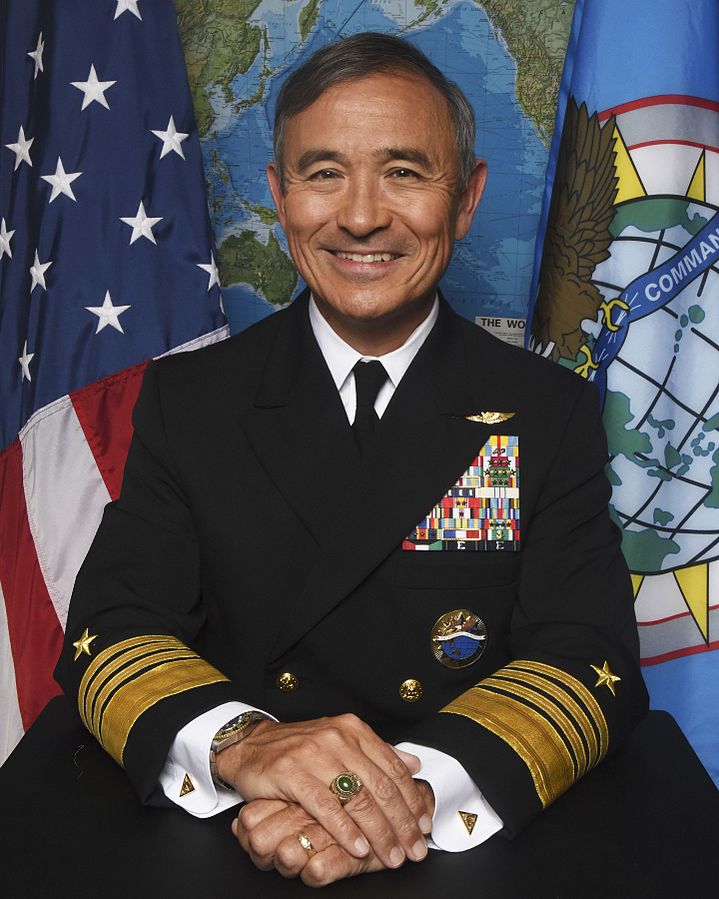
Admiral Harry Harris (Image: Wiki Commons)
TOKYO, Aug. 19 (Yonhap) -- The chief of the United States armed forces responsible for the Indo-Asia-Pacific region will visit South Korea to discuss various security issues surrounding the area, a Japanese newspaper reported Saturday.

Japan's Asahi Shimbun said Admiral Harry Harris, commander of the U.S. Pacific Command, will stay in South Korea from Sunday to Tuesday, and will meet with South Korean Defense Minister Song Young-moo and Joint Chiefs of Staff Chairman Jeong Kyeong-doo.

Harris is also expected to inspect a joint South Korea-U.S. military drill called the Ulchi Freedom Guardian (UFG) exercise that starts Monday and visit the southern port city of Busan, according to the newspaper. The Asahi Shimbun added that Harris is also expected to request South Korea to fully complete the deployment of a U.S. missile shield called THAAD.

Read the full story at YonhapNews

18 August 2017

News Story: No change to S. Korea-U.S. military exercises next week - State Department

By Lee Haye-ah

WASHINGTON, Aug. 16 (Yonhap) -- The United States will hold joint military exercises with South Korea next week regardless of North Korea's opposition to them, the State Department said Wednesday.

Heather Nauert, a department spokeswoman, reaffirmed that the computer-based drills will kick off in South Korea Monday despite recent tensions over the North's nuclear and missile programs.

"We will continue to conduct joint military exercises," she told foreign reporters during a briefing, noting that such drills are conducted routinely with many allies around the world.

She went further to reject calls for a so-called "double freeze," or the suspension of the exercises in exchange for a stop to North Korea's provocations. That idea was recently floated by China and Russia.

Nauert declined to comment on whether the exercises could be scaled back, saying it's a question for the Pentagon.

In response to a similar question earlier this week, Pentagon spokesman Col. Rob Manning declined to get into specific exercise scenarios.

Read the full story at YonhapNews

04 August 2017

News Story: Moon's security adviser dismisses possibility of war

SEOUL, Aug. 3 (Yonhap) -- President Moon Jae-in's top security adviser on Thursday dismissed the possibility of war on the Korean Peninsula, amid reports about U.S. President Donald Trump's mention of a potential armed conflict with an increasingly belligerent North Korea.

"Even the United States does not appear to see (war possibilities)," Chung Eui-yong, the chief of the National Security Office, was quoted by a ruling party spokesman as saying.

Chung made the remarks during his talks with Woo Won-shik, the floor leader of the Democratic Party, where he explained a set of measures Seoul has taken in response to the North's test last Friday of a long-range ballistic missile, the second in less than a month.

Earlier this week, U.S. Senator Lindsey Graham told NBC that Trump cited the possibility of engaging in war with the hermit state if Pyongyang continues to target the U.S. mainland with its evolving missile program.

Talk of war has also been fueled by the North's menacing rhetoric against Seoul and Washington that are gearing up to stage their annual join military exercise later this month. Pyongyang has long denounced the exercise as a "rehearsal for a northward invasion."

Read the full story at YonhapNews

27 July 2017

News Story: (RoK) Defense chief vows stronger alliance with U.S.

SEOUL, July 26 (Yonhap) -- South Korean Defense Minister Song Young-moo on Wednesday emphasized the need for closer cooperation with the United States to handle security risks on the peninsula.

During an introductory meeting with Marc Knapper, the acting U.S. ambassador to Seoul, the minister reaffirmed his commitment to a stronger alliance.

"The current security conditions on the Korean Peninsula are graver than any other time due to the advancement of North Korea's nuclear and missile capabilities," Song told the envoy in the meeting at his office.

Read the full story at YonhapNews

04 July 2017

News Report: Pyongyang Celebrates Its Rocket Forces in Wake of Seoul-Washington Summit

While Americans prepare for the US’ Independence Day on July 4, on the other side of the Pacific North Korea celebrated the 18th anniversary of the country’s Strategic Rocket Forces with a level of restraint that has Korea watchers wondering whether the crisis could be at a turning point.

Pyongyang on Monday reiterated its warning that its projectiles will strike anywhere at the discretion of Supreme Leader Kim Jong-un, while prominent North Korean newspaper Rodong Sinmun celebrated the “beloved” Rocket Force as the “pride and power” of the Democratic People’s Republic of Korea (DPRK). The unit is responsible for the country’s “reliable nuclear force,” which Stanford University professor Siegfried Hecker estimates to be comprised of more than two dozen nuclear warheads.

A study by the Korea Economic Institute of America forecasted Pyongyang would test its missile program roughly every two weeks for the remainder of the year, but Kim’s forces held off on displaying their rockets and missiles for this year’s anniversary, the Korea Times reported on Monday.

News Story: N.K. paper condemns Seoul for 'yielding' to Washington amid summit

SEOUL, July 2 (Yonhap) -- North Korea on Sunday condemned the South for what it called Seoul's "submission to the U.S.," as leaders of the two countries joined their voices last week in urging Pyongyang to give up its nuclear ambition.

The Rodong Sinmun, the North's main newspaper, published a commentary that assessed Seoul's senior officials as having "revealed their miserable appearance seized with sycophancy and submission to the U.S. occasioned by the chief executive's first junket to the U.S.," referring to South Korean President Moon Jae-in's recent first trip to Washington.

The newspaper argued that albeit talks of alliance between the two sides, the U.S. "regards them (South Korea) as a mere puppet and colonial servant."

The Rodong Sinmun further lashed out at the new Seoul administration, saying that its senior leadership would end up "into the rubbish heap of history" if the South "yields to the U.S" while antagonizing the North.

Read the full story at YonhapNews

03 July 2017

News Report: THAAD and Pyongyang - How Trump Achieved Four Key Concessions From S Korea

South Korean President Moon Jae-in completed his first official visit to the United States. There, the leader who promised to establish a dialogue with Pyongyang and who showed signs of making foreign policy decisions which were independent from the US was compelled to toe the line.

The US president even managed to achieve maximum trade and economic concessions

North Korean dilemma

The main thing that interested the public during the visit of the South Korean President was the North Korea issue, which had become aggravated in the last few months. 

April 2017 saw a new high in the escalation between the US and the DPRK. Since then things have calmed down a little; however, during the press conference of Moon Jae-in and Trump, the US President said that strategic patience with regard to the DPRK is coming to an end.

Trump called for increased pressure on Pyongyang, including the introduction of sanctions. 

News Story: DPRK denounces Moon for displaying "sycophancy" during U.S. visit

PYONGYANG, July 2 (Xinhua) -- The Democratic People's Republic of Korea (DPRK) on Sunday denounced South Korean President Moon Jae-in for displaying "sycophancy and submission" to the United States during his visit to Washington last week.

The official daily Rodong Sinmum said in a commentary that the new South Korean government "suffered mental pressure from the U.S. even before taking office and went without principle."

"South Korean authorities revealed their miserable appearance seized with sycophancy and submission to the U.S. occasioned by the chief executive's first junket to the U.S.," said the daily in the first response to Moon's trip to the United States by DPRK official media.

"Now their behavior raises doubt as to whether the pro-U.S. regime really ended," said the commentary in reference to the former South Korean government under President Park Geun-hye.

Read the full story at Xinhua

News Story: S. Korea-U.S. summit brings mixed signals to President Moon Jae-in

SEOUL, July 1 (Xinhua) -- The first summit meeting in Washington between visiting South Korean President Moon Jae-in and U.S. President Donald Trump brought a "significant success" to the new South Korean leader, local media reports and experts said as the two leaders were in harmony to tackle Korean Peninsula nuclear issue.

The summit meeting, which lasted from Thursday to Friday local time, left some of issues unresolved, such as whether to renegotiate a 2012 free trade pact between the two countries and whether to increase the costs for U.S. forces stationed in South Korea.

"It was a significant success," Bong Young-shik, a research fellow at Yonsei Institute for North Korean studies in Seoul, told Xinhua Saturday, referring to the new South Korean leader's first face-to-face talks with the U.S. president since he took office on May 10.

According to the joint statement released after the bilateral meeting, Trump supported South Korea's "leading role" in fostering an environment for peaceful reunification of the Korean Peninsula.

Moon and Trump agreed that the door to dialogue with the Democratic People's Republic of Korea (DPRK) remained open "under the right circumstances" and that sanctions on Pyongyang were a "tool of diplomacy" to bring the country back to the dialogue table.

The six-party talks to dismantle the Korean Peninsula nuclear issue, which involves the Korean Peninsula, China, the United States, Russia and Japan, have been suspended since late 2008.

The researcher at Yonsei Institute said President Moon delivered a message that he would pursue peace in his DPRK policy based on a firm security alliance with the United States, shrugging off concerns among the conservative bloc in South Korea and a part of U.S. experts and politicians that Moon may adhere solely to dialogue with the DPRK.

Read the full story at Xinhua

News Story: Moon's efforts for inter-Korean ties to gain pace with Trump's support

SEOUL, July 2 (Yonhap) -- President Moon Jae-in has received a boost in his push for improving inter-Korean relations as U.S. President Donald Trump has formally thrown his weight behind it, government officials and experts here said Sunday.

They emphasized it's important to follow up their summit agreement via close coordination on a more specific "road map."

In their meeting in Washington, D.C. last week, Moon and Trump agreed to leave the door to dialogue with North Korea open "under the right circumstances," according to a joint statement.

Trump also "supported President Moon's aspirations to restart inter-Korean dialogue on issues including humanitarian affairs" and hailed South Korea's "leading role" in creating the conditions for the peaceful reunification of the two Koreas.

The agreement has helped ease concerns about a possible mismatch in the allies' approach toward the nuclear-armed North.

It's apparently one of the biggest accomplishments for Moon, a liberal president who took office in early May, in his first talks with Trump.

Read the full story at YonhapNews

01 July 2017

News Story: Moon wins a nod from U.S. lawmakers over suspension of THAAD deployment

South Korean President Moon Jae-in
WASHINGTON, June 29 (Yonhap) -- South Korean President Moon Jae-in on Thursday explained a delay in the deployment of the THAAD U.S. missile defense system to his country, prompting U.S. congressional leaders to nod in what his spokesman called an "apparent understanding."

In a meeting with leaders of the U.S. House of Representatives, the South Korean president reiterated the temporary suspension of the THAAD deployment did not mean a change in his country's decision to host the U.S. missile shield.

"THAAD deployment was an agreement based on the Korea-U.S. alliance to protect the lives of South Korean people and U.S. forces in Korea, and I have repeatedly clarified that my government will not treat it lightly simply because the agreement was reached by the former administration," Moon was quoted as saying.

The new South Korean administration suspended the deployment, pending an environmental impact assessment.

"Should any of you hold a doubt, by any chance, that I or my new administration are pushing for the procedure with an aim to withdraw the agreement, I say you may discard such suspicions," Moon said, according to his spokesman, Park Soo-hyun.

Many U.S. representatives present at the meeting nodded, apparently expressing their understanding, Park told a press briefing.

Read the full story at YonhapNews

News Story: Moon, Trump to hold talks on N. Korea, alliance

WASHINGTON, June 30 (Yonhap) -- South Korean President Moon Jae-in and U.S. President Donald Trump were set to hold bilateral talks Friday over a wide range of issues that will likely include ways to strengthen the countries' alliance and their joints efforts to rid North Korea of nuclear weapons.

The first bilateral summit between the two leaders was set to begin at 10:15 a.m. at the White House. The 30-minute one-on-one meeting will quickly be followed by what Seoul officials have called an "expanded summit" that will include top officials from both countries.

The talks will likely focus on ways to further develop the countries' traditional alliance as they struggle to rein in North Korea's evolving nuclear and missile threats.

Pyongyang has staged five missile tests since the new South Korean administration came into office on May 10.

And to ensure their joint efforts, officials from South Korea's presidential office Cheong Wa Dae said it was imperative for the countries' leaders to form a close personal relationship.

"We hope the two heads of state will form a close relationship and trust, so they will establish a close consultative mechanism through telephone conversations whenever necessary, reciprocal visits and multilateral meetings," Chung Eui-yong, Moon's top security adviser and head of the presidential National Security Office, said earlier.

Since his arrival here Wednesday, Moon has been provided with what South Korean officials called the highest formalities afforded to a foreign leader, apparently reflecting the importance Trump and his administration place on the Korea-U.S. alliance.

Read the full story at YonhapNews

30 June 2017

News Story: DPRK slams S. Korean gov't for hostile attitude

PYONGYANG, June 29 (Xinhua) -- The Democratic People's Republic of Korea (DPRK) Thursday criticized South Korean President Moon Jae-in for yielding to pressure from the United States by adopting a hostile attitude towards the north.

A spokesman for the National Peace Committee of Korea, an official organ of the DPRK dealing with inter-Korean ties, said South Korean military and U.S. forces staged joint drills of bombing the nuclear facilities of the DPRK in both South Korea and the U.S. mainland and a "unification drill in 2017" recently.

The Korean Central News Agency quoted the spokesman as saying, without naming the South Korean president, that the "South Korean chief executive" and his top officials also made anti-DPRK remarks during visits to military bases at the front lines and missile launching sites recently.

Read the full story at Xinhua

News Story: Moon says reducing military drills not an option, at least for now

AIR FORCE ONE, June 28 (Yonhap) -- South Korean President Moon Jae-in on Wednesday said reducing his country's joint military exercises with the United States was not an option for now, though it may be considered following what he called irreversible and verifiable steps by North Korea to denuclearize.

"First of all, the official position we have now is that North Korea's nuclear freeze and reduction of joint military exercises between South Korea and the United States cannot be linked," Moon said.

"That has been the official position of South Korea and the United States, and that position has not changed," he added, while aboard Air Force One on his way to Washington for a summit with his U.S. counterpart, Donald Trump.

Moon's remarks came after his special security adviser, Moon Chung-in, claimed Seoul and Washington may consider scaling back their joint military drills staged in South Korea should the North freeze its nuclear activities.

The Yonsei University professor later said he was speaking within his personal capacity and not a special adviser to the president.

Still, his remarks sparked concerns that Seoul's new liberal government under the new president may be considering making such an offer to Pyongyang despite the North's continued nuclear and missile provocations.

"I do believe the notion that we must not reward bad behavior is a principle we must uphold," the new South Korean president told reporters.

North Korea has staged five missile tests since Moon came into office on May 10.

Read the full story at YonhapNews

29 June 2017

News Report: US Embassy in Seoul Lodges Protest Over ‘Problematic’ Anti-THAAD Rally

In response to a rally held last week calling for the withdrawal of the US’ Terminal High Altitude Area Defense (THAAD) missile defense system, the US Embassy in Seoul lodged a protest Wednesday with the South Korean government.

More than 2,000 protesters representing 90 civic groups formed a human chain around the embassy building for about 19 minutes during the Saturday demonstration against the anti-missile system installed in Seongju County, North Gyeongsang Province. The demonstration was a tactic the embassy called “problematic” in a letter sent to the Ministry of Foreign Affairs.

"The deployment of THAAD, which is unnecessary for the defense of the Korean Peninsula, should be pulled back," Yonhap News Agency quoted one speaker at the rally saying. "The South Korea-US summit to come next week should be a venue where the review of the THAAD deployment should be assured."

Demonstrators held signs that read "Yes to peace talks" and "Koreans hate THAAD."