Showing posts with label Okinawa. Show all posts

26 September 2017

USA: USS Bonhomme Richard returns to Sasebo after 4-month patrol

By MC2 Diana Quinlan, USS Bonhomme Richard Public Affairs

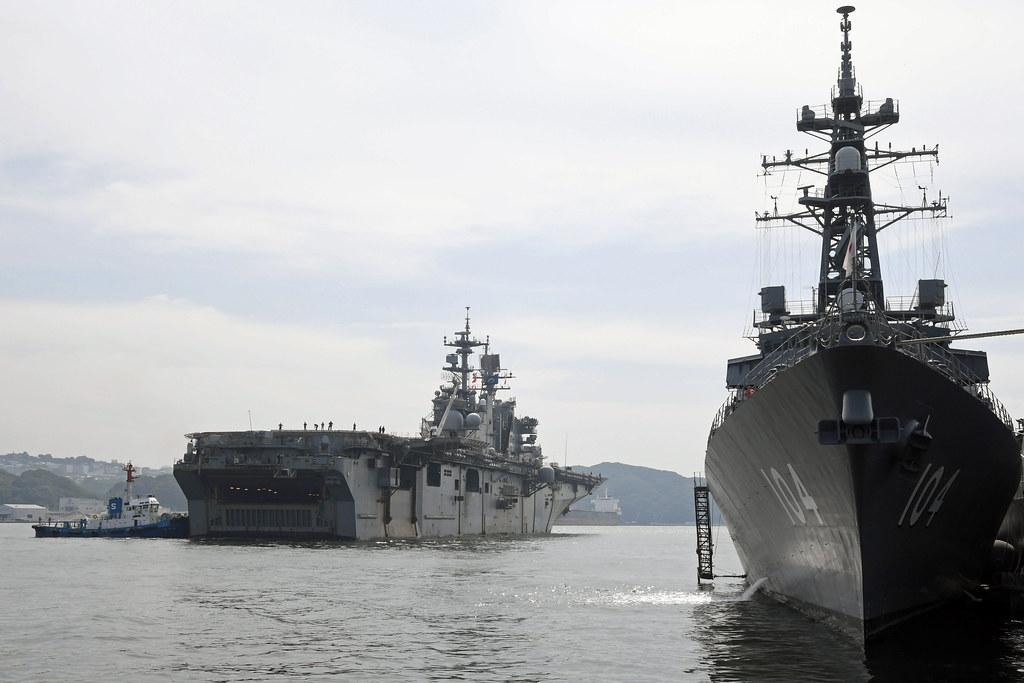
USS Bonhomme Richard (LHD 6) passes Japan Maritime Self-Defense Force destroyer JS Kirisame (DD 104) upon its return to Sasebo, Sept. 25. (U.S. Navy/MC1 David R. Krigbaum) >>

SASEBO, Japan - The amphibious assault ship USS Bonhomme Richard (LHD 6) returned to Sasebo, Japan, after completing a four-month deployment in the 7th Fleet area of operations, Sept. 25.

While deployed to the South Pacific, Bonhomme Richard, with the embarked 31st Marine Expeditionary Unit (MEU), participated in the bilateral, biennial U.S.-Australia exercise Talisman Saber 2017, completed amphibious integration training (AIT), successfully certified during the 31st MEU's certification exercise (CERTEX) and completed an amphibious maritime warfare (AMW) evaluation.

Additionally, Bonhomme Richard conducted port visits to Australia's cities of Sydney, Brisbane and Melbourne, during which many Sailors and Marines participated in community service projects, including visits to children's hospitals and care centers for underprivileged and disabled members of the local communities. Alongside the multiple COMREL events, the crew also hosted several ship tours to allow Australian allies a look into life aboard a U.S. naval amphibious vessel.

News Story: Conservative parties renew speculation over 'Korea passing'

B-1B Lancer bomber (Image: Wiki Commons)
SEOUL, Sept. 25 (Yonhap) -- Conservative parties on Monday raised speculation that South Korea was bypassed by the United States in the latter's decision to fly a fleet of bombers and fighters near North Korea's east coast in the latest show of force against the wayward regime.

Although the presidential office Cheong Wa Dae said the rare flight on Saturday night followed the allies' prior coordination, the parties demanded President Moon Jae-in explain the situation and craft measures to prevent what they term "Korea passing."

Escorted by F-15 fighters from Kadena Air Base in Okinawa, U.S. B-1B Lancer bombers from Andersen Air Force Base in Guam carried out the mission, which Washington said underscored "the seriousness with which we take (the North's) reckless behavior."

The flight came after U.S. President Donald Trump and North Korean leader Kim Jong-un traded barbs. During a U.N. speech last week, Trump called Kim a "Rocket Man on a suicide mission," threatening to "totally destroy" the North. Kim, in turn, cast Trump as "mentally deranged."

"The U.S. independently carried out an unprecedented military operation to fly its bombers and fighters north of the Northern Limit Line (NLL) for the first time since the Korean War (1950-53)," Chung Woo-taik, the floor leader of the main opposition Liberty Korea Party, said during a party meeting. The NLL is the de facto inter-Korean sea border.

"Cheong Wa Dae and the government have to explain to the National Assembly and citizens why such a military operation just short of a war came with South Korea being excluded from it, and what kind of cooperation there was on that matter between Seoul and Washington," he added.

Critics here noted that the flight of U.S. warplanes might signal that Washington could stage unilateral military operations without consulting Seoul first in the case of a major North Korean provocation.

Read the full story at YonhapNews

25 September 2017

News Story: US B-1B bombers fly off N. Korea's eastern coast in show of force

B-1B Lancer (Image: Wiki Commons)
SEOUL, Sept 24 (Yonhap) -- U.S. Air Force B-1B Lancer bombers flew in international airspace off North Korea's eastern coast in the latest show of force against the isolated country, officials said, amid an escalating war of words between Pyongyang and Washington.

The strategic bombers deployed from Andersen Air Force Base in Guam flew with F-15C air superiority fighters from Kadena Air Base on Okinawa on a mission meant to send a clear message that the United States has many military options to defeat any threat from North Korea.

"This is the farthest north of the Demilitarized Zone (DMZ) any U.S. fighter or bomber aircraft has flown off North Korea's coast in the 21st century, underscoring the seriousness with which we take (North Korea's) reckless behavior," Pentagon spokeswoman Dana White said in a statement.

"We are prepared to use the full range of military capabilities to defend the U.S. homeland and our allies."

The U.S. has warned that all options, including a military strike, are on the table over North Korea's nuclear and missile threats.

Read the full story at YonhapNews

23 September 2017

News Story: Japanese city eyes change in name of disputed islands


NAHA, Japan (Kyodo) -- A city in the southern Japanese island prefecture of Okinawa said Thursday its mayor plans to propose changing the name of a group of islands over which it has administrative authority to officially include "Senkaku."

Ishigaki Mayor Yoshitaka Nakayama is pushing for the name change of the Japanese-controlled islets in the East China Sea. The islands are currently known as "Tonoshiro, Ishigaki city," and the plan is to explicitly refer to them as "Senkaku, Ishigaki city."

The uninhabited islets, known as Senkaku in Japan and called Diaoyu by Beijing, are at the center of a territorial dispute between Japan and China.

Nakayama will submit the proposal to the city assembly for discussion during its regular session in December, and the name change is likely to be approved.

The mayor on Tuesday revealed his plan to change the islands' formal name. "I want the (plan) to be presented to the assembly for sure so that the formal address will now contain the (Chinese characters) 'Senkaku,'" he said.

The islands, located between Okinawa and Taiwan, which also claims the islands it calls Tiaoyutai, are said to be close to oil fields beneath the sea floor.

Read the full story at The Mainichi

22 September 2017

News Story: Japan to fund Marine Corps facilities on Guam pending Okinawa move

by Stephen Carlson

Japan will fund a $17.9 million contract to Contack Watts Inc. to build a Waterfront Headquarters Building at Naval Base Guam, the U.S. Navy announced on Tuesday.

The contract will help pay for the infrastructure necessary to move U.S. Marines from Okinawa, Japan, to Guam, as previously determined.

"For the Marines to effectively execute amphibious operations, a fully capable waterfront facility and associated infrastructure are essential," Officer in Charge of Construction Marianas Commanding Officer Capt. Dan Turner said in a press release.

"The award of this contract marks yet another critical step forward in the Marine Corps relocation to Guam and it is another excellent example of the tremendous financial investment by our Government of Japan partners toward our shared national defense interests," Turner added.

Read the full story at SpaceDaily

News Story: US military conducts controversial parachute drill in Okinawa

Parachute Training from a C-130 (File Photo)
NAHA -- The U.S. military carried out controversial parachute training at the Kadena Air Base in Okinawa Prefecture on Sept. 21 -- an act that contravenes an agreement between the Japanese and U.S. governments.

Under the pact, which was made in 1996, parachute training by the U.S. military is specifically designated to take place at the Ie Shima Airfield on the remote Okinawan island of Iejima, and should only take place at the Kadena Air Base under "exceptional circumstances."

Although the Japanese government was warned about the training in advance on Sept. 15, it later requested that the training be canceled. This is the third time this year that the U.S. military has conducted parachute training at the Kadena Air Base -- much to the displeasure of the Okinawa Prefectural Government and local municipalities, which think that the training went ahead with no regard for the agreement.

Read the full story at The Mainichi

09 September 2017

News Report: US Assault Ship Loaded with Joint Strike Fighters Heads to North Korea

Lockheed Martin F-35 Lightning
The USS Wasp is sailing from its homeport in Virginia to Sasebo, Japan, to join the US Navy’s 7th Fleet and bring Washington’s most advanced fighter jets to North Korea’s backyard.

The Wasp, an Amphibious Assault Ship and lead ship of her class, doesn’t have quite as much surface area for jets to take off and land as the larger Nimitz-class aircraft carriers, but the ship will still bring a new squadron of carrier-compatible F-35B aircraft to the 7th Fleet’s area of operations. 

The F-35B jets have the AV-8B Harrier’s capability of taking off vertically, as a helicopter does, while also being able to operate in the air like fighter jets. 

08 September 2017

USA: USS Green Bay completes patrol in Indo-Asia-Pacific

By MC3 Sarah Myers, USS Green Bay Public Affairs

In this file photo, USS Green Bay (LPD 20) operates in the Coral Sea during exercise Talisman Saber in July. (U.S. Navy/MC1 Byron C. Linder) >>

SASEBO, Japan - The amphibious transport dock USS Green Bay (LPD 20) returned to its forward-deployed base in Sasebo, Japan, Sept. 7, culminating three-plus months of operations in the Indo-Asia-Pacific region.

Green Bay, part of the Bonhomme Richard Expeditionary Strike Group, and embarked Marines with the 31st Marine Expeditionary Unit (MEU) participated in Talisman Saber 17 off of the coast of Australia, made community-enriching port visits to Cairns and Brisbane, and completed U.S. Navy-Marine Corps integrated training while deployed.

“I am so incredibly impressed and pleased with the performance of our Blue-Green Team over the course of this deployment,” said Capt. Nate Moyer, commanding officer of Green Bay. “Our Sailors and Marines serving in 7th Fleet are resilient. We proved that resiliency day-for-day throughout the past three months while strengthening both our presence and our ability to operate with our Australian counterparts.”

04 September 2017

News Story: Japan defense chief asks new US envoy to pay heed to base concerns

TOKYO (Kyodo) -- Defense Minister Itsunori Onodera asked new U.S. Ambassador to Japan William Hagerty on Friday to pay heed to Japanese people's concerns over the hosting of U.S. bases.

"On the (U.S. military's) Osprey aircraft, I believe great care is taken in ensuring their safety, but various concerns are still voiced in Japan," Onodera told Hagerty, who paid a courtesy call a day after he assumed his post.

"I hope you will lend an ear to the voices of local people, including on issues related to the U.S. forces in Japan," the minister also said during the meeting, the start of which was open to the media.

Hagerty, a businessman close to U.S. President Donald Trump, arrived in Japan at a time when the bilateral alliance is becoming more important in the face of repeated ballistic missile launches by North Korea, including one that flew over Japan into the Pacific Ocean earlier this week.

Read the full story at The Mainichi

01 September 2017

News Story: Japan's defense ministry seeks record budget for FY 2018

CGI of an Aegis Ashore System
TOKYO, Aug. 31 (Xinhua) -- Japan's Ministry of Defense announced on Thursday a record-high budget request for the fiscal year 2018, which, if approved, would mark the sixth annual increase since Prime Minister Shinzo Abe retook office in 2012.

The defense ministry's budget request, up by 2.5 percent from this year's initial budget, totals 5.26 trillion yen (47.8 billion U.S. dollars) for the fiscal year starting from April, 2018.

The budget request was compiled by setting the dollar's exchange rate at 110 yen for fiscal 2018, according to the ministry.

Part of the money would be used to introduce a new missile shield system, possibly the land-based Aegis Ashore, but the amount was unspecified as it still needs to be hammered out with the United States, said the ministry.

Japan has so far taken steps to counter any potential launches of ballistic missiles by deploying high-tech Aegis advanced radar-equipped destroyers which are tasked with stopping missiles in the outer atmosphere, and ground-based Patriot Advanced Capability-3 interceptors which will counter the attack at lower altitudes.

The Aegis Ashore system is a land-based version of the Aegis advanced radar system, and with potential to be permanently installed, it is expected to reduce the workload of the Japanese Self-Defense Forces members in missile intercept operations.

Each Aegis Ashore unit costs around 80 billion yen, and Japan would need two units to cover the whole landmass, experts here have said.

Read the full story at Xinhua

31 August 2017

News Story: Japanese DM, local media differ on cause of Osprey's emergency landing

TOKYO, Aug. 30 (Xinhua) -- A U.S. Marine Corps Osprey aircraft that made an emergency landing at a commercial airport in southwestern Japan may have done so due to an instrument malfunction, Japanese Defense Minister Itsunori Onodera said Wednesday.

Onodera's remarks came despite local media reporting that the plane's crew notified air traffic controllers of its need to make an emergency landing due to engine trouble.

The controversial Osprey, known for its checkered safety history, is reportedly the same aircraft that was forced to make an emergency landing near Okinawa's main island in June under potentially similar circumstances.

Onodera, conceding that the tilt-rotor airplanes are continuing to have accidents, called for tighter safety measures to be implemented.

"Accidents involving Ospreys are continuing to happen, so I want safety to be ensured when operating them," the defense minister told a press briefing on the matter.

Japan's top government spokesperson, Chief Cabinet Secretary Yoshihide Suga, also expressed his concerns over the safety of the turboprop planes that can take off and land like a helicopter and fly like a fix-winged aircraft.

Suga told a press briefing that the government has requested further information on the incident and for thorough safety management regarding the planes.

Read the full story at Xinhua

30 August 2017

News Story: Okinawa Pref. Assembly demands withdrawal of all Osprey aircraft, US Marines

NAHA -- The Okinawa Prefectural Assembly approved a resolution on Aug. 28 demanding the pullout of all MV-22 Osprey aircraft from the prefecture following a series of accidents, as well as all U.S. Marine units.

The resolution, as well as a formal statement of opinion also passed by the assembly, furthermore called for the closure of U.S. Marine Corps Air Station Futenma -- where the Ospreys are now based -- within five years. The vote came following the crash earlier this month of an Osprey off the coast of Australia. The aircraft involved in the incident was based at Futenma.

The resolution was submitted to the assembly by the ruling faction of Gov. Takeshi Onaga, which is opposed to the Futenma base's planned relocation to the city of Nago's Henoko district, or to anywhere else within Okinawa Prefecture.

Read the full story at The Mainichi

26 August 2017

News Report: Tokyo Concerned Over Chinese Bombers Patrolling Japanese Border

Japanese Defense Minister Itsunori Onodera said Friday his country had voiced concern to Beijing after chasing away six Chinese bombers from its southern frontiers.

TOKYO (Sputnik) — Despite there was no violation of the international law, Japanese authorities were "analyzing motives" of the Chinese side sending jets to the region, the Kyodo news agency reported quoting the minister.

China's H-6 medium-range bombers flew between the islands of Okinawa and Miyakojima and approached the Kii peninsula in the south of of Honshu. This was the first time they followed that route, according to Onodera.

Japanese fighter jets were scrambled to intercept the planes although they did not intrude into the Japanese airspace. Tokyo's response was handed over diplomatic channels and there was no official note of protest.

24 August 2017

News Story: US court revives environment lawsuit over Okinawa base relocation

LOS ANGELES (Kyodo) -- A U.S. federal appeals court revived Monday a previously dismissed lawsuit seeking to halt the planned relocation of a U.S. Marine Corps air base within Japan's Okinawa Prefecture due to the potential impact on endangered dugong.

The 9th Circuit Court of Appeals ruled that the Center for Biological Diversity, a U.S. nonprofit conservation group, can challenge in a district court a U.S. government review that found the construction of a new base at Henoko, a coastal area in the city of Nago, would not negatively affect the Okinawa dugong.

Landfill work is currently taking place at Henoko despite opposition from local people and the Okinawa prefectural government. Opponents argue the base should be moved out of the island prefecture, which already hosts the bulk of the U.S. military presence in Japan.

U.S. Marine Corps Air Station Futenma is currently located in the middle of a densely populated residential area in Ginowan, presenting safety concerns, and the Japanese and U.S. governments say moving it to Henoko is the "only solution."

Read the full story at The Mainichi

23 August 2017

News Story: Ospreys to be tentatively deployed at SDF camp

TOKYO (Kyodo) -- The government has decided to deploy Osprey aircraft tentatively at a Ground Self-Defense Force camp due to difficulty in stationing them at an airport in the southern Japan prefecture of Saga in fiscal 2019 as planned, a source close to the matter said Monday.

The decision comes as concerns have been growing in Saga over the safety of the tilt-rotor transport aircraft following a fatal crash off the coast of Australia earlier this month.

A fleet of Ospreys is likely to be stationed at a GSDF camp in the Kyushu region, which includes Saga Prefecture, or at its Camp Kisarazu in Chiba Prefecture near Tokyo, the source said.

Opposition, however, is expected in the envisioned areas to the deployment of the Ospreys, which take off and land like helicopters but cruise like planes.

Read the full story at The Mainichi

15 August 2017

News Story: Okinawa criticizes central gov't for backing flights of accident-prone Ospreys

TOKYO, Aug. 14 (Xinhua) -- Okinawa Governor Takeshi Onaga on Monday expressed his dissatisfaction at the central government for allowing accident-prone Osprey aircraft to fly in Japan just days after a fatal crash off the coast of Australia.

In a meeting with newly-appointed Defense Minister Itsunori Onodera in Okinawa's capital of Naha, Onaga said that Japan backing the United States' decision for the tilt-rotor planes to be flown here was not in the interests of protecting people's lives.

"The response was extremely disappointing from the viewpoint of protecting the lives of the people in the prefecture and in the country," Onaga was quoted by local media as telling Onodera.

Onaga's remarks follow Okinawa Deputy Governor Moritake Tomikawa on Aug. 8 lodging a strong protest with U.S. forces for flying an Osprey in Japan's southernmost prefecture.

Tomikawa's protest came on the heels of the central government requesting a halt to flights, following the crash in Australia on Aug. 5, which killed three U.S. Marines.

Onodera, for his part, told Onaga that the transport plane is "very important for our country's security" and promised Onaga that he would repeatedly implore the U.S. to fly the planes safely.

The U.S. Marine Corps on Wednesday decided the Ospreys were safe to be flown following an investigation.

Read the full story at Xinhua

12 August 2017

News Story: Japan OKs U.S. flights of Ospreys in Japan

TOKYO (Kyodo) -- The Defense Ministry said Friday it will allow the U.S. military to fly Ospreys in Japan, accepting U.S. assurances that the tilt-rotor aircraft is safe despite a fatal crash off the coast of Australia last week.

The decision came a day after the U.S. Marine Corps said in a statement that it had determined that Ospreys are "safe to fly," resuming operations after a 48-hour pause.

An MV-22 Osprey crashed off the eastern coast of Australia on Saturday, leaving three U.S. Marines dead. The crashed plane was one of the Ospreys deployed at the Futenma air base in Japan's southernmost island prefecture of Okinawa, which hosts the bulk of U.S. forces in the country.

Read the full story at The Mainichi

11 August 2017

News Report: Guam - Small But Important Piece of US Territory in Pacific

North Korea's threat against Guam spotlights a western Pacific U.S. territory that looms large as a military asset, despite being smaller than Singapore.

A former Spanish colony, Guam has been in American hands since the end of the nineteenth century. It is one of 17 non-self-governing territories of the United States.

Guam serves as a major military base for the United States, with U.S. Air Force and Navy installations occupying some 29 percent of the island's total land area. It is also a major hub for submarine communications cables between the western United States, Hawaii, Australia, and Asia.

Guam, with an area of only 544 square kilometers, hosts a military presence of nearly 7,000 military personnel and it is expected to house thousands more in the near future, as the United States moves military assets and personnel currently housed on the Japanese island of Okinawa.

10 August 2017

News Story: New Okinawa minister says US forces status accord should be re-examined

TOKYO (Kyodo) -- The new minister in charge of issues related to Okinawa said Tuesday the Japan-U.S. status of forces agreement should be "re-examined" in light of the fatal crash off Australia involving an Okinawa-based Marine Corps Osprey aircraft, likely overstepping Tokyo's official line on the politically sensitive pact.

Tetsuma Esaki defended his comment later in the day, saying it does not contradict the stance of Prime Minister Shinzo Abe's administration which had negotiated modifications to the accord.

His remark could be taken as calling for a revision to the agreement, which is not among the Abe government's policy goals.

The 1960 pact defines the rights of U.S. forces and their personnel in Japan. While the government of Okinawa has called for a revision of the agreement on the grounds that its provisions are unfair to Japan by being overly protective of the personnel, the Japanese government has been extremely reluctant to propose renegotiating the pact, which has never been amended.

The 73-year-old Esaki has just drawn fire from opposition parties for having said Saturday, just two days after he was appointed, that he would "read aloud" texts prepared by government officials so as not to make mistakes.

It was not immediately clear what impact Tuesday's remark would have inside the government. But as the Cabinet minister with the portfolio, Esaki is tasked with promoting the economy of the island prefecture. It is therefore unusual for someone in his capacity to address a possible revision of SOFA.

Read the full story at The Mainichi

09 August 2017

News Report: Okinawa Authorities Protest US Air Base’s Osprey Flights After Deadly Crash

Authorities of Japan’s Okinawa Prefecture, home to several large US military bases, voiced their objections after the United States didn't put a halt to flights of MV-22 Osprey aircraft after a deadly crash of the heli-plane, local media reported Tuesday.

TOKYO (Sputnik) — On August 5, a US Marine Corps Osprey went down near Australia. The US Department of Defense announced Monday that three US Marines have been declared dead following extensive search and rescue efforts after the crash.

Okinawa's Deputy Governor Moritake Tomikawa met with the head of US forces in Okinawa, Lt. Gen. Lawrence Nicholson, and expressed his discontent over the fact that the United States had not ceased Osprey flights despite repeated requests from local authorities and residents, the NHK broadcaster reported.

The US military official replied saying that Ospreys are used worldwide, and that Washington does not plan on decommissioning the aircraft, according to the broadcaster.