
 |
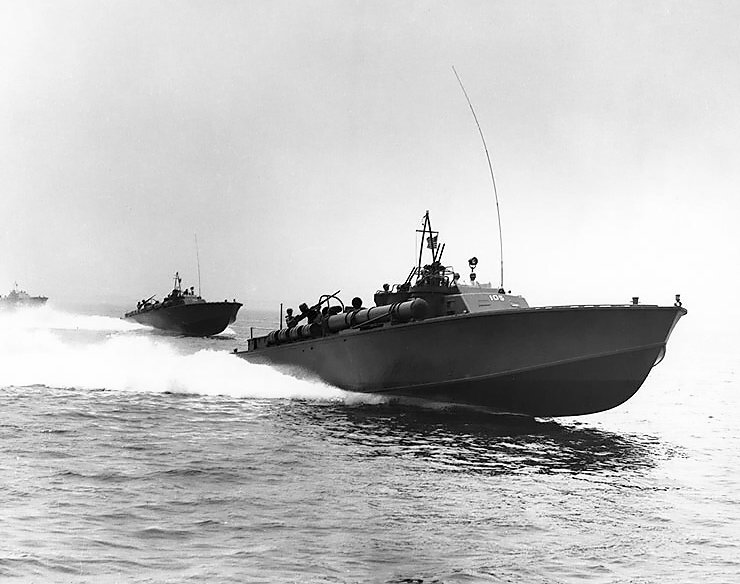
| US Navy WWII PT boats underway (Image: Wiki Commons) |
By SYDNEY J. FREEDBERG JR.
WASHINGTON: Light carriers. Robot PT boats. Unmanned subs. A congressionally chartered study, the Alternative Future Fleet Platform Architecture Study, “does not represent any official Navy position,” but offers a surprisingly bold vision for the future of the US Navy.
The study, by a “Navy Project Team” of officers, civil servants, and contractors free to brainstorm without being “constrained” by the service’s official plans, calls for a future “battle force” of 321 manned ships. That’s 10 percent smaller than the official Navy program for 355, let alone the parallel studies Congress commissioned from thinktanks CSBA, which calls for 340 manned ships, and MITRE for 414. But while the official 30-year shipbuilding plan submitted to Congress in 2017 only includes 10 large, seagoing unmanned vessels, and CSBA proposes 80, the Alternative Future Fleet would include 138.
That would be a mix of 48 unmanned underwater vessels — designed to supplement traditional nuclear-powered attack submarines — and a whopping 88 unmanned fast attack boats, derived from the Mark V Special Operations vessel or the Mark VI patrol craft. (A Coast Guard patrol boat is a third option). Instead of developing a new purpose-built unmanned boat, like DARPA’s Sea Hunter, this approach would build on ongoing Navy experiments with converting standard small craft for unmanned operations. They’d be launched from shore bases or from the well decks of amphibious assault ships normally used to transport Marines. The Alternative Future Fleet vessels would be about the 80-foot length of World War II Patrol Torpedo boats (remember PT-109?), and like the PT boats, they’d be armed to attack much larger vessels, with “anti-ship cruise missiles, mines or torpedoes with an operating range in the hundreds of nautical miles.”
The PT boats suffered heavy casualties in World War II, and the modern Navy has eschewed such well-armed but fragile small craft. Countries more callous about casualties, such as Iran, have embraced them. Making the expendable attack boats unmanned might make them palatable to the Navy.
Read the full story at BreakingDefense