Showing posts with label MI-35. Show all posts

26 September 2017

News Report: Pakistan, Russia Begin 'Friendship 2017' Joint Anti-terror Drill

Ayaz Gul

ISLAMABAD — Pakistani and Russian military commandos have launched joint counterterrorism drills in the mountains and forests of Russia's North Caucasus republic of Karachaevo-Cherkessia.

The two-week-long exercise dubbed as "Friendship 2017" involves more than 200 mostly special forces from both countries who will conduct joint "hostage rescue" and "cordon-and-search" operations, according to the Pakistani military.

"The joint exercise will enhance and further strengthen military ties between the countries and share Pakistan army's experience in war against terrorism," it added.

Meanwhile, a nearly three-week-long joint air force exercises China is hosting with Pakistan are due to conclude this week. A spokesman for the Chinese air force described them as "routine" exercises.

Pakistan's deepening political, economic and defense ties with traditional ally China and its emerging new alliance with Russia come amid Islamabad's increasingly uneasy and strained relations with the United States.

25 September 2017

News Story: US And Russian Envoys Meet At UNGA Over Afghanistan

By Samim Faramarz

Russia’s media has reported that Russian and US representatives for Afghanistan have met on the sidelines of the United Nations General Assembly (UNGA) and discussed ways to cooperate over Afghanistan.

US special acting representative for Afghanistan and Pakistan, Alice Wells met 

with Zamir Kabulov, who reportedly told her that Russia is ready to cooperate with the US in Afghanistan if the US lifts sanctions against Russia. 

“Alice Wells said Washington is interested to cooperate with us in Afghanistan, while she knows there is little chance of this. Wells knows about the sanctions, but the sanctions were approved by the US. If you want us to work together, you should lift the sanctions,” said Kabulov.

Meanwhile the Afghan government has said it welcomes US and Russia cooperation and coordination over Afghanistan. 

Read the full story at TOLOnews

20 September 2017

News Story: First Black Hawks Arrive In Kandahar For AAF

BlackHawk Helicopters (File Photo)
By Rajab Taieb

The first UH-60s Black Hawks for the Afghan Air Force (AAF) arrived in Kandahar airport on Monday, Resolute Support confirmed in a tweet Monday evening. 

Resolute Support said the new Black Hawks will increase the Afghan Air Force capability and sustainability.

“The first Afghan Air Force UH-60s arrived today in Kandahar,” read the tweet.

On Saturday the Afghan defense ministry said they expected to receive six Black Hawks this week.

Read the full story at TOLOnews

18 September 2017

News Story: AAF To Take Delivery Next Week Of Six Black Hawks

By Samim Faramarz

The Afghan Ministry of Defense (MoD) on Saturday said six Black Hawk helicopters will be handed over to the Afghan Air Force (AAF) by next week. 

The Black Hawks will eventually replace the Russian Mi-17 and Mi-35 helicopters currently in use by the AAF. 

A few months ago, the United States announced that it will provide the Afghan Air Force with 150 Black Hawks and other aircraft over the next four years.

According to the MoD, the air force will take delivery of the first Black Hawks next week. 

“We need Black Hawks to overcome a number of challenges including transferring supplies, eradicating enemy strongholds, evacuating patients and wounded and also transferring supplies to  check-posts that are located in mountains,” defense ministry spokesman, Dawlat Waziri said. 

Read the full story at TOLOnews

31 July 2017

News Story: U.S. Black Hawks To Replace Russian Helicopters In Afghanistan

Blackhawk Helicopter (Image: Wiki Commons)
By Samim Faramarz

Afghan and U.S. officials said efforts are underway to replace Russian MI-35 strike aircrafts with American Black Hawks within the next three months as part of the government’s plans to increase the number of the Afghan Air Force (AAF) aircrafts to 260 from a total of 120 within the upcoming seven years.  

Statistics by the Afghan Air Force reveal that there are four MI-35 Russian strike aircrafts and 26 MI-17 lift aircrafts in Afghanistan. Two of the MI-35 Russian helicopters need repairing.

The statistics reveal that Afghanistan has 120 aircrafts in total including 56 strike planes, 60 lift planes and 71 helicopters.

The number, official said, will be increased to 260 in total including 175 strike planes, 89 lift planes and 214 helicopters.

Following Russia’s decision to send its troops to Ukraine in 2015, the U.S. and the European Union agreed on sanctions against Moscow.  Since then, the repairing of Russian helicopters has become complex issue for Afghanistan.

Ahead of the sanctions, the Russian helicopters were sent to Ukraine and Czech Republic for repairing.

“The intention is not to keep those MI-35s going; it is to replace that capability with the Black Hawks, they also can perform the mission,” Colonel Sean C. Mclay, a former advisor to Afghan Air Force, told TOLOnews.

Read the full story at TOLOnews

27 April 2017

News Report: Afghanistan Asks India to Help Repair Grounded Planes, Helicopters

Afghan Mi-35 (Image: Wiki Commons)
Following the terror attack on a military base which left 140 people killed, Afghanistan has asked India to step up military assistance including the repair of grounded aircraft and helicopters.

New Delhi (Sputnik) — Afghanistan has asked for new parts and repairs to 11 grounded Mi-35 helicopters and seven transport aircraft. A technical team, which visited Afghanistan last year, estimated a cost of $50 million for repair and supply of parts.

The Indian government is considering a proposal where it is ready to pay the cost of repair, spares, and the cost of transporting the aircraft to Russia or the former Soviet states if Russia or other CIS countries agree to provide the spares.

25 March 2017

News Story: Defense Ministry Welcomes India’s ‘Willingness’ To Help Air Force

An Afghan Air Force Mi-35 over Kandahar, 2009
(Image: Wiki Commons)
By Gulabuddin Ghubar

The Afghan Ministry of Defense (MoD) on Thursday welcomed India’s decision to consider whether to pay for repairs to grounded helicopters and transport planes from the Afghan Air Force as part of their willingness to step up military assistance to Kabul.

The Defense Ministry spokesman Dawlat Waziri said the friendship between Afghanistan and India does not mean enmity with another nation.

He said New Delhi has positively responded to Kabul’s call for military assistance.

“We want India’s cooperation in any sector which is in the interests of the two countries. India is a friend of Afghanistan and we are independent countries,” Waziri told TOLOnews.

Meanwhile, commenting on what India’s willingness for military support to Afghanistan reveals, military analyst Muhsen Mukhtar said India knows what Afghanistan needs militarily.

Read the full story at TOLOnews

09 February 2017

News Story: Is the Afghan air force trigger happy? Here's what the numbers say

Afghan Air Force MD-530 Cayuse Warrior Attack Helicopters
By: Shawn Snow and Andrew deGrandpre

The top American commander in Afghanistan, Gen. John Nicholson, heads to Capitol Hill on Thursday where he is likely to endure intense questioning from Senate lawmakers eager for his assessment of the challenges complicating the military’s ability to withdraw from the United States’ longest war. High on that list is the competency of Afghanistan's air force, which according to the United Nations’ latest report is largely responsible for a stunning rise in civilian casualties resulting from airstrikes.

Compared to 2015, the number of civilian casualties caused by Afghan airstrikes doubled last year to 252, according to the U.N. That figure includes civilians killed and wounded. And while American military officials say those numbers are grossly inflated, they have nevertheless begun to fast-track training for a new cadre of Afghan tactical air controllers who can, from the ground, warn pilots when they are at risk of killing innocent people.

What remains an issue of debate is whether this increase in civilian casualties is to blame on the Afghans being overly aggressive or undisciplined, whether it's the result of rushed training, or whether it is the inevitable result of assuming greater responsibility for their country’s security. U.S. and Afghan officials insist these pilots demonstrate restraint while in the cockpit, saying 66 percent of their requests to attack specific targets are rejected over concerns they could result in unintentional deaths.

However, the Afghans’ primary attack pilots are firing their weapons during four of every 10 combat missions, a rate three times greater than that of their U.S. Air Force counterparts, a Military Times analysis shows. And herein lies an enormous predicament, not only for Nicholson, but for President Donald Trump and his administration. The U.S. military's ability to extract from Afghanistan is inextricably linked to the success of Afghanistan's security forces — and most especially its air force, which is seen as a vital link to protecting Afghan ground forces from the pressure they face not only from relentless Taliban militants but from the host of al-Qaida affiliates that operate throughout the country, as well.  

Read the full story at MilitaryTimes

03 February 2017

News Story: Experts gives hint on possible type of Russian attack copter sale to PH

An Afghan Mi-35 over Kandahar (Image: Wiki Commons)
While Moscow and Manila finally started discussing defense cooperation last year, experts reveal that Russia is likely to offer Philippines rotary wing aircraft like the Mi-17 multipurpose helicopters and a few Mi-35 attack helicopters.

Philippine Ambassador to Russia Carlos Sorreta told RBTH that the Defense Cooperation Agreement (DCA) that is now being prepared “is not an agreement that creates a military alliance.”

Sorreta said Manila was looking for “small arms, surveillance drones, rotary wing aircraft and certain naval vessels.”

Meanwhile, Vasily Kashin from the Institute for Far Eastern Studies said the fact that most of the Philippine military equipment was gifted by the U.S. should not be seen as an obstacle.

Read the full story at Tankler

24 September 2016

News Story: Russian troops arrive in Pakistan for joint exercises: army

ISLAMABAD, Sept. 23 (Xinhua) -- Russian ground forces arrived in Pakistan on Friday for the first ever Pakistan-Russia joint exercise, the army said.

The two-week exercises will start on Sept. 24 and continue until Oct. 10, the army spokesman said.

The military exercises, named as "Friendship-2016" will be conducted in mountainous areas of northern areas and at a special forces training center in Cherat area of Khyber Pakhtoonkhwa province.

The joint exercises is seen important for the growing cooperation between the two armies.

Read the full story at Xinhua

15 September 2016

News Story: Pakistan-Russia To Hold First-Ever Joint Military Drills

Former Cold War rivals, Pakistan and Russia are set to hold their first-ever joint military exercises later this year, reflecting increased military cooperation between the two countries.

According to Pakistan media, about 200 military personnel from the two sides are expected to take part in the joint military exercises.

The move comes amid increasing defense ties between Moscow and Islamabad as the latter is reportedly also thinking about buying advanced Russian warplanes, Pakistan's Express Tribune reported.

Pakistan's ambassador to Moscow Qazi Khalilullah told the newspaper that this is the first time that military personnel from the two countries would be taking part in joint military drills called 'Friendship-2016'.

He, however, did not divulge further details about the nature of the exercises or dates.

Read the full story at TOLOnews

10 February 2016

Editorial: New Alliances in Central Asia

By Pierre-Olivier Bussieres

Why Russo-Indian relations matter.

As China’s One Belt, One Road policy unfolds in Central Asia, strategic alliances within the region are becoming increasingly complex. While existing partnerships are deepening, new opportunities are emerging for key South Asian players. India, a long-standing absentee in the region, may very well hold the key to the balance of power in Central Asia as a potential ally of Russia.

Missed Opportunities

India began to develop a presence in Central Asia following the collapse of the Soviet Union. In 2002, Russia and India signed an agreement to launch the International North South Transport Corridor (INSTC). In 2012, New Delhi devised its official Central Asian policy, a 12-point list aiming at increasing connectivity among the five Central Asian stans, taking advantage at the energy potential of the region and developing its banking sector. Opening roads to Central Asia, China’s prime objective in the region, has also been India’s priority for a decade. Ensuring that these roads aren’t carrying only Chinese goods, however, will remain a key priority for India as it does for Russia. This is one of the reasons why the two countries may both stand to gain significantly from active collaboration in the region.

Narendra Modi has been more proactive than his predecessors on Central Asia policy. The Indian prime minister toured the five Central Asian countries in July 2015. Among the multiple deals signed with Central Asian leaders, Modi secured an agreement with Kazakhstan to supply 5000 tons of uranium to Delhi for the next four years. The belated Turkmenistan-Afghanistan-Pakistan-India (TAPI) gas pipeline was discussed with Turkmenistan, poised to take the lead on the project. Although a recent boom in construction, IT and pharmaceuticals has stirred the Kazakh, Turkmen and Uzbekistan economies, poor infrastructure and geographic distance has severely limited trade between India and the region.

Conversely, India figures relatively high in Central Asia. New Delhi enjoys a reputation as a neutral country. A former leader of the non-aligned world during the Cold War, its presence in Central Asia threatens neither China and Russia. India’s clearly stated willingness to engage in the multinational bodies associated with the region is a relief in the context of fears over Chinese and Russian dominance.

Read the full story at The Diplomat

02 February 2016

Editorial: Why India Transferred Attack Helicopters to Afghanistan

Afghan Mi-35 (Wiki Info - Image: Wiki Commons)
By Ankit Panda

India’s attack helicopter transfer to Afghanistan suggests a new era in ties between New Delhi and Kabul.

Earlier this month, the Afghan Ministry of Defense inducted three Mi-25 attack helicopters into the Afghan Air Force (AAF). The helicopters were supplied by India and mark the first time that New Delhi has transferred lethal military equipment to Afghanistan. The AAF inducted three of four scheduled Mi-25 helicopters. The Mi-25s will replace Afghanistan’s aging Mi-35 attack helicopters and provide a much-needed boost to Afghanistan’s air support capabilities in the ongoing struggle against the Taliban across the country.

On January 20, Afghanistan confirmed that three multirole Mi-25 had been assembled and were ready for operational use. The Mi-25s will likely see their first use in the ongoing struggle against Taliban fighters in Helmand province. “We have always been helped by India. The helicopters donated by India to Afghanistan have been assembled and will help us fight terrorists,” Ghulam Sakhi Ahmadzai, deputy chief of procurement at the Afghan defense ministry, told Tolo News.

The Mi-25 agreement between the two countries was announced in November 2015, when Afghan National Security Adviser Hanif Atmar and Afghan Deputy Foreign Minister Hekmat Khalil Karzai visited New Delhi. India had previously supplied three Hindustan Aeronautic Limited (HAL) Cheetal trainer helicopters to the AAF.

Read the full story at The Diplomat

04 January 2016

Editorial: New Momentum for India-Russia Relations?

By Sumit Kumar

In a state visit, Indian PM Narendra Modi gives the relationship a boost.

In late December, Indian Prime Minister Narendra Modi made his first state visit to Russia to take part in the 16th annual bilateral summit. Modi and Russian President Vladimir Putin used the summit to review bilateral ties across a number of areas, including security, trade, commerce, science and technology, defense, and energy. Talking about the relationship, Modi described Russia as “a strong and reliable friend,” while Putin expressed his happiness about “developing the privileged strategic partnership between India and Russia.”

This rhetoric, along with the signing of sixteen agreements, is being seen as very significant in sustaining and expanding India-Russia ties. One major step taken is a deepening of India’s defense partnership with Russia. On the eve of Modi’s visit to Russia, the Indian government announced the purchase of five S-400 supersonic air defense systems from Russia, costing around $6 billion, while Modi sealed some other important defense deals with Putin in Moscow. For instance, the two sides agreed that the Kamov 226 helicopter would be manufactured in India.

These defense agreements are important for both countries. India’s defense ties with the erstwhile Soviet Union and later with Russia were a major pillar of bilateral ties. However, in recent times there has been deep strain in the relationship. Russian strategists and diplomats have made much over the loss of some Indian defense deals to the U.S., Israel and other countries. On the other hand, Russia’s failure to deliver the aircraft carrier Admiral Gorshkov on time annoyed New Delhi because it forced India to pay Russia $2.34 billion, against the originally agreed price of $947 million. Russia’s decision to supply Pakistan with the Mi-35 Hind attack helicopters and Klimov RDP93 engines for the JF-17 has also alarmed the Indian defense establishment.

Read the full story at The Diplomat

10 December 2015

Editorial: Russian Jet Fighters in Asia - Why Politics Still Matters

By Benjamin David Baker

Moscow faces competition in attempting to sell its most modern jet in Asia. Its best selling point is still politics.

Russia is known for exporting combat aircraft throughout the world. From the beginning of the Cold War onward, Soviet and Russian MiGs, Sukhois and Yaks have formed the backbone of many air forces throughout the world. This was partly due to old Cold War politics, where states were basically obliged to acquire military equipment from whichever bloc they were aligned with.

Russia has inherited much of its old military R&D and production capabilities with regards to military aircraft. Soviet and Russian planes are still in high demand throughout the world. This is primarily due to three thing; costs, quality and the lack of arms sanctions often imposed by western states on unsavory states.

This is also true in Asia. As The Diplomat has covered recently, several Asian states are looking to update or replace their fighter fleets. Sweden’s Saab Gripen, France’s Dassualt Rafale, the Eurofighter Typhoon and Boeing’s F/A-18 Super Hornet are all models that are being offered.

One of Russia’s main contenders in this game is the Sukhoi Su-35 (Flanker-E, also known as the “Super Flanker”). Based on the venerable and widely exported Su-27, the Su-35 has been touted as a “fourth generation plus” for the many advanced technologies installed in the aircraft. According to Militaryfactory.com, the Su-35 integrates an in-flight refueling probe, provision for electronic countermeasures and a forward and rear- facing Phazotron AESA radar capable of simultaneously tracking 24 different targets at a hundred kilometers’ distance over uneven terrain. Avionics include an Irbis-E passive phased array radar system.

The Su-35 is powered by twin powerful Saturn AL- 41 (117) turbofans. These engines have thrust vectoring, allowing the aircraft to climb at a greater rate than its predecessor, the Su-27, and serves as a testbed for Russia’s fifth generation fighter, the SU PAK-FA. The aircraft can reportedly reach speeds of Mach 2.25, roughly 2,400 kilometers per hour on internal fuel tanks.

Read the full story at The Diplomat

21 November 2015

Editorial: India and Russia - A Course Correction

INS Vikramaditya (formerly the Russian Admiral Gorshkov)
By Kabir Taneja

An upcoming visit by Indian PM Narendra Modi may lend some needed momentum to ties.

Over the past six months, Russia has made its presence felt in the global realpolitik scene with gusto. With the Kremlin militarily intervening in Syria, reportedly bombing ISIS and in effect protecting Bashar al-Assad’s regime in Damascus, while juggling a yet unresolved Ukraine crisis and dealing with Western sanctions… Moscow has its hands full.

Most aspects of India-Russia bilateral ties are quite institutionalized, and work in an automated manner irrespective of who is in power in New Delhi or Moscow. Russia could perhaps be seen as India’s only definitive “strategic” partner in its truest form, and this unique relationship has developed over decades.

However, over the past year the Moscow-Delhi dynamic seems to have lost some of its previous momentum. This may now be about to change, with Prime Minister Narendra Modi preparing to make his first visit to Moscow early next month.

Read the full story at The Diplomat

06 November 2015

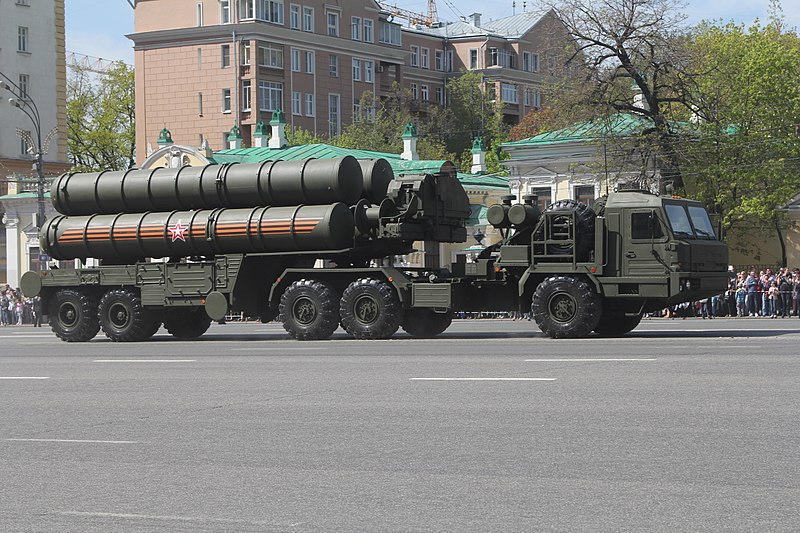
Editorial: After China, India Will Become Second Buyer of Advanced Russian S-400 Missile Defense Systems

Russian S-400 TEL (Wiki Info - Image: Wiki Commons)
By Ankit Panda

New Delhi’s S-400 deal with Russia may be the largest defense deal ever between the two countries.

India has agreed to procure Russia’s advanced S-400 Triumf surface-to-air anti-ballistic missile system in a deal valued at around $10 billion dollars. Once completed, the S-400 deal could represent the largest one ever between New Delhi and Moscow and a major coup for Russia, which has sought to sell its S-400s across the world. According to Indian state media, the S-400 deal was agreed to between Indian Defese Minister Manohar Parrikar and his Russian counterpart Sergei Shoigu during a meeting of a high-level bilateral group on military and technical cooperation. The deal will likely be announced formally during the anticipated state visit by Indian Prime Minister Narendra Modi to Russia later this year.

The S-400 is an impressive piece of equipment and is an evolution of the S-300 anti-ballistic missile defense system. The S-400 is manufactured by Almaz-Antey and has been in the service of the Russian military since 2007. The system is particularly well-suited against aircraft, including any fighters and bombers that may conceivably enter Indian airspace with hostile intentions from either China or Pakistan. The S-400 is presumably also capable of intercepting most medium- and short-range ballistic missiles and cruise missiles. The system can engage up to 36 targets simultaneously within a range of 400 km. The system launches three types of missiles and can comprise a layered defense system. Earlier this year, China became the first foreign buyer of the S-400 system.

Read the full story at The Diplomat

Editorial: Will India Deliver Attack Helicopters to Afghanistan?

An Afghan Air Force Mi-35 over Kandahar, 2009
(Image: Wiki Commons)
By Franz-Stefan Gady

The aircraft would be the first offensive weapons supplied by New Delhi to Kabul.

India is considering transferring four Russian-made attack helicopters to Afghanistan to help the government in Kabul battle the ongoing insurgency in the country The Hindu reports.

The Afghan National Security Adviser Hanif Atmar and Afghan Deputy Foreign Minister Hekmat Khalil Karzai will visit New Delhi this weekend to discuss details of the possible weapons transfer, according to an Indian government source interviewed by The Hindu.

The visit of the Afghan delegation is being seen as a “reach out” to India by the Afghan government the source explains. Afghanistan so far has received only limited military aid from India including a number of jeeps, three unarmed Cheetal Helicopters, manufactured by Hindustan Aeronautics Limited (HAL), and periodic training programs for Afghan officers.

According to local media, India’s National Security Advisor, Ajit Doval, extended an invitation to his counterpart during a phone conversation 12 days ago. The Afghan delegation is also scheduled to meet with India’s Minister for External Affairs Sushma Swaraj. The major topic of discussion will first and foremost be the deteriorating security situation in Afghanistan.

Read the full story at The Diplomat

10 October 2015

Editorial: Russia to Sell Modern Attack Helicopters to Afghanistan

Afghan National Air Corps MI-35 helicopters
(Image: Wiki Commons)
By Franz-Stefan Gady

A contract for the delivery of Mi-35 attack aircraft will be signed this month.

Russia is in talks with Afghanistan over the purchase of an unknown number of Mi-35 (likely the M or “Hind E” variant) combat helicopters, Sputnik News reports.

Russian presidential envoy to Afghanistan and head of the Russian Foreign Ministry’s Second Asia Department Zamir Kabulov told a Russian newspaper that Afghanistan’s first Vice President Abdul Rashid Dostum has requested Moscow’s support to fight against ISIS insurgents.

“We plan to conclude a contract with the Afghan side in October on the delivery, on a commercial basis, of several Mi-35 combat helicopters,” Kabulov said.

The Afghan government already announced in April of this year, that it is interested in purchasing new Russian attack helicopters. “We intend to buy Mi-35 helicopters from Russia. This issue is on the agenda. I think we will begin negotiations on that in the nearest future,” an Afghan government official told Interfax back then.

The Afghan Air Force currently is already operating five heavily armored older Mi-35 gunships supplied by the Czech Republic in 2008 but they are rarely operational.

Read the full story at The Diplomat

12 September 2015

News Story: Analysts Skeptical Over Pakistan-Russia Su-35 Negotiations

By Usman Ansari

ISLAMABAD — Analysts are generally skeptical at present of reports Pakistan and Russia are engaged in negotiations for the delivery of a number of Su-35 Flanker E fighter aircraft, though there is a potential requirement for such a heavy fighter.

The reports, first published in Russian media, cited Russian Deputy Foreign Minister Sergei Ryabkov as saying both sides were negotiating for the delivery of an unspecified number of Su-35 jets alongside the Mi-35M "Hind E" helicopter gunships that have recently been agreed upon.

However, no word on any such negotiations was received from the Ministry of Defence Production in Pakistan when asked for comment on the issue. The agency also handles acquisition.

Experts are generally skeptical of any Su-35 being acquired by Pakistan.

Read the full story at DefenseNews