
 |
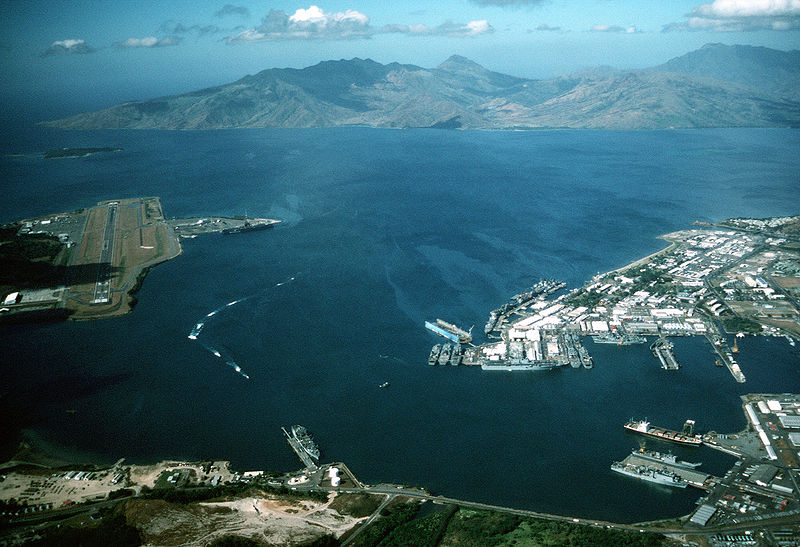
| An aerial view of Subic Bay |
By James Hardy
A return to a familiar port of call serves as another reminder of the United States continued "rebalance" towards Asia.
U.S. and Philippine officials recently confirmed that Subic Bay – a natural harbor 80 km north of Manila that was the US 7th Fleet’s home until 1992 – is going to be playing a much larger role in U.S. Pacific Fleet deployments from now on.
The former U.S. naval port and its air station, now known as Subic Bay Freeport Zone, is set to host U.S. ships, marines and aircraft on a semi-permanent basis. To compare it to a relationship: the U.S. isn’t moving back in, but it’s going to be leaving a few things at the apartment. And it’s a bit more than just a toothbrush.
"There are very few ports that can accommodate naval assets and naval carriers, and one of them is Subic,” said Philippines Department of Foreign Affairs (DFA) Visiting Forces Agreement Director Edilberto Adan, who was speaking to reporters aboard USS Bonhomme Richard, a Wasp-class amphibious assault ship. Bonhomme Richard was just one U.S. ship that was at Subic Freeport in preparation for PHIBLEX 2013 – a 10-day annual amphibious exercise involving U.S. and Philippine Marines that began its 29th iteration earlier this month.
Adan explicitly linked Subic to the U.S. military’s much-heralded shift of emphasis to the Pacific theatre. "As the U.S. begins to implement [the rebalance], Subic will play an important role because it is one of the important facilities that can service its presence in the Pacific," he said.
Read the full 2 page story at The Diplomat