Showing posts with label SM-6. Show all posts

06 September 2017

News Report: UN Chief - N. Korea Nuclear Threat is World's Most Serious

Steve Herman

WHITE HOUSE — North Korea's nuclear weapons program is the most serious threat the world currently faces, the U.N. secretary-general said Tuesday, warning that "confrontational rhetoric may lead to unintended consequences."

At U.N. headquarters, Antonio Guterres said that "the solution must be political. The potential consequences of military action are too horrific."

"Negotiations will depend on the will of the parties," the U.N. chief added. "My appeal is not for any specific solution."

North Korea on Tuesday, two days after its latest atomic test, declared itself a "full-fledged nuclear power in possession of ICBM as well as A-bomb and H-bomb."

U.S. President Donald Trump said Tuesday that he was allowing Japan and South Korea to buy more U.S. military equipment.

01 September 2017

News Story: Trump says dialogue with N. Korea 'not the answer'

By Lee Haye-ah and Song Sang-ho

WASHINGTON/SEOUL, Aug. 30 (Yonhap) -- U.S. President Donald Trump said Wednesday that "talking" will not solve the standoff with North Korea, signaling a more aggressive response to the regime's nuclear and missile programs.

Trump made the remark on Twitter, saying, "The U.S. has been talking to North Korea, and paying them extortion money, for 25 years. Talking is not the answer!"

It appeared to be his latest response to North Korea's firing Tuesday of a missile over Japan.

He initially said in a White House statement that "all options are on the table" to deal with the North Korean threats.

The tweet came shortly before U.S. Defense Secretary Jim Mattis met with South Korean Defense Minister Song Young-moo at the Pentagon.

Seated across from Song, Mattis was asked by a reporter whether diplomatic solutions are off the table.

"No," he said flatly.

Asked what additional diplomatic solutions could be taken, he responded, "We're never out of diplomatic solutions. We continue to work together. The minister and I share a responsibility to provide for the protection of our nations, our populations, and our interests, which is what we're here to discuss today."

Read the full story at YonhapNews


Related Stories:

31 August 2017

News Report: US Test-Intercepts Medium-Range Ballistic Missile Off Hawaii Coast

USS John Paul Jones (Image: Wiki Commons)
A day after the latest North Korean missile launch, the US military test-intercepted a ballistic missile off the Hawaii coast.

MOSCOW (Sputnik) – The US Missile Defense Agency said it had conducted jointly with the US Navy soldiers missile defense flight test, intercepting a medium-range ballistic missile target off the coast of Hawaii.

"The Missile Defense Agency and U.S. Navy sailors aboard the USS John Paul Jones (DDG 53) successfully conducted a complex missile defense flight test, resulting in the intercept of a medium-range ballistic missile (MRBM) target using Standard Missile-6 (SM-6) guided missiles during a test off the coast of Hawaii today," the statement read.

The vessel detected and tracked the target missile launched from the Pacific Missile Range Facility on Kauai, Hawaii with its onboard AN/SPY-1 radar, the statement read.

17 June 2017

Industry: Lockheed Martin Team Congratulates Australia in joining the global Aegis Fleet

ADELAIDE, Australia, June 16, 2017 – Lockheed Martin Australia congratulates the Commonwealth of Australia for receiving its first Aegis-equipped ship, HOBART at a ceremony marking the occasion today in Adelaide. 

The handover of HOBART to the Department of Defence marks a significant milestone for Australia – officially joining the Lockheed Martin global Aegis fleet alongside Japan, Spain, Norway, the Republic of Korea and the United States.

HOBART marks the 107th ship to join the fleet and the sixth Allied nation to benefit from Aegis capabilities.

“Lockheed Martin Australia is continuing to invest in growing Australia’s maritime workforce. We are proud of the superior warfighting capability of Aegis and stand ready to support the Commonwealth with future programs – such as Australia’s Future Frigates, said Vince Di Pietro, Chief Executive, Lockheed Martin Australia.

11 January 2017

News Report: SM-6 Cleared for International Sale; Australia, Japan, Korea Could Be Early Customers

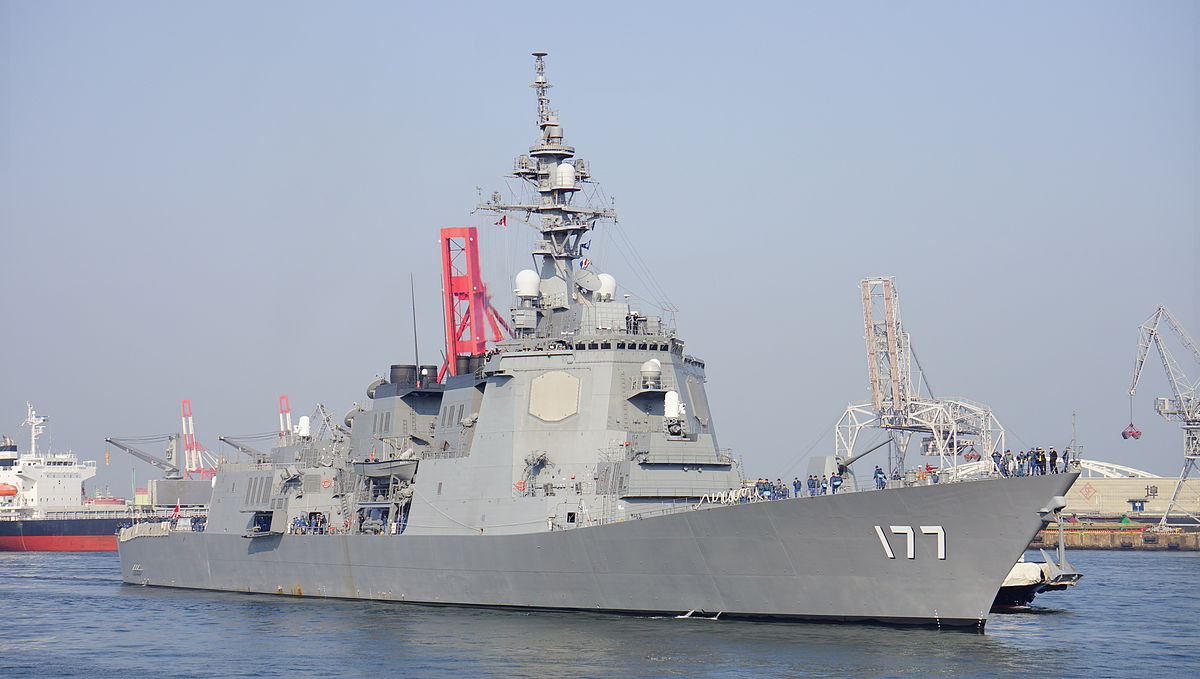
Japan's Atago class, base design for the 27DDG destroyer
(Image: Wiki Commons)
By: Sam LaGrone

Raytheon’s Standard Missile 6 has been cleared by the Pentagon for international sales and a trio of potential Pacific nations are likely the first customers.

SM-6 — currently in limited initial production – is a key weapon in the both the Navy’s emerging distributed lethality concept and the service’s Naval Integrated Fire Control Counter-Air (NIFC-CA) for its ability to strike air, surface and limited ballistic missile targets.

Of the five international Aegis combat system operators, three are in the process to have the upgraded combat system to field the SM-6 – Australia, Japan and South Korea.

All three countries to have guided missile combatants upgraded to Aegis Baseline 9. Baseline 9 replaces the Aegis combat system older military specific computers with commercial-off-the-shelf servers to handle the data the ships absorb through its radar and adds a multi-signal processor. The modifications allow an Aegis ship to take targeting information from a third party to interdict air and sea warfare threats using the SM-6.

20 October 2016

News Story: Japan launches 735 million USD destroyer as military budget swells despite stagnant economy

Japan's Maritime Self-Defense Force (MSDF) ships underway
TOKYO, Oct. 19 (Xinhua) -- Japan's Maritime Self-Defense Force (MSDF) launched a new near-billion U.S. dollar destroyer on Wednesday in Nagasaki Prefecture, on the island of Kyushu in southwestern Japan, in spite of the pacifist bindings of its constitution and a stagnant economy ill-financed for such extrinsic military hardware.

The newly-built 5,100-ton vessel called "Asahi" will go into full service for the MSDF in 2018 and its launching ceremony was attended by senior vice defense minister Kenji Wakamiya as well as around 1,300 people, local media reported.

The new destroy, sources close to the matter revealed, comprises both an electric propulsion system and a gas turbine engine, which makes for a "hybrid" like fuel efficiency powertrain, enhancing both the vessel's performance and range.

The destroy, standing at 151 meters in length and more than 18 meters in width, is also fitted with sonar technology to detect submarines, military observers said.

At a cost of 76 billion yen (735.37 million U.S. dollars) to the Japanese taxpayer, the destroyer is a small part of an increasingly rising tab for Japan's Ministry of Defense which for fiscal year 2017 has requested a record-high budget, marking the fifth annual increase since Prime Minister Shinzo Abe retook office in 2012.

Read the full story at Xinhua

--

PacificSentinel: I really wish China would get off their Japan Bashing kick, this article would be rather good with out the Anti-Japan nonsense.

14 October 2016

News Story: New Army Long-Range Missile Might Kill Ships, Too - LRPF

MGM-140 ATACMS (Army Tactical Missile
System) [Image: Wiki Commons]
By SYDNEY J. FREEDBERG JR.

Outranged and outgunned” by Russian and Chinese missiles, the US Army wants a new long-range artillery rocket of its own. The nascent Long-Range Precision Fires program could do much more than replace the 25-year-old ATACMS missile, however. LRPF could become a linchpin of what the Army is calling Multi-Domain Battle, extending ground-based artillery’s reach not only to unprecedented ranges — hitting distant targets once reserved for airstrikes — but out to sea.

Why does the Army need to do this? Since 1991, when the Soviet Union fell and ATACMS entered service, the Army has largely neglected the artillery, so much so that one group of disgruntled officers called it a “dead branch walking.” Ground troops relied on the Air Force and Navy to dominate their own domains, prevent enemy airstrikes, and provide firepower on demand. But Russia, China, and even lesser powers like Iran have invested heavily in long-range, land-based anti-ship and anti-aircraft missiles to keep the US Air Force and Navy at bay. That means Army forces may have to bring their own in-house heavy firepower to the fight — not only to support its own units on land, but to help out the other services in the air and sea.

That’s where Multi-Domain Battle comes in. Against a high-tech foe with so-called Anti-Access/Area Denial defenses, where US fighters risk being shot down, the best way to take out an enemy airbase, missile battery or command post may be with a long-range land-based missile of one’s own. Likewise, when fighting an A2/AD adversary over a relatively narrow waterway — the Baltic and Black Seas in Europe, the East and South China Seas in Asia — the best way to destroy the enemy fleet may be from unsinkable missile bases on the land.

Read the full story at BreakingDefense

14 September 2016

Industry: F-35 and Aegis Combat System Successfully Demonstrate Integration Potential in First Live Missile Test

Demonstration shows capability to extend the battlefront using Naval Integrated Fire Control-Counter Air (NIFC-CA)

WHITE SANDS MISSILE RANGE, New Mexico Sept. 13, 2016 – Two pre-eminent weapon systems, the F-35 Lightning II and Aegis Weapon System, worked together for the first time during a live fire exercise. The joint Lockheed Martin, (NYSE: LMT) U.S. Navy and U.S. Marine Corps exercise was the first live fire missile event that successfully demonstrated the integration of the F-35 to support Naval Integrated Fire Control-Counter Air (NIFC-CA).

During the Sept. 12 test, an unmodified U.S. Marine Corps F-35B from the Marine Operational Test and Evaluation Squadron 1, acted as an elevated sensor and detected an over-the-horizon threat. The F-35B sent data through the aircraft’s Multi-Function Advanced Data Link (MADL) to a ground station connected to the Aegis Weapon System on the USS Desert Ship (LLS-1), a land-based ship. The target was subsequently engaged and intercepted by a Standard Missile 6.

24 February 2016

Think Tank: Filling the gap - Anti-ship missiles and the Royal Australian Navy

Christopher Cowan

On 4 February, US Secretary of Defense Ash Carter announced that the US Navy had developed a new anti-ship missile (ASM)—the Standard Missile 6 (SM-6). But that ‘new’ missile isn’t as new as it might seem. The SM-6 has been in limited service with the US Navy as its most capable long range anti-air and anti-missile weapons system since 2013. The SM-6 is estimated to have a range of over 200 nautical miles (370km) and flies at Mach 3.5, giving it the ability to hit an adversary at a long range with little to no warning from defensive radars.

That news comes at a welcome time for many around the world lamenting the US Navy’s lack of a long-range ASM capability. Since retiring the anti-ship variant of the venerable AGM-65 Tomahawk in 1994, the US Navy has been in want of a long range supersonic ASM and has relied upon the slower and shorter ranged RGM-84 Harpoon and SM-2 (the SM-6’s predecessor which had a limited anti-ship capability) missiles to satisfy its surface-to-surface requirements. However, the US Navy isn’t the only state with this capability gap. Years of disinterest in surface warfare, caused by a lack of credible adversaries, have left many western navies (including Australia) far behind the likes of China and Russia in the development of those types of missiles.