
 |
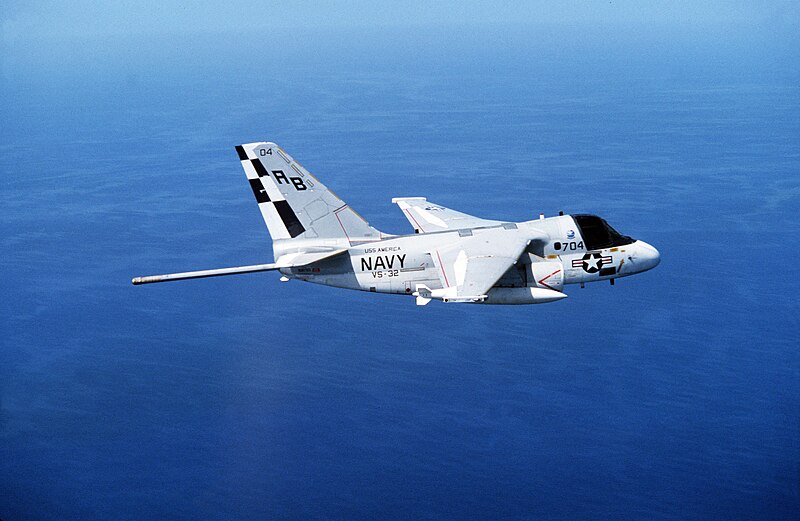
| S-3 Viking (Image: Wiki Commons) |
By Ben Ho Wan Beng
The retired aircraft could help fill a significant capability gap for carrier strike groups.
The boneyard at Davis-Monthan Air Force Base in the U.S. state of Arizona may offer the solution – an interim one perhaps – to two critical capability gaps that carrier air wings (CVWs) of the United States Navy are facing for the foreseeable future. A Hudson Institute report, Sharpening the Spear: The Carrier, the Joint Force and High-End Conflict, which was released earlier this month highlights, among other issues, the relatively short range of the CVW’s strike aircraft and its limited anti-submarine warfare (ASW) repertoire. Also released this month was Retreat from Range: The Rise and Fall of Carrier Aviation, a hard-hitting analysis by Dr. Jerry Hendrix of the Center for a New American Security (CNAS) that alludes to the CVW’s lack of deep-strike capabilities.
The S-3 Viking, which was taken out of service in 2009 in the name of cost savings – a move that has been criticized as short-sighted – could arguably fill these two shortfalls. Eighty-seven S-3s are being kept in mothballs at Davis-Monthan Air Force Base. Resurrecting most of them could go some way towards addressing the aforementioned capability gaps. After all, the innocuous-looking aircraft had a diverse operational portfolio that included ASW and aerial tanking. Moreover, developing new aircraft, whether manned or otherwise, to address the two shortcomings would take time, and the Viking could serve as a stop-gap measure until these new platforms are brought into service; indeed, the S-3 is believed to be able to fly for another 10,000 to 12,000 hours.
Strike Range Problem
In recent years, a number of defense analysts have argued that the U.S. flattop will be rendered obsolescent, or at the very least highly vulnerable, by the proliferation of modern long-range anti-access/area-denial (A2/AD) capabilities. Chief among such capabilities that would make the U.S super-carrier go the way of the battleship, experts contend, is the anti-ship ballistic missile (ASBM), of which China owns two types: the DF-21D and its derivative, the DF-26. The Hudson Institute and CNAS reports along with several assessments of a similar nature acknowledge the threat posed by these missiles, maintaining that they outrange the U.S. CVW and concomitantly jeopardize the mother ship’s safety. To illustrate, the DF-21D and DF-26 have a range of at least 1,000 and 1,600 nautical miles (nm), respectively.
In stark contrast, the sole U.S. naval attack fighter, the F/A-18 Hornet, has a combat radius of only about 500 nm – albeit without mid-air refueling. In fact, this relatively “short-legged” platform often relies on aerial tanking for missions conducted at a greater distance. That said, the coming into service of the carrier-based Joint Strike Fighter, supposedly in 2018, will not solve the CVW’s lack of reach, as the F-35C Lightning has only a marginally higher combat radius – 550 nm – than the Hornet. Therefore, even with the F-35C deployed, the U.S. carrier would still be well within the A2/AD envelope of potential adversaries like China.
Aerial tanking is one solution to the CVW’s range woes. Indeed, much has been said of how American carrier strike aviation proved very useful [PDF] during a number of campaigns in the post-Cold War era, such as Operations Enduring Freedom and Iraqi Freedom, but it must be noted this was made possible largely because of mid-air refueling – either by U.S. Air Force (USAF)/Allied tankers or by U.S. carrier aircraft operating in a refueling role. In other words, aerial tanking has proven to be a critical enabler of American carrier aviation before, and this will persist considering the short reach of the F/A-18.
Read the full story at The Diplomat