
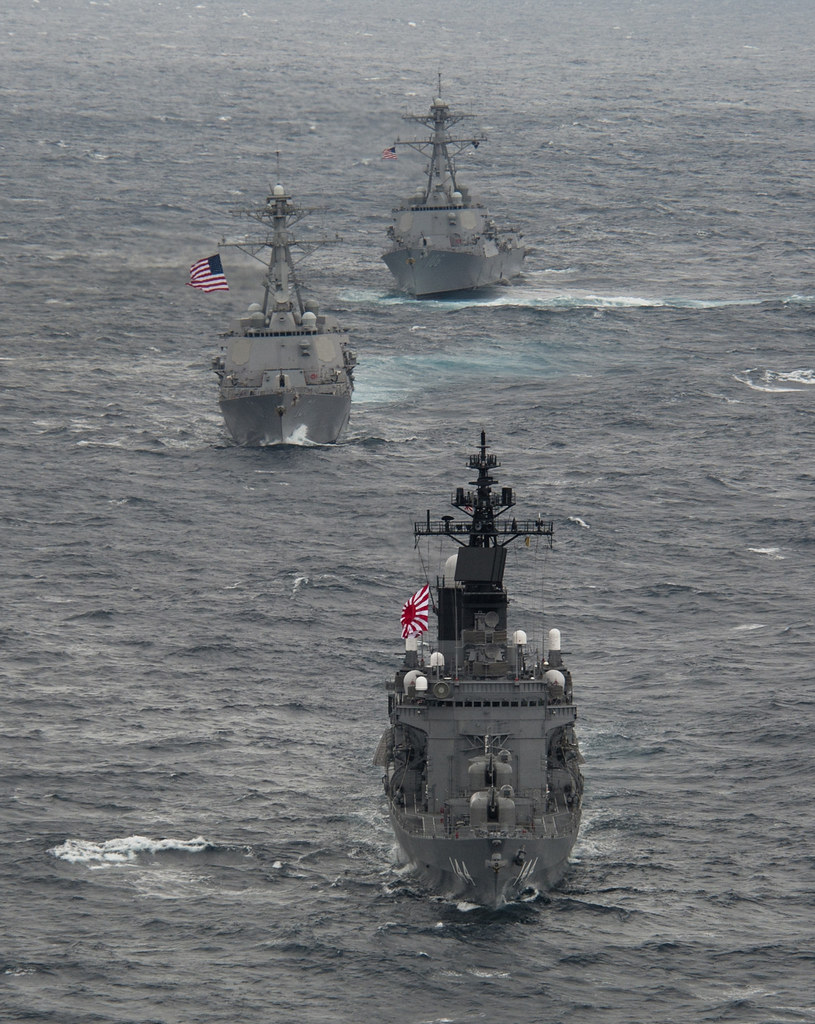
 |
| Image: Flickr User - Official U.S. Navy Page |
By Dingding Chen
A deepening U.S.-Japan alliance might actually hurt Japan’s security interests
Japanese Prime Minister Shinzo Abe’s visit to the U.S. has achieved one main goal for Japan: a deepening of the U.S.-Japan security alliance. The biggest change is the new joint defense guidelines now allow Japan’s military to fight alongside the U.S. military anywhere in the world, as long as Japan deems it necessary for Japan’s national security interests. On the surface, such a move might strengthen Japan’s security, particularly during China’s rise in Asia. It might also increase the odds of the U.S. coming to aid Japan militarily since now Japan is ready to help the U.S. anywhere. A closer analysis, however, reveals that a deepening U.S.-Japan alliance might actually hurt Japan’s security interests.
To start with, a possible global presence of Japan’s military will involve Japan in unnecessary conflicts in some dangerous quarters of the world. The U.S. is a superpower with security interests in every corner of the world, but Japan is not a superpower and hence does not have security interests globally. Also, in the past 15 years, the U.S. has fought two very costly, yet unnecessary, wars in Iraq and Afghanistan and now is probably entering a new war in the Middle East and even Ukraine. If the United States decides to send ground troops to fight ISIS or help Ukraine fight Russia, how should Japan help? And can Japan really help? Of course, Japan can provide some logistical assistance, but real military assistance involving Japanese soldiers would be highly risky. Already, two Japanese citizens were beheaded by ISIS for Japan’s close relationship with the U.S. in fighting the ISIS. Japanese involvement in the United States’ conflicts could lead to greater suffering for Japanese citizens.
Read the full story at The Diplomat